
Last updated: 28 Oct 2026
Picture a salesman at a mobile shop who has worked the counter for two years and one evening says he is leaving on Saturday. The owner wants a month’s notice. The salesman says nobody ever told him about notice. The owner opens the file and finds a WhatsApp message from 2024 that says “Join from Monday, ₹15,000 salary.” That’s the entire paper trail. Who wins that argument? Honestly, neither of them. They both just lose a week of peace.
That shop is made up, but the situation isn’t rare. In payroll work you see the same handful of fights again and again: notice, the salary figure, whether probation was ever over, whether PF should have been cut, and what was promised at the time of joining. An appointment letter, done properly on day one, settles almost all of them before they start. That is how I’d like you to think about it. It isn’t an HR formality. It’s the cheapest insurance your business will ever buy.
Below you’ll find what the law now expects (it changed in November 2025), four ready letters for different kinds of staff, a salary break-up worked out in rupees, and the mistakes I’d fix first in most small businesses.
What I’d settle on joining day
- The four Labour Codes came into force on 21 November 2025, and section 6(1)(f) of the OSH Code requires an appointment letter on appointment. It really bites once you have ten or more workers, and existing staff were to get one within three months.
- Under ten people, one page can do the job: designation and joining date, salary split into basic, DA and allowances, probation, notice, whether PF and ESI apply, the weekly off and the pay date.
- Set a sensible basic. If HRA, conveyance and other excluded items go above half of total pay, the excess is added back to wages for PF and gratuity anyway.
- The letter must match payroll. Basic ₹12,000 in the letter and ₹9,000 on the salary slip is worse than no letter: now there are two written versions of the truth.
- Leave out what you can’t enforce. A clause stopping someone working elsewhere after they leave is generally void under section 27 of the Indian Contract Act, and keeping original certificates “as security” is worse.
A quick word before we start: this is general information, not legal advice. Labour rules differ from state to state and some are still being notified, so for anything high-stakes, check with a labour lawyer or your CA. Our full disclaimer is here.
On this page
- What the letter actually protects you from
- Download the templates
- Offer letter vs appointment letter
- Is an appointment letter mandatory?
- The 16 particulars the central rules ask for
- Mandatory vs recommended clauses
- One page or the full version?
- Filled salary break-up in ₹
- PF, ESI and gratuity: does your business qualify?
- Appointment letter formats by employee type
- → Standard appointment letter (private company)
- → Appointment letter for shop staff
- → Appointment letter for a fresher
- → Appointment letter for a fixed-term or contract worker
- Probation, notice and leave
- State shops and establishments rules
- Common mistakes
- If a dispute comes up
- FAQs
- Related guides
What the letter actually protects you from
Almost every employment quarrel in a small business comes back to one question: what did we agree? Memory is a poor witness, and it gets worse when money is involved. A signed appointment letter answers that question for five things that cause most of the trouble:
- Notice. How much either side must give, and whether salary can be paid instead.
- Salary. Not just the total, but how it splits into basic, DA and allowances. That split decides PF, ESI and later gratuity.
- Probation. How long it runs and what happens at the end of it. “He was still on probation” is a weak argument if nothing was written down.
- PF and ESI. Whether they apply. Staff who discover later that nothing was deducted, or that too much was, tend to be very unhappy.
- Ending the job. The notice clause you write today is the one you’ll be reading out loud when someone leaves.
There’s a second, quieter benefit. A good letter forces you to decide things you’d otherwise leave vague. Which day is the weekly off? Who answers for the cash counter? When is salary paid? Owners who sit down for twenty minutes to fill one in often realise they’ve been running on assumptions for years.
Download appointment letter templates (Word, PDF, Excel)
All three files are free, and there’s no sign-up. Most people start with the Word file. Delete the three versions you don’t need, fill in the brackets and print the one you keep on your letterhead.
Word: 4 editable letters
Private company, shop staff, fresher and fixed-term worker. Each has the employee particulars block, salary table and acceptance slip. Replace the [square brackets]. Download Word (.docx)
PDF: printable pack
The same four letters in a fixed layout, for filling by hand or checking what goes where. Download PDF (.pdf)
Excel: salary break-up (Annexure A)
Type basic, DA and allowances; it works out gross, PF, ESI, take-home pay and employer cost, and flags if allowances cross half of pay. Formula cells are locked (no password). Download Excel (.xlsx)
Prefer Google Docs or Sheets? Upload the file to Drive and open it there. The layout and the formulas both survive the trip.
Offer letter vs appointment letter: which one, when?
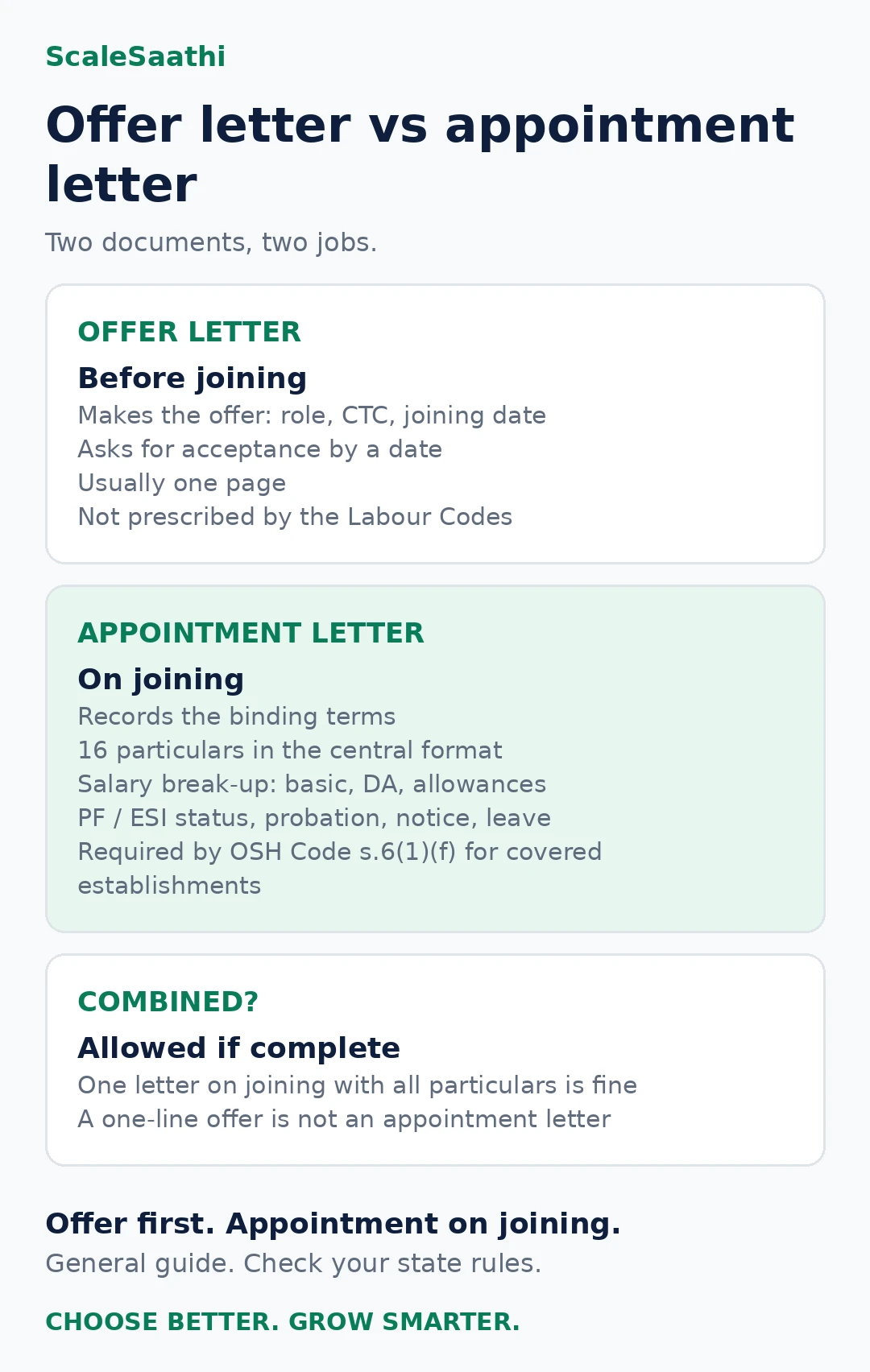
This is the mix-up I see most often. An owner shows me an “appointment letter” and it’s really a one-paragraph offer: role, salary, joining date, please confirm. That’s fine as an offer. It isn’t an appointment letter.
The offer is the invitation. It’s sent before the person joins and it asks a question: will you come? The appointment letter comes once they’ve said yes and walked in. It records the terms you will both be held to. If you’re still at the hiring stage, our offer letter format and the free Offer Letter Generator are the right place to start.
| Offer letter | Appointment letter | |
|---|---|---|
| When | Before joining, after selection | On or around the joining date |
| Purpose | Makes the offer; asks for acceptance | Records the binding terms of employment |
| Length | Usually one page | Two to four pages, often with a salary annexure |
| Detail | Role, CTC, joining date, validity of offer | Full particulars, pay break-up, probation, hours, leave, notice, PF/ESI, duties |
| Legal status under the Labour Codes | Not prescribed | Required for employees of covered establishments (OSH Code, section 6(1)(f)) |
| Signed by employee? | Acceptance by email or signature | Yes, keep a signed copy in the employee file |
Can one letter do both jobs? It can, as long as it’s handed over on joining and carries all the particulars below. What you can’t do is send the short offer and quietly treat it as the appointment letter.
Is an appointment letter mandatory in India?
For most growing businesses, yes, and that’s fairly new. The four Labour Codes came into force on 21 November 2025, and the government’s own announcement put “mandatory appointment letters to all workers” on its list of changes. The duty sits in section 6(1)(f) of the Occupational Safety, Health and Working Conditions Code, 2020 (the OSH Code). It asks every employer to issue a letter of appointment to every employee on appointment, with the information and in the form the government prescribes. People who were already on your rolls without a letter were to be given one within three months of the Code starting.
Two details matter in practice. The OSH Code defines an “establishment” as a place with ten or more workers, so the duty really bites once you cross ten. And the format comes from rules, not from the Code itself. Where the Centre is the appropriate government, Rule 6 of the OSH (Central) Rules, 2026 (notified 8 May 2026) says no employee shall be employed unless an appointment letter in the set format has been issued. Most shops, traders and private companies come under their state government, though, and each state makes its own rules. Look up what your state has notified. Where it hasn’t notified anything yet, the central format is the safest model to copy.
Under ten people? I’d still write one, every time. It’s your proof of the salary and notice you agreed, it often helps your employee open a bank account or apply for a loan, and it saves you from the Saturday-evening argument above.
The 16 particulars in the central format (Rule 6)
Here is the list from the form under Rule 6 of the OSH (Central) Rules, 2026. It looks long, but most of it is information you already collect when someone joins. Every one of our four templates has a place for each item.
| # | Particular | Tip for small businesses |
|---|---|---|
| 1 | Name of employee | |
| 2 | Date of birth | |
| 3 | Father’s / mother’s name | |
| 4 | Aadhaar number | Only after the employee’s consent; the rule says so |
| 5 | Labour Identification Number (LIN) of the establishment | From the Shram Suvidha / state registration, if allotted |
| 6 | UAN and/or ESI Insurance Number | If available. Freshers may not have one yet |
| 7 | Designation | |
| 8 | Type of employment | Regular, fixed-term or contractual |
| 9 | Category of skill | Unskilled, semi-skilled, skilled or highly skilled; matches your state’s minimum wage table |
| 10 | Date of joining | |
| 11 | Wages: basic pay and DA | |
| 12 | Other allowances, including accommodation | HRA, conveyance and so on |
| 13 | Whether EPFO / ESIC benefits apply | Write applicable or not applicable |
| 14 | Broad nature of duties | Two or three lines is enough |
| 15 | Maternity benefits (for women employees) | Under Chapter VI of the Code on Social Security, 2020 |
| 16 | Any other information; signature or digital signature of employer | Probation, hours, leave, notice go here |
Item 9 is the one owners skip, and it matters more than it looks. The skill category is what you match against your state’s minimum wage table. Write “skilled” for a helper and you may be promising a higher minimum than you meant to.
Mandatory vs recommended clauses
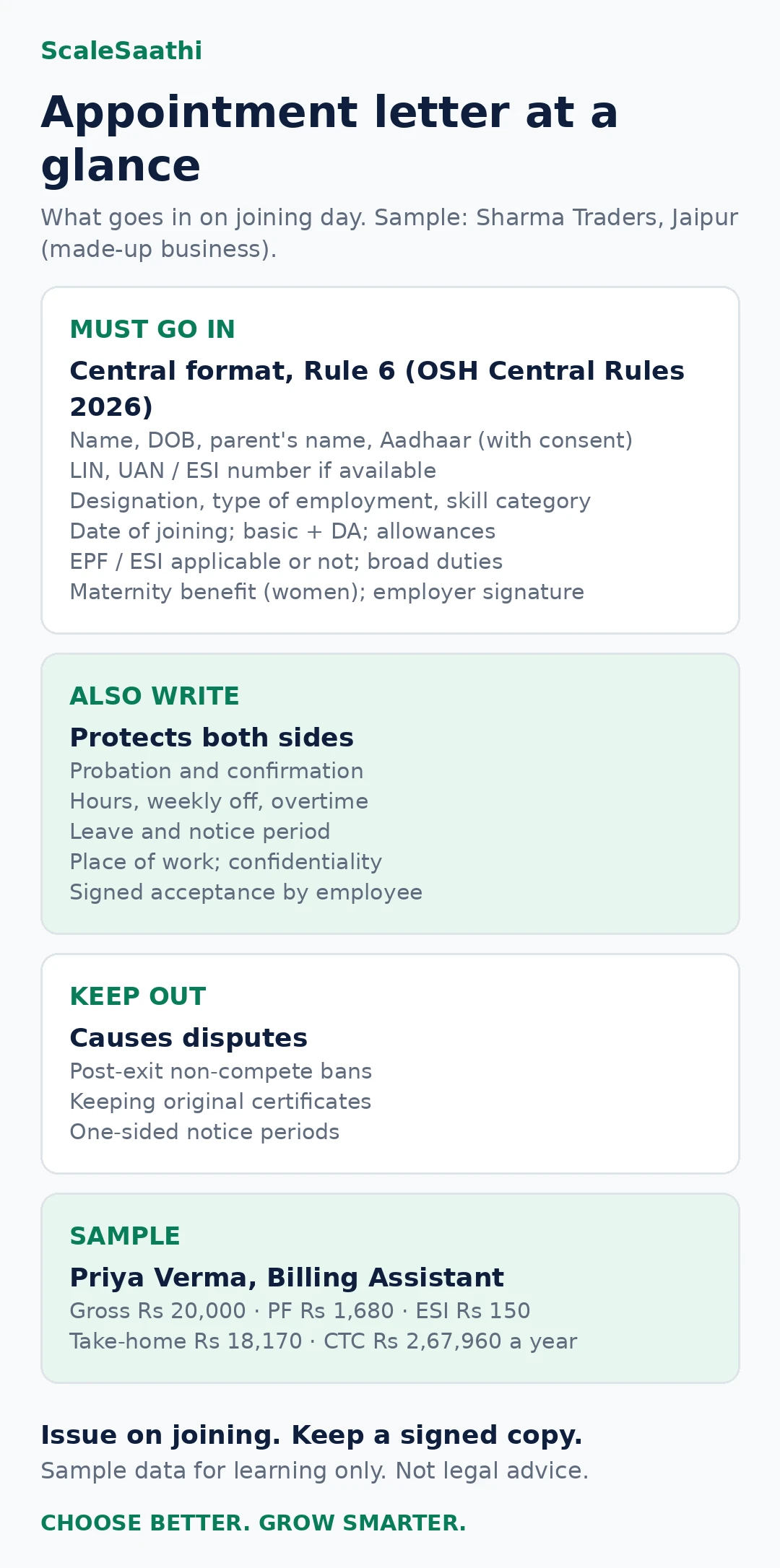
It helps to think of the letter in two layers. The left column below is what the rules ask for. The right column is what actually saves you when something goes wrong. A letter with only the left column is legal. It just isn’t very useful.
| Must have (central format) | Strongly recommended |
|---|---|
| Employee particulars (name, DOB, parent’s name, Aadhaar with consent) | Probation period and how confirmation happens |
| LIN, UAN / ESI number | Working hours, weekly off and overtime |
| Designation, type of employment, skill category, date of joining | Leave entitlement or a pointer to your leave policy |
| Basic + DA and other allowances | Notice period and pay in lieu |
| EPF / ESI applicability | Place of work and transfer |
| Broad nature of duties | Confidentiality, company property, cash handling |
| Maternity benefit (women employees) | Documents to submit; no originals kept |
| Employer’s signature or digital signature | Employee’s signed acceptance |
Leave out anything you can’t enforce. A clause stopping someone from working anywhere else after they leave is generally void under section 27 of the Indian Contract Act, 1872, so all it does is make the letter look aggressive. Keeping original certificates “as security” is worse. It feels like protection, and in practice it’s the thing most likely to turn an ordinary resignation into a complaint.
One page or the full version? A judgement call
Not every hire needs a four-page document, and I’d rather you issued a short letter today than a perfect one never. Here’s roughly how I decide.
If you have ten or more workers, use the full format with all 16 particulars. That’s not a style choice any more. Keep the clauses tight and the language plain, but don’t drop items from the list.
If you’re a small shop or office under ten, one page can do the job, provided it nails the essentials: designation and joining date, salary split into basic, DA and allowances, probation, notice, and whether PF and ESI apply. Add the weekly off and the pay date. That’s enough to prevent most arguments.
Wherever money or risk is involved, go longer. Someone handling the cash counter, someone with access to your customer list, someone on a fixed term: these are the hires where an extra clause or two earns its keep.
One more thing. Whichever length you pick, the salary in the letter must match what your payroll actually pays. A letter that says basic ₹12,000 while the salary slip shows ₹9,000 basic and a big “special allowance” is worse than no letter, because now there are two written versions of the truth.
Filled example: salary break-up for a shop employee in ₹
Numbers make this easier, so here’s Annexure A filled in for a made-up business. Sharma Traders is an imaginary Jaipur wholesale and retail trader with 23 employees. Its new billing assistant, Priya Verma, joins on 3 November 2026. Every name and figure here is an example. Swap in your own.
| Component (monthly) | Amount | Note |
|---|---|---|
| Basic pay | ₹12,000 | |
| Dearness allowance (DA) | ₹2,000 | |
| House rent allowance | ₹4,000 | Excluded from “wages” |
| Conveyance allowance | ₹2,000 | Excluded from “wages” |
| Gross monthly salary | ₹20,000 | |
| Employee PF (12% of ₹14,000) | −₹1,680 | PF wages within the ₹25,000 ceiling |
| Employee ESI (0.75% of ₹20,000) | −₹150 | Gross is within ₹21,000 |
| Professional tax | As per state | Not included in this example |
| Take-home pay | ₹18,170 | |
| Employer PF (12%) | +₹1,680 | Pension and admin split per EPFO |
| Employer ESI (3.25%) | +₹650 | |
| Cost to company per month | ₹22,330 | |
| Annual CTC | ₹2,67,960 | ₹22,330 × 12 |
Why is PF worked on ₹14,000 and not ₹20,000? The Code on Social Security, 2020 counts basic, DA and retaining allowance as “wages” and leaves out things like HRA and conveyance, but only up to half of total pay. If the excluded items go above 50%, the excess is added back to wages. Here HRA and conveyance come to ₹6,000, which is 30% of ₹20,000, so nothing is added back.
This is where a lot of salary structures quietly break. The old habit of a tiny basic and a fat “special allowance” doesn’t save what it used to, because the 50% rule pulls the excess back into the PF and gratuity base anyway. Better to set a sensible basic in the letter now than to restructure everyone’s pay later.
ESI here is worked on the full gross, which is how most payroll software does it. Gratuity isn’t part of this CTC. If Priya stays five years, each completed year earns 15 days’ wages, about ₹8,076.92 a year at today’s ₹14,000. You can try your own figures in the PF calculator, gratuity calculator or salary calculator.
PF, ESI and gratuity: does your business qualify?
The letter has to say whether EPF and ESI apply, so you need to know your own coverage before you write it. These are the headcount triggers in the Code on Social Security, 2020, along with the ceilings in force today.
| Benefit | Applies when | Current figure (checked 28 Oct 2026) |
|---|---|---|
| EPF | Establishment with 20 or more employees | Currently 12% each from employer and employee for most establishments (section 16 of the Social Security Code sets 10%, raised to 12% by notification); check EPFO for your industry. Wage ceiling ₹25,000 a month from 17 Sep 2026 (S.O. 5109(E)) |
| ESI | Establishment with 10 or more persons | Covers employees earning up to ₹21,000 a month (₹25,000 for persons with disability). Employee 0.75%, employer 3.25% |
| Gratuity | Shops and establishments with 10 or more employees on any day in the preceding 12 months | 15 days’ wages per completed year after 5 years’ continuous service; pro rata for fixed-term employees |
| Maternity benefit | Shops and establishments with 10 or more employees | Mention it for women employees, as Rule 6 asks |
| Minimum wage | Every employee | State notification for the skill category and zone; must not be below the central floor wage |
Below 20 employees, EPF isn’t compulsory, though you can join voluntarily. If it doesn’t apply, write “not applicable”. A blank line looks like you forgot, and in an argument a blank line gets read against you. And check your state’s current minimum wage for the employee’s skill category before you fix the basic. The Code on Wages, 2019 doesn’t let you pay below it, whatever the letter says.
Appointment letter formats by employee type
A shop helper, a fresh graduate and a six-month project hire need different letters, even though the particulars block at the top is identical. All four versions below are in the Word and PDF downloads.
Standard appointment letter (private company)
The everyday letter for an office, a firm or a private limited company. It points back to the offer letter so the two documents tell the same story, and it has room for a transfer clause if you have more than one branch.
[Company Name]
[Address, city, PIN] · [Phone] · [Email]
Labour Identification Number (LIN): [if allotted] · GSTIN: [if any]

Ref: [HR/APP/2026/__]
Date: [DD Month YYYY]

To,
[Employee Name]
[Address]

Subject: Letter of appointment

Dear [Employee Name],
Further to our offer letter dated [date] and your acceptance, we are pleased to appoint you as [Designation] in our [Department] department with effect from [date of joining], on the terms below.

EMPLOYEE PARTICULARS
Name: [Full name]   Date of birth: [DD-MM-YYYY]
Father's / Mother's name: [Name]
Aadhaar number: [only with written consent]
UAN (EPF): [if available]   ESI Insurance Number: [if available]
Designation: [Designation]   Category of skill: [Unskilled / Semi-skilled / Skilled / Highly skilled]
Type of employment: [Regular / Fixed-term / Contractual]   Date of joining: [DD-MM-YYYY]

SALARY (per month)
Basic pay: Rs [ ]   Dearness allowance: Rs [ ]
House rent / accommodation allowance: Rs [ ]   Other allowances: Rs [ ]
Gross monthly salary: Rs [ ]  (salary break-up attached as Annexure A)
EPF: [applicable / not applicable]   ESI: [applicable / not applicable]

1. Duties: You will [broad nature of duties, e.g. handle customer billing, maintain sales records and assist with stock reconciliation]. You may be given related work as the business needs.
2. Place of work: [Address]. You may be posted to another branch of the company in [city/state] with reasonable notice.
3. Probation: You will be on probation for [3/6] months. The company may confirm, extend (once, by up to [3] months) or end your employment during probation with [7/15] days' notice on either side.
4. Working hours: [9.30 am to 6.30 pm], [six] days a week, with a [one-hour] break. Weekly off: [Sunday]. Overtime, if asked, is paid as per law.
5. Leave: [number] days of earned leave a year as per company policy and the law that applies to us, plus the public holidays listed in the leave policy.
6. Notice after confirmation: Either side may end the employment with [one month's] written notice or salary in lieu of notice, subject to applicable law.
7. Statutory benefits: PF, ESI, gratuity, bonus and maternity benefit will apply as per the Code on Social Security, 2020 and the Code on Wages, 2019, where you and the company are covered.
8. Confidentiality and company property: You will keep business information confidential and return all company property when you leave.
9. Documents: Please give us copies of your ID, address proof, education certificates and bank details. We will not keep your original certificates.
10. This letter replaces any earlier offer or discussion on these terms. Any change will be made in writing.
Yours sincerely,

For [Company Name]

[Authorised Signatory Name], [Proprietor / Partner / Director / HR Manager]
(Signature or digital signature, and seal if used)

ACCEPTANCE
I have read and understood the terms above and accept them. I received a copy of this letter.
Employee signature: ____________   Date: ____________
Appointment letter for shop staff
Shop staff handle cash and stock, stand long hours and often get a weekday off rather than Sunday. This version says all of that plainly. Keep the language simple enough that you could read it aloud to the employee, because often that’s exactly what you’ll do.
[Company Name]
[Address, city, PIN] · [Phone] · [Email]
Labour Identification Number (LIN): [if allotted] · GSTIN: [if any]

Ref: [HR/APP/2026/__]
Date: [DD Month YYYY]

To,
[Employee Name]
[Address]

Subject: Appointment as [Salesperson / Cashier / Helper]

Dear [Employee Name],
We are happy to appoint you as [Designation] at our shop at [Shop address] from [date of joining].

EMPLOYEE PARTICULARS
Name: [Full name]   Date of birth: [DD-MM-YYYY]
Father's / Mother's name: [Name]
Aadhaar number: [only with written consent]
UAN (EPF): [if available]   ESI Insurance Number: [if available]
Designation: [Designation]   Category of skill: [Unskilled / Semi-skilled / Skilled / Highly skilled]
Type of employment: [Regular / Fixed-term / Contractual]   Date of joining: [DD-MM-YYYY]

SALARY (per month)
Basic pay: Rs [ ]   Dearness allowance: Rs [ ]
House rent / accommodation allowance: Rs [ ]   Other allowances: Rs [ ]
Gross monthly salary: Rs [ ]  (salary break-up attached as Annexure A)
EPF: [applicable / not applicable]   ESI: [applicable / not applicable]

1. Work: Serving customers, billing, arranging and counting stock, keeping the shop clean and any related work given by the owner or manager.
2. Timings: [10 am to 8 pm] with [one-hour] lunch break. Total working hours will not exceed what the law allows. Weekly off: [Tuesday].
3. Salary is paid by [bank transfer / UPI] on or before the [7th] of every month. Overtime is paid at twice the ordinary rate of wages.
4. Probation: [3] months. During probation either side can end the job with [7] days' notice.
5. Leave: [number] days of paid leave a year, and festival holidays as displayed in the shop, as per the shops and establishments law of [State].
6. Cash and stock: You are responsible for the cash counter / stock given to you. Any shortage will be discussed with you and recovered only as the law allows, in writing.
7. Notice after probation: [one month] on either side, or wages in lieu of notice.
8. ESI / PF: [applicable from your date of joining / not applicable as the shop is not covered]. Please share your UAN or ESI number if you have one.
Yours sincerely,

For [Company Name]

[Authorised Signatory Name], [Proprietor / Partner / Director / HR Manager]
(Signature or digital signature, and seal if used)

ACCEPTANCE
I have read and understood the terms above and accept them. I received a copy of this letter.
Employee signature: ____________   Date: ____________
Appointment letter for a fresher
With a first job, the thing that goes wrong is confirmation. Six months pass, nobody says anything, and the fresher has no idea whether they’re confirmed. This version builds in training, a clear confirmation step, and states outright that there’s no training bond.
[Company Name]
[Address, city, PIN] · [Phone] · [Email]
Labour Identification Number (LIN): [if allotted] · GSTIN: [if any]

Ref: [HR/APP/2026/__]
Date: [DD Month YYYY]

To,
[Employee Name]
[Address]

Subject: Appointment as [Trainee / Junior Executive]

Dear [Employee Name],
Congratulations. Further to your interview on [date], we appoint you as [Designation] from [date of joining]. As this is your first job, the first months include training.

EMPLOYEE PARTICULARS
Name: [Full name]   Date of birth: [DD-MM-YYYY]
Father's / Mother's name: [Name]
Aadhaar number: [only with written consent]
UAN (EPF): [if available]   ESI Insurance Number: [if available]
Designation: [Designation]   Category of skill: [Unskilled / Semi-skilled / Skilled / Highly skilled]
Type of employment: [Regular / Fixed-term / Contractual]   Date of joining: [DD-MM-YYYY]

SALARY (per month)
Basic pay: Rs [ ]   Dearness allowance: Rs [ ]
House rent / accommodation allowance: Rs [ ]   Other allowances: Rs [ ]
Gross monthly salary: Rs [ ]  (salary break-up attached as Annexure A)
EPF: [applicable / not applicable]   ESI: [applicable / not applicable]

1. Training and probation: You will be on probation for [6] months, including [one month] of on-the-job training under [Name / Role]. Salary is payable in full during training.
2. Confirmation: At the end of probation we will review your work and confirm you in writing. If we need more time, we will tell you in writing before probation ends and may extend it once by up to [3] months.
3. Duties: [Broad nature of duties].
4. Working hours: [9.30 am to 6 pm], [Monday to Saturday]. Weekly off: [Sunday].
5. Leave: [number] days of paid leave a year as per policy and applicable law.
6. Notice: During probation [15] days on either side. After confirmation [one month] on either side, or salary in lieu.
7. Training cost: No training bond applies. [If you use one, state the cost, period and recovery in a separate agreement and take legal advice.]
8. Documents: Copies of your mark sheets, degree / provisional certificate, ID, PAN and bank details. Originals will be seen and returned the same day.
Yours sincerely,

For [Company Name]

[Authorised Signatory Name], [Proprietor / Partner / Director / HR Manager]
(Signature or digital signature, and seal if used)

ACCEPTANCE
I have read and understood the terms above and accept them. I received a copy of this letter.
Employee signature: ____________   Date: ____________
Appointment letter for a fixed-term or contract worker
Use this for people you hire directly for a set period. The Code on Social Security, 2020 says fixed-term employees get the same hours, wages and benefits as permanent staff doing similar work, and gratuity pro rata. Don’t try to save money by paying the fixed-term person less for the same job. If the workers come through a contractor or agency, it’s the contractor who issues their letter, so check your contract with them.
[Company Name]
[Address, city, PIN] · [Phone] · [Email]
Labour Identification Number (LIN): [if allotted] · GSTIN: [if any]

Ref: [HR/APP/2026/__]
Date: [DD Month YYYY]

To,
[Employee Name]
[Address]

Subject: Fixed-term appointment as [Designation]

Dear [Employee Name],
We appoint you as [Designation] on a fixed-term basis from [start date] to [end date].

EMPLOYEE PARTICULARS
Name: [Full name]   Date of birth: [DD-MM-YYYY]
Father's / Mother's name: [Name]
Aadhaar number: [only with written consent]
UAN (EPF): [if available]   ESI Insurance Number: [if available]
Designation: [Designation]   Category of skill: [Unskilled / Semi-skilled / Skilled / Highly skilled]
Type of employment: [Regular / Fixed-term / Contractual]   Date of joining: [DD-MM-YYYY]

SALARY (per month)
Basic pay: Rs [ ]   Dearness allowance: Rs [ ]
House rent / accommodation allowance: Rs [ ]   Other allowances: Rs [ ]
Gross monthly salary: Rs [ ]  (salary break-up attached as Annexure A)
EPF: [applicable / not applicable]   ESI: [applicable / not applicable]

1. Term: Your employment ends automatically on [end date] unless extended in writing. No separate notice is needed at the end of the term.
2. Work and place: [Broad nature of duties] at [place of work].
3. Hours, wages, allowances and benefits are the same as those of our permanent employees doing the same or similar work.
4. Leave: [number] days of paid leave for the term, worked out pro rata as per policy and applicable law.
5. Gratuity: You will be paid gratuity on a pro rata basis for the period of the fixed term, as the Code on Social Security, 2020 provides for fixed-term employees.
6. Early exit: Either side may end the employment before [end date] with [15] days' written notice or wages in lieu.
7. EPF / ESI: [applicable / not applicable] from the date of joining.
Yours sincerely,

For [Company Name]

[Authorised Signatory Name], [Proprietor / Partner / Director / HR Manager]
(Signature or digital signature, and seal if used)

ACCEPTANCE
I have read and understood the terms above and accept them. I received a copy of this letter.
Employee signature: ____________   Date: ____________
Probation, notice and leave: what’s fixed by law and what you decide
Owners often assume the law fixes all of this. Some of it, yes. A surprising amount is left to you, which is exactly why it has to be in writing.
- Probation is your call. No central Code fixes a probation period for shops or offices. It’s a contract term, so write the length, the notice during probation and how confirmation happens. Three to six months is common in small firms. Whatever you choose, actually send the confirmation letter when it ends.
- Notice is mostly your call, within limits. Under the Industrial Relations Code, 2020, a worker in an industry with at least one year’s continuous service can’t be retrenched without one month’s written notice (or wages in lieu) plus compensation. Your state shops law may add its own rules. My advice: keep notice equal for both sides. Lopsided notice is the first thing anyone notices in a dispute.
- Leave has a legal floor. Section 32 of the OSH Code gives a worker who has worked 180 days or more in a calendar year one day’s paid leave for every 20 days worked. Your state shops law may give more. The letter can promise more than the law, never less.
- Hours and overtime are fixed. The OSH Code caps a worker’s day at eight hours (with spread-overs the government notifies) and requires overtime at twice the ordinary rate of wages.
- Think about the exit on day one. The notice clause you write now is the one you’ll rely on in the relieving letter later. Write it so that a stranger reading it would understand it.
State shops and establishments rules: what to check
Shops and offices also fall under their state’s shops and establishments law, which covers registration, hours, weekly off, holidays and leave. The Labour Codes are changing how these two sets of rules fit together, and states are moving at different speeds. Maharashtra, for example, issued a circular on 30 April 2026 saying establishments with ten or more workers registered under the OSH Code don’t need a separate shops-act registration, while smaller ones give an intimation under its 2017 Act. Your state may be ahead of that or behind it. Before you finalise the letter, spend ten minutes on your state labour department’s website and check three things:
- Whether your state has notified its own OSH rules and an appointment letter format.
- The current minimum wage for your zone and the employee’s skill category.
- Leave, holiday and weekly-off rules under your state shops act.
Common mistakes in appointment letters
If I had to fix only a few things in most small-business letters, it would be these, roughly in order of how much trouble they cause.
- Issuing it weeks after joining. By then the person has worked under unwritten terms, and anything new in the letter looks like it’s being imposed. Hand it over on the first day, or before.
- Writing only the CTC. “₹2.4 lakh per annum” tells nobody what the basic is, and Rule 6 asks for basic, DA and allowances separately. Attach the break-up.
- A salary structure that doesn’t match payroll. The letter says one split, the salary slip shows another. Whoever reads both in a dispute will trust neither.
- No probation clause, or no confirmation. Without it, every new hire is effectively confirmed from day one. With it but no confirmation letter, nobody knows where they stand.
- No notice clause, or a one-sided one. Three months for the employee and seven days for you invites exactly the argument you were trying to avoid.
- Leaving PF and ESI blank. Say applicable or not applicable. Don’t make anyone guess.
- No signed copy on file. The letter you gave away doesn’t help you. The acceptance slip with the employee’s signature, sitting in your file, does.
- Taking original certificates, or asking for Aadhaar without consent. See the originals, copy them and hand them back the same day. The central format says Aadhaar only “after consent”, so note that consent in writing.
If a dispute comes up
Say it’s already happened. An employee who left last month says you owe them a month’s salary in lieu of notice, or that PF should have been deducted all along. Here’s the order I’d work in before anyone raises their voice.
First, pull out the signed appointment letter and the acceptance slip. Read the notice, probation and salary clauses slowly, as if you were the other side. Second, put the salary slips and bank transfers next to it. Do they match what the letter promised? If they do, you’re in a strong position, and a calm conversation showing the employee their own signed copy settles most of these. If they don’t match, be honest with yourself about it, because that gap is what the dispute is really about.
Third, if money is genuinely owed, pay it and get a written settlement and a proper relieving letter. Small amounts paid quickly cost far less than a complaint to the labour department. And if a notice, a complaint or a claim for a large amount arrives, that’s the point to bring in a labour lawyer, with the letter, the slips and your bank records in hand.
If you find there was never a letter at all, don’t write one now and backdate it. Issue correct letters to everyone currently working for you, dated today, and fix the problem going forward.
Frequently asked questions
What is an appointment letter?
It’s the letter you give an employee when they join, setting out the terms you’ve both agreed: designation, joining date, salary break-up, probation, hours, leave, notice, and whether PF and ESI apply. Under the OSH Code, 2020 it also has to carry the particulars the government prescribes.
Is an appointment letter mandatory in India?
For establishments covered by the OSH Code, 2020, which generally means ten or more workers, yes. Section 6(1)(f) requires one for every employee, and the Labour Codes took effect on 21 November 2025. If you’re smaller, issue one anyway. It’s your best proof of what was agreed.
What is the difference between an offer letter and an appointment letter?
The offer letter comes first, before joining, and asks the person to accept. The appointment letter is handed over on joining and records the full terms, including the salary break-up and the PF and ESI position. One asks a question; the other writes down the answer.
What details must an appointment letter contain?
The central format under Rule 6 of the OSH (Central) Rules, 2026 lists 16 items, including name, date of birth, Aadhaar with consent, UAN or ESI number, designation, type of employment, skill category, date of joining, basic and DA, allowances, EPF and ESI applicability, duties, maternity benefit for women, and the employer’s signature. Your state may have its own rules too, so check them.
Can I give a shop employee an appointment letter in Hindi or another language?
Yes. Nothing we read requires English. In fact a letter the employee can actually read is far more useful to you, so use a language they understand and keep a signed copy.
What probation period should I write?
The law doesn’t fix one for shops or offices. Three to six months is common in small businesses. Write the length, the notice during probation and how confirmation happens, and then remember to send the confirmation letter when it ends.
Do I need to mention PF and ESI if my business is not covered?
Yes, write not applicable rather than leaving it blank. EPF applies to establishments with 20 or more employees and ESI to those with 10 or more, with ESI covering employees earning up to ₹21,000 a month.
Does a fresher need a different appointment letter?
The legal particulars are the same. A good fresher letter adds training, often a longer probation and a clear confirmation step. Avoid training bonds unless you’ve taken legal advice.
Can an appointment letter be signed digitally?
Yes. Rule 6 of the central rules allows the employer’s signature or digital signature, and electronic records are recognised under the Information Technology Act, 2000. Get the employee’s acceptance signed too, on paper or electronically.
Do existing employees need an appointment letter?
Yes. The OSH Code says employees who had no appointment letter when it commenced should have been given one within three months. If that slipped, issue one now, dated today, rather than backdating anything.
Related guides and tools
An appointment letter is one step in a chain that runs from the offer to the day someone leaves. These pick up the other steps.
| Guide or tool | Use it when |
|---|---|
| Offer letter format | You are making the offer, before joining |
| Offer Letter Generator | You want an offer letter filled online |
| Salary slip format | You are paying the first salary |
| Salary slip generator | You want payslips made for you |
| PF calculator | You want to check PF on a salary |
| Gratuity calculator | You want to estimate gratuity |
| Leave encashment calculator | An employee is cashing in leave |
| Relieving letter format | The employee is leaving |
| Experience Letter Generator | You need an experience letter |
| Payroll software for India | You want payroll and letters handled in software |
Sources and checked dates
- OSH Code, 2020 (sections 2(1)(v), 6(1)(f), 25, 27, 32), Gazette of India. Checked 28 Oct 2026.
- OSH (Central) Rules, 2026, G.S.R. 345(E), Rule 6 appointment letter format, Ministry of Labour and Employment. Checked 28 Oct 2026.
- PIB: four Labour Codes effective from 21 November 2025. Checked 28 Oct 2026.
- Ministry of Labour and Employment: Labour Codes FAQ. Checked 28 Oct 2026.
- Code on Social Security, 2020 (sections 2(34), 2(88), 53; First Schedule). Checked 28 Oct 2026.
- S.O. 5109(E), 17 Sep 2026: EPF wage ceiling ₹25,000. Checked 28 Oct 2026.
- ESIC Standard Note on the ESI Scheme as on 1 Jan 2026. Checked 28 Oct 2026.
- ESIC: contribution rates. Checked 28 Oct 2026.
- Code on Wages, 2019 (sections 5, 6, 9). Checked 28 Oct 2026.
- Industrial Relations Code, 2020 (section 70). Checked 28 Oct 2026.
- Indian Contract Act, 1872 (section 27), India Code. Checked 28 Oct 2026.
- Information Technology Act, 2000 (sections 4, 5), India Code. Checked 28 Oct 2026.
- Maharashtra Industries, Energy, Labour and Mining Dept circular, 30 Apr 2026. Checked 28 Oct 2026.
How we researched this guide
ScaleSaathi publishes practical guides for Indian small businesses under LendLink Tech Private Limited. On 28 October 2026 we read the OSH Code, the OSH (Central) Rules, 2026, the Social Security and Wages Codes, and the EPF and ESIC notices listed above. The letters, the Sharma Traders example, the shop scenario at the top and the Excel sheet are our own illustrations, and we recalculated the sheet to check every figure on this page. We couldn’t confirm every state’s rules, so where they matter we tell you where to look rather than guess.