A delivery challan format records goods moving under a permitted challan procedure rather than an ordinary sales invoice. Under GST Rule 55, it identifies the sender, receiver, goods, quantity, value and applicable tax details. Job work is a common use. A challan does not, by itself, make the movement tax-free or remove the need for an e-way bill. Read the Rule 55 particulars.
Fill this online (free): create your delivery challan online, then print or save PDF. Blank Word/Excel downloads stay below.
Download the editable files below, then check the movement before filling the form. The most costly mistake is not a missing logo: it is choosing a challan when the transaction requires an invoice, or sending goods without the separate transport documentation that applies.
When goods move out on a challan, reduce the matching line in your stock register (opening, inward, outward, closing — free Excel, Word and PDF with a FIFO ₹ example).
Start with the reason for movement
Ordinary sale? Use the applicable invoice process. Job work or another qualifying movement? Prepare the challan and separately check the e-way bill. Goods will return? Keep the outward reference and reconcile each return, rather than treating a receiver’s signature as closure.
Download the delivery challan format in Word, Excel or PDF
Editable Word packet
A blank challan, a fictional outward job-work example, a fictional partial-return challan and a dispatch checklist. Download Word (.docx)
Excel template and return tracker
A blank form, worked example, formula-based goods values, same-unit return tracking, checklist and source notes. Download Excel (.xlsx)
Printable PDF packet
The same four-page document packet, ready to print for reference or to adapt through the Word original. Download PDF (.pdf)
Which file should you use?
Use Word for a tailored letterhead layout, Excel for repeated arithmetic and tracking, and PDF to review the specimen. Keep your final issued copy separately from the editable master.
The files are free downloads without a sign-up form. These are ScaleSaathi templates, not government-issued forms or an e-way bill generator. All example businesses and quantities are fictional. GSTINs, HSN classifications, vehicle details and signatures are deliberately left as fields to complete, not plausible-looking invented identifiers.
In Excel, enter quantities and unit values to calculate line totals. Tax fields are manual because the workbook cannot decide whether your movement is a supply, select an HSN or apply the correct tax treatment. The return tracker is only for the same item coming back in the same unit; it does not model manufacturing yield, waste or substituted goods.
In this guide
When is a delivery challan appropriate under GST?
Rule 55 expressly covers transportation for job work, movement for reasons other than supply, liquid-gas supplies where the quantity is unknown at removal, and other supplies notified by the Board. It is not a blanket alternative to invoicing whenever the accounts team is busy. Check the permitted circumstances in Rule 55.
Job work: goods belong to the principal
A registered principal can send its goods for processing under the applicable job-work procedure. The challan documents the goods moving; the job worker’s charges for processing are a separate matter. Rule 45 and the job-work circular explain the principal’s challan and subsequent movement records. CBIC’s job-work documentation guidance.
Other non-supply movements: classify the facts first
Equipment sent for a qualifying repair movement or goods temporarily moved for display may need a challan, but the description alone does not settle the GST position. Record ownership, why the goods are moving, whether a supply has already taken place and what happens next. Resolve that before choosing a reason from a software drop-down.
Do not assume every branch transfer is non-supply. Schedule I includes business supplies between distinct persons even without consideration; separate GST registrations can be distinct persons under section 25. “No payment”, “our own branch” or “not for sale” therefore cannot replace a transaction-specific check. See section 25 and Schedule I of the CGST Act.
Delivery challan format: the nine Rule 55 particulars
The design can change, but the relevant particulars must remain. The following field groups follow Rule 55; the tax and place-of-supply qualifications matter just as much as the labels. Official delivery challan field requirements.
1. Number and date
Use a controlled, serially numbered challan in one or more series. The number must not exceed 16 characters. Record the actual date.
2. Sender details
Consignor name and address, plus GSTIN if registered. Identify the business actually sending the goods.
3. Receiver details
Consignee name and address, plus GSTIN or UIN if registered. Do not invent a registration number for an unregistered recipient.
4. Goods and HSN
Describe the goods and enter the correct HSN. A vague line such as “material” can make later quantity reconciliation difficult.
5. Quantity
Show the quantity and a clear unit. The rule allows provisional quantity where the exact quantity being supplied is not known.
6. Value
Include taxable value. For a non-supply transport example, record an appropriate declared goods value; do not enter zero merely because no customer is paying.
7. Tax where for supply
Show the relevant rate and amount of CGST, SGST, IGST, UTGST or cess where transportation is for supply to the consignee. Not every challan should be labelled tax-free.
8. Inter-State place of supply
Include place of supply in the case of inter-State movement. Keep the State information consistent with the actual transaction and transport records.
9. Signature
Provide the required signature. The template leaves a space for the actual authorised person, not a specimen signature or a fabricated seal.
Reason for movement, job-order reference, transporter details, vehicle number, package count, expected return date and receipt acknowledgement are helpful operational additions. Some details also support separate transport requirements. They should not be confused with the nine-item Rule 55 list, nor should optional details displace the required particulars.
Numbering and copies: keep an auditable dispatch record
A compact reference such as DC/26-27/001 leaves room within the 16-character limit. Maintain control of the series so two team members do not issue the same number. The Excel check tests length only: it does not search your other files for duplicates.
Reference the buyer’s purchase order number on the challan so goods can be matched; see our purchase order format.
Rule 55(2) prescribes triplicate in the case of supply of goods, with these labels: ORIGINAL FOR CONSIGNEE, DUPLICATE FOR TRANSPORTER and TRIPLICATE FOR CONSIGNER. The spelling on the last label follows the rule. Rule 55 copy requirements.
For job work, paragraph 8.4(i) of Circular 38/12/2018 separately directs the principal to prepare the challan in triplicate. It explains sending two copies with the goods and the job worker returning one with the goods in the straightforward return case. Do not overlook that procedure merely because the goods are not being sold. Job-work circular, paragraph 8.4.
The downloadable form contains a copy-label field rather than three pre-filled duplicate pages. Select the correct label for each required copy and ensure the transaction details match. Keep an issued copy that is not accidentally overwritten when next month’s challan is prepared.
Worked example: ₹50,000 of goods sent for job work
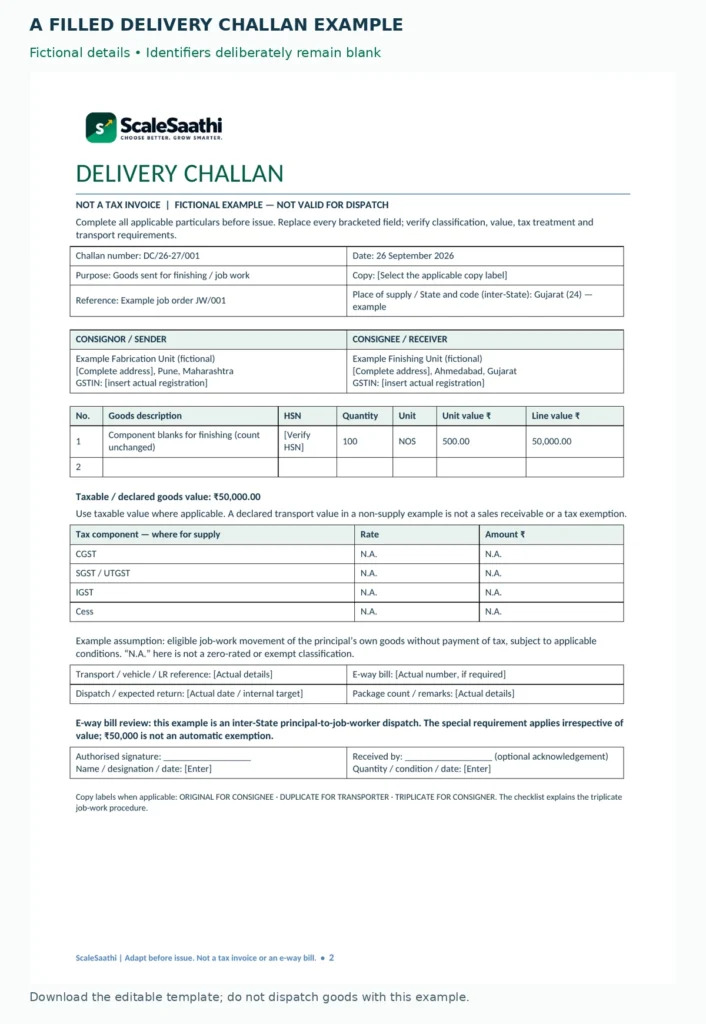
Assume a registered principal, Example Fabrication Unit in Pune, sends 100 component blanks to Example Finishing Unit in Ahmedabad for finishing. The quantity and identity of the components do not change. The illustrative value is ₹500 per piece, and the example assumes the eligible job-work conditions are met.
Outward dispatch
Challan DC/26-27/001: 100 NOS × ₹500 = ₹50,000. The principal remains the owner in this example.
Partial return
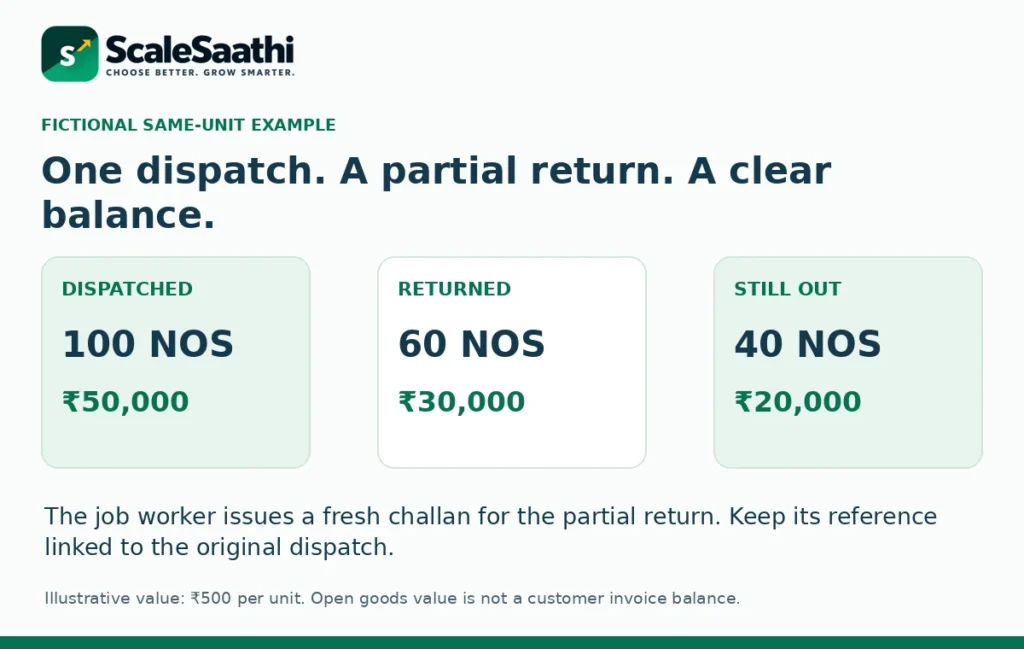
The worker returns 60 NOS under fresh return challan RT/26-27/001, referring to the original dispatch. Illustrative returned value: ₹30,000.
Outstanding goods
100 − 60 = 40 NOS remain with the worker, with an illustrative value of ₹20,000. This is not a customer payment balance.
Tax and transport checks
No tax is charged on the underlying eligible job-work movement in this example. That assumption does not remove the separate inter-State job-work e-way bill requirement.
The numbers match the Word example, PDF and Excel workbook. The goods description is deliberately generic, so the HSN remains a field to verify. Do not use an example code or guessed GSTIN simply to make the form look complete.
This example also shows why quantity and money should be tracked separately. A ₹20,000 outstanding goods value does not mean the worker owes ₹20,000, and it does not calculate the processing charge. Keep the service invoice and the principal’s goods reconciliation as separate records.
A delivery challan is not an e-way bill
The general e-way bill rule concerns movement by a registered person of goods with a consignment value exceeding ₹50,000, including relevant non-supply movements. Exceptions, exemptions and State-specific rules need checking. The challan can be a supporting document for generating an e-way bill; it is not the e-way bill itself. NIC’s e-way bill FAQ.
Important job-work exception: where a principal in one State or Union territory sends goods to a job worker in another, an e-way bill is required irrespective of consignment value under the specific rule. It may be generated by the principal or the registered job worker, as applicable. That is why the ₹50,000 outward example above is not automatically exempt. Circular 38/12/2018, paragraph 8.3.
Before dispatch, check who will generate the actual e-way bill, the document reference, the goods and value, and the transport details. The person in charge must carry the relevant invoice, bill of supply or delivery challan and the e-way bill information as required. A blank “EWB number” box on a PDF does not satisfy that requirement. Documents required during movement.
Do not apply the outward-job-work example mechanically to every return, repair or local movement. Check the particular journey and applicable exceptions. This guide is not a State-by-State exemption list, and the workbook does not determine e-way bill eligibility, validity or extension.
Partial returns need more than an edited outward quantity
For goods returned in piecemeal quantities after job work, the circular says the original challan issued by the principal cannot merely be endorsed for that purpose: a fresh challan is required from the job worker. Keep the original reference so the movement can be reconciled to its source. Paragraph 8.4(v): piecemeal returns.
In the example, the worker’s 60-piece return does not change the original dispatch from 100 to 60. The outward record remains 100; the return record documents 60; the balance is 40. If another batch comes back later, retain that return reference too. Do not replace the previous return evidence with a single unexplained cumulative total.
The Excel tracker accepts the cumulative returned quantity and calculates the open quantity and its illustrative value. Keep each actual return document in your records and list its reference. Negative quantities, returns greater than the dispatched quantity and missing numeric inputs produce a CHECK flag.
For transformed goods, yield differences, scrap, wastage or different units, this simple subtraction is not enough. Use a process-specific reconciliation and accountant review. An internal “expected return” date is useful for follow-up, but it is not a calculation of section 143’s statutory time limits.
Job-work records can also feed GST ITC-04. The current GST portal manual distinguishes half-yearly reporting for preceding-year aggregate turnover above ₹5 crore and annual reporting for turnover up to ₹5 crore; the old blanket quarterly description is outdated. Check applicability and the current filing period in the portal. These templates do not prepare or file the return. Current GST ITC-04 manual.
Approval goods, batches and delayed invoices need separate care
Goods sent on approval
Section 31(7) provides that, where approval-for-sale-or-return goods are removed before supply, the invoice must be issued before or at supply or six months from removal, whichever is earlier. That is a specific invoice-timing rule, not a universal six-month validity period for every challan. Record the removal date and outcome and obtain advice on the actual arrangement. CGST Act, section 31(7).
If the buyer must approve the price or pay an advance first, send a proforma invoice.
One supply delivered in batches or lots
Rule 55(5) sets a distinct procedure for semi-knocked-down, completely-knocked-down, batch or lot movements. Issue the complete invoice before the first consignment; subsequent challans reference it. The rule also calls for the corresponding challan and a duly certified invoice copy with each consignment, with the original invoice accompanying the last consignment. Rule 55(5), consignment documentation.
When an invoice could not be issued at removal
Rule 55(4) provides for a tax invoice after delivery in the circumstance it describes. Do not turn that provision into a routine “invoice whenever convenient” policy. Read it with the applicable invoice-timing requirements and confirm the movement qualifies for the chosen procedure.
How to fill and issue the template without losing control
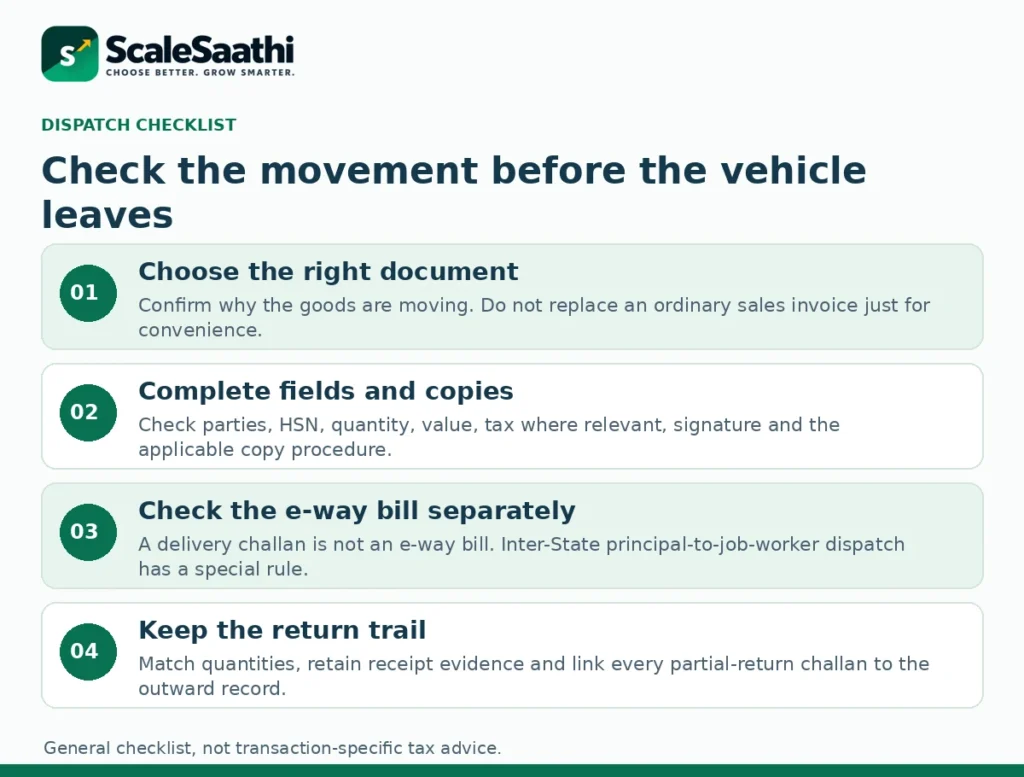
First, record the facts. Identify who owns the goods, who sends them, who receives them, why they move and whether they will return. Decide which document and transport procedure apply before entering amounts.
Then prepare the particulars. Use the actual number and date, party details, goods description, HSN, quantity and value. Complete conditional tax fields and inter-State place of supply as appropriate. Do not let an attractive template conceal missing information.
Review the dispatch as a whole. Match the physical goods, packages and transport record. Prepare the required copies, obtain the actual authorisation and complete the separate e-way bill steps where required. Save the issued document in a controlled folder.
Finally, close the loop. Record receipt, shortages, partial returns and the final reconciliation. Follow up on open quantities and internal target dates. If the transaction becomes a sale or requires a separate tax document, deal with that event through the appropriate invoice process rather than relabelling the challan.
When a spreadsheet is enough—and when it is not
For a small number of simple movements, a controlled template and register can make the process clearer. Its limits become visible when several people issue documents, goods move between multiple job workers, or process output no longer matches the input quantity. At that point, look for controlled numbering, permissions, document references and exports—not merely an “unlimited challans” feature.
Use ScaleSaathi’s accounting software selection checklist to define the records your team needs. Our accounting and invoicing software guide is a broader comparison; it does not replace checking whether the chosen product supports your actual dispatch and return procedure.
Before adopting a new tool, try one complete example: outward movement, partial return, outstanding quantity, final return and export of the supporting documents. The business software selection guide explains how to test a workflow rather than buy from a feature count.
Avoid five shortcuts: declaring every branch transfer non-supply; always putting zero value because goods are not for sale; assuming ₹50,000 ends every e-way bill question; using the original quantity for a partial return; and printing a fictional example with placeholder IDs. None is corrected by a higher SEO score, better logo or cleaner PDF.
The practical standard is simple: the document, goods, purpose, value and separate transport requirements should tell the same story. Use the downloads as a starting structure, verify the applicable GST treatment with your accountant where needed, and keep evidence of what left and what came back.
Scope: general Indian GST document guidance and educational templates. This is not personalised tax advice or a guarantee for every movement. No e-way bill, IRN, tax classification or filing is generated. Check current notifications and State-specific requirements before issuing documents.
Frequently asked questions
What is a delivery challan format?
It is the document structure used to record a qualifying goods movement under a challan procedure. It identifies the parties, goods, quantity, value and applicable details. A delivery challan is not automatically a sales invoice or an e-way bill.
Can I use a delivery challan instead of a GST invoice for every sale?
No. Rule 55 describes particular circumstances and procedures. An ordinary taxable sale cannot be treated as non-supply simply by issuing a challan or writing “not for sale”. Check the invoice requirements for the actual transaction.
Does a delivery challan number have a maximum length?
Yes. Rule 55 requires serial numbering not exceeding 16 characters, in one or multiple series. The workbook checks length only; you still need to control uniqueness and the issued series.
Should every delivery challan show GST?
Rule 55 requires tax rate and tax amount where transportation is for supply to the consignee. The correct entries depend on the actual movement. Do not assume all challans are tax-free or copy a sample tax rate without review.
How many copies should be prepared?
Rule 55(2) prescribes triplicate in the case of supply of goods. The job-work circular also directs the principal to prepare triplicate challans for job work. The role labels are Original for Consignee, Duplicate for Transporter and Triplicate for Consigner.
Is an e-way bill unnecessary when the value is ₹50,000 or less?
Not necessarily. The general threshold has exceptions. In particular, an inter-State principal-to-job-worker dispatch requires an e-way bill irrespective of consignment value under the specific rule. Review the actual movement and applicable exemptions.
How should I document a partial return from a job worker?
For piecemeal returns after job work, the circular requires a fresh challan issued by the job worker rather than merely endorsing the principal’s original challan. Retain the outward reference and reconcile the quantity returned and still outstanding.
Are the Word, Excel and PDF files government-approved forms?
No. They are editable ScaleSaathi educational templates built around the relevant particulars and workflow. Complete the actual details, check applicability and obtain transaction-specific advice where needed before issue.
Can the Excel file calculate the statutory job-work return deadline?
No. It calculates goods values and simple same-item, same-unit outstanding quantities. Its assessment and expected-return dates are internal follow-up inputs. It does not calculate statutory time limits, process yield, tax liability or GST ITC-04.
Can a delivery challan be used as proof of an e-invoice registration?
No. The template does not register an e-invoice or generate an IRN or signed QR code. Where a tax invoice and e-invoice compliance are required, follow those processes separately; changing a document title or saving a PDF does not perform them.
Sources and further reading
- CBIC: CGST Rule 55 — permitted movements, particulars, copies and batches/lots
- GST Council: CGST Rules compilation through 1 June 2021 — Rules 45, 55 and 138 (read with current portal guidance)
- CBIC Circular 38/12/2018-GST — job-work documentation, paragraphs 8.3–8.4
- NIC: e-way bill system FAQ — documents, thresholds and exceptions
- GST portal: ITC-04 manual — reporting frequency and principal’s records
- CBIC: CGST Act — section 31(7), section 25 and Schedule I; legacy compilation used only for the cited provisions