Last updated 30 October 2026. Fees below were seen on Cashfree’s and Razorpay’s official India pricing pages, help docs and offer terms on 29 and 30 October 2026.
Cashfree is slightly cheaper on paper: 1.95% against Razorpay’s 2% on everyday Indian payments. That 0.05% is real but small, about ₹118 a month for a seller doing ₹2 lakh. Over three years the gap for our three example sellers runs from ₹4,248 to ₹87,084, GST included. Right now the bigger difference is the sign-up offer. Cashfree waives its fee on your first ₹20 lakh of eligible sales until 31 March 2027. Razorpay’s offer stops at ₹5 lakh or 90 days, whichever comes first.
Price is rarely the reason a gateway works out or fails, though. After years of watching small businesses switch gateways, the reasons I see are almost always the same: a settlement held during KYC review, a plugin that broke checkout on a sale day, or a support ticket that sat unanswered for a week. Fees matter, but they are only one row of the comparison below.
Which one to pick
- Cashfree if you’re opening a new account before 31 March 2027. Your first ₹20 lakh of eligible domestic sales carry no platform fee, though 18% GST is still billed (about ₹351 per ₹1 lakh).
- Razorpay if you want one flat 2% on every method, a lot of your buyers pay with Pay Later, or your developer already knows its plugin.
- Both if a checkout failing on a sale day would really hurt you. Keeping a second account idle costs nothing.
- Don’t choose on the rate alone. 1.95% vs 2% (official pages, seen 30 Oct 2026) works out to about ₹118 a month on ₹2 lakh of sales. Payment success rate, support and your plugin matter more.
- Keep instant settlement switched off by default. At 0.30% + GST it costs more than the whole gap between the two rates.
Disclosure: This page has no affiliate links. ScaleSaathi earns nothing if you sign up with Cashfree or Razorpay. Read our affiliate disclosure and editorial policy.
Cashfree vs Razorpay at a glance
| Cashfree | Razorpay | |
|---|---|---|
| UPI, cards, netbanking, wallets | 1.95% (2.30% with GST) | 2% (2.36% with GST) |
| RuPay credit card on UPI | 2.15% | 2% |
| Corporate credit cards | Not listed separately | 2.15% |
| Pay Later | 2.20% | 2% |
| International cards | 2.99% Visa/Mastercard, 2.95% Amex | Up to 3% |
| Setup fee / annual fee | ₹0 / ₹0 | ₹0 / ₹0 |
| Default settlement | T+2 working days (T+1 on request) | T+2 working days (settlement docs); “typically T+1” (pricing page) |
| Instant settlement fee | From 0.30% + GST | 0.20%–0.30% on demand |
| Payment links | Free (method rate only) | Free (method rate only) |
| Welcome offer (new accounts) | 0% on first ₹20 lakh, till 31 Mar 2027 | 0% on first ₹5 lakh or 90 days |
All rates exclude 18% GST unless shown. Razorpay figures are from its India pricing page; Cashfree figures are from its charges page and its pricing help page, both seen 30 October 2026.
Rates by payment method
Razorpay keeps it simple: one 2% platform fee on UPI, Visa, Mastercard, RuPay, netbanking across 72+ banks, wallets, Pay Later, EMI and cardless EMI. The exceptions are corporate cards at 2.15% and international cards at up to 3%. Its pricing page also lists Amex and Diners under the 2%. Our Razorpay charges guide explains why we still treat those as worth confirming, since another Razorpay page shows 3% for them.
Cashfree prices each method separately, and that is where the detail matters:
- Everyday methods at 1.95%: UPI (intent, collect, credit line), Visa, Mastercard, RuPay and Maestro cards, netbanking, wallets and prepaid cards.
- UPI on a RuPay credit card at 2.15%. This is the one everyday method where Cashfree costs more than Razorpay. If your buyers pay with credit cards linked to UPI apps, part of your “UPI” volume is billed at this rate.
- EMI: debit card EMI 1.50%, cardless EMI 1.90%, and credit card EMI from 1.90% plus 0.25%. Cashfree’s charges page shows 2.2% for credit card EMI, so plan for the higher figure.
- Pay Later at 2.20%, against Razorpay’s 2%.
- International: 2.99% on Visa and Mastercard, 2.95% on Amex, plus a currency conversion charge if you settle in anything other than rupees. PayPal is billed at PayPal’s own rates, and Cashfree adds nothing on top.
- Bank transfers to a virtual account: a flat fee from ₹20 per IMPS, NEFT or RTGS payment. That fixed fee works well on large B2B invoices, where 2% of ₹2 lakh would be ₹4,000.
What GST does to these numbers
GST at 18% is charged on the gateway’s fee, not on your sale. So 1.95% becomes 2.301% of the sale and 2% becomes 2.36%. On a ₹1,000 order, Cashfree keeps ₹23.01 and Razorpay keeps ₹23.60. If you are GST-registered, you can usually claim that GST back as input tax credit, provided your GSTIN is on the gateway’s invoice. Cashfree puts its invoice on the dashboard by the 5th of the following month. Make sure someone downloads it and gives it to your accountant.
UPI is not free, whatever you have heard
UPI has zero MDR for most merchants, and owners hear “UPI is free” and expect a gateway to charge nothing on it. A gateway charges a platform fee for the checkout, the dashboard, refunds and reconciliation, and both of these charge their full rate on UPI. If most of your customers already pay you by scanning a shop QR, keep doing that for walk-in sales. Use the gateway only where you need an online checkout or a link, because that is the part you are paying for.
3-year cost for three sellers
Here are three sellers we see often. The payment mix is the share of sales value by method, and it is the assumption that matters most. Change it in the calculator to match your own dashboard.
| Seller | Sales | Payment mix (by value) |
|---|---|---|
| Seller A: Instagram and WhatsApp seller, payment links | ₹2,00,000 a month | UPI 80%, Domestic debit/credit cards 15%, Netbanking 5% |
| Seller B: D2C website with checkout | ₹10,00,000 a month | UPI 65%, Domestic debit/credit cards 25%, Netbanking 5%, Wallets 3%, Pay Later 2% |
| Seller C: Larger D2C brand with overseas buyers | ₹50,00,000 a month | UPI 55%, Domestic debit/credit cards 25%, Netbanking 5%, Wallets 3%, Pay Later 2%, International cards 10% |
| Seller | Cashfree: blended rate → 3-year cost with GST | Razorpay: blended rate → 3-year cost with GST | Cashfree saves |
|---|---|---|---|
| Seller A | 1.950% → ₹1,65,672 | 2.000% → ₹1,69,920 | ₹4,248 |
| Seller B | 1.955% → ₹8,30,484 | 2.000% → ₹8,49,600 | ₹19,116 |
| Seller C | 2.059% → ₹43,73,316 | 2.100% → ₹44,60,400 | ₹87,084 |
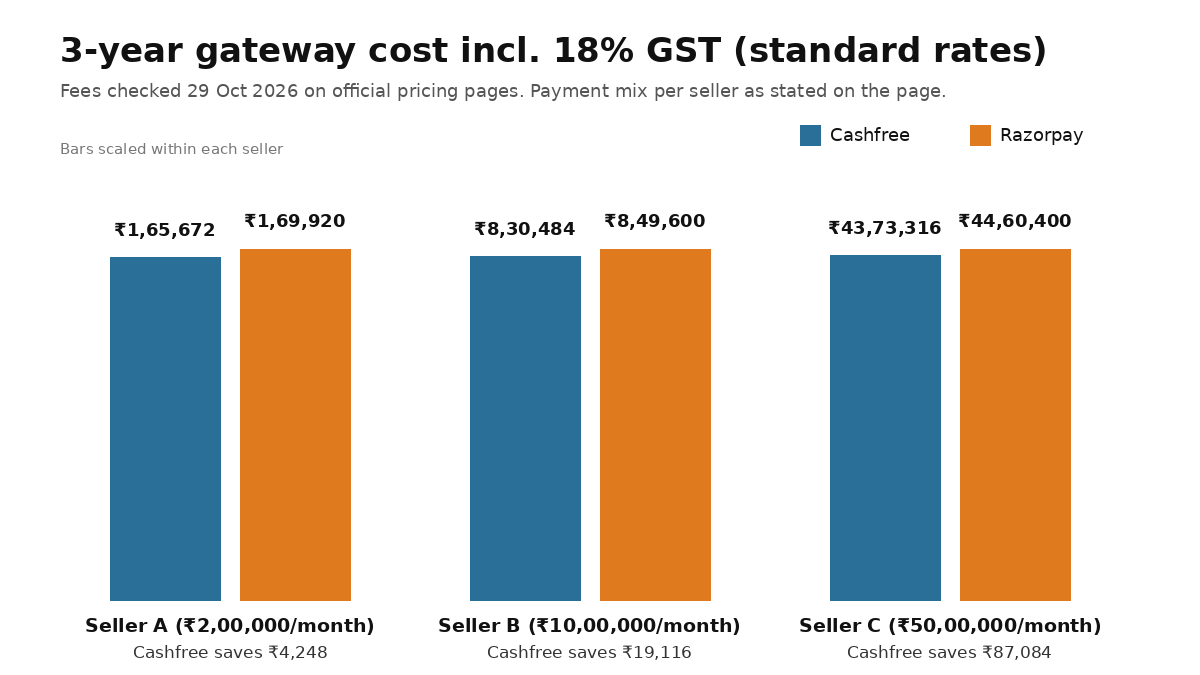
Standard rates without welcome offers, plus 18% GST, over 36 months; Razorpay international taken at its 3% ceiling (rates seen 30 October 2026).
Put the gap in proportion. For Seller B, three years of fees come to about ₹8,30,484 on Cashfree and ₹8,49,600 on Razorpay. The difference, ₹19,116, is real money, but one weekend of failed payments during a sale can cost more than that. If one gateway gives you a noticeably better success rate on your traffic, that matters more than the 0.05%.
Seller C shows where negotiation starts to matter. At ₹50 lakh a month, either gateway will discuss custom pricing. Razorpay says enterprise pricing is for businesses above ₹5 lakh a month, and Cashfree offers custom rates on volume. A 0.2% cut on ₹6 crore a year is ₹1.2 lakh before GST, more than the whole published gap between the two. Get a quote from both and let them compete. One catch on the Cashfree side: its welcome offer does not apply to any account with custom pricing on any payment method. So a negotiated rate means giving up the ₹20 lakh offer. Work out what each is worth over your first year before you choose.
The two welcome offers, read properly
Both gateways are running a “0% fee” offer for new accounts. Neither is as generous as the banner suggests, and they differ more than the rate cards do.
| Cashfree festive offer | Razorpay 90-day offer | |
|---|---|---|
| Who qualifies | New merchants signed up on or after 21 July 2026 who had not transacted on Cashfree before that date | Merchants activated on or after 1 July 2026 who had not transacted before that date |
| What is free | Platform fee on the first ₹20,00,000 of domestic sales | Platform fee on the first ₹5,00,000 of domestic sales |
| Ends | At ₹20 lakh or 31 March 2027, whichever comes first | At ₹5 lakh or 90 days, whichever comes first |
| GST | Still charged at 18% on the 1.95% rate | Not waived |
| Not covered | Amex, Diners, corporate cards, EMI, prepaid, Pay Later, e-mandate subscriptions, international, any method with a standard fee of 3% or more; and any account on custom pricing for any method | Prepaid, corporate, Amex, Diners, EMI; international (domestic only) |
| Can be withdrawn if | Credit cards reach 60% or more of your sales | Credit cards exceed 90% of your volume (Razorpay may then apply standard charges retrospectively) |
What the offers are worth, assuming you sign up on 1 November 2026 (five months before Cashfree’s offer ends): Seller A saves about ₹19,500 with Cashfree against ₹10,000 with Razorpay. Sellers B and C hit both caps quickly, so their saving is about ₹39,000 with Cashfree and ₹10,000 with Razorpay. These savings are before GST, and the GST is still payable.
The trap is the GST line. Under Cashfree’s offer you still pay 18% GST on the 1.95% you were not charged, which is ₹351 on every ₹1 lakh of sales. Your invoice will show a fee of zero and GST that is not zero. That is how the offer is designed, not a billing error. Razorpay’s terms also say GST is not waived. Our calculator assumes it works the same way, but ask Razorpay to confirm in writing.
Also note that Cashfree’s offer is limited to one per PAN or bank account and is not available if a partner or reseller referred you. If your web developer “sets up Cashfree for you” through their partner link, you may lose it.
Settlement and instant settlement
Both gateways pay out domestic payments on T+2 working days by default. A Friday sale usually reaches your bank on Tuesday, and a bank holiday pushes it out further. Razorpay’s pricing page says settlement is “typically T+1 or Instant” (seen 30 October 2026), but its settlement documentation says T+2 working days, so plan on T+2 and treat T+1 as a bonus, as on our Razorpay guide. Cashfree lets you request a T+1 cycle through its support form. Here Cashfree’s own pages disagree. The offer terms say offer accounts get T+1 by 8 PM as the default during the campaign; the help page says this is for GST-registered businesses. Confirm which applies to you when you sign up.
Instant settlement is where cash-flow-hungry businesses quietly spend more than they save on the base rate:
- Cashfree lists instant settlement from 0.30% plus GST, at intervals as short as 15 minutes, including holidays. The rate is marked “might vary based on type and risk assessment”. New accounts come with a ₹50,000 instant settlement limit already switched on.
- Razorpay lists on-demand settlement at 0.20% to 0.30% (paid out in about 10 seconds) and same-day or early settlement at 0.15% to 0.20%. The minimum is ₹100, there is a daily limit, and international payments are excluded.
Run the numbers before you switch it on. Settling all of Seller B’s ₹10 lakh a month instantly at the 0.30% starting rate costs at least ₹3,540 a month with GST, or ₹1,27,440 over three years. That is far more than the gap between the two base rates. Use instant settlement in the weeks you really need the cash, such as stock for Diwali or salary day, and leave it off the rest of the year.
International payments settle in rupees on both. Cashfree’s international gateway settles within T+2 and supports 140+ currencies. Razorpay supports 135 currencies, includes FIRC, and settles international payments as per applicable law, which in practice can take longer than domestic payments.
Payment links, subscriptions and splits
Payment links
If you sell on Instagram or WhatsApp, the payment link is your whole checkout. Neither gateway charges extra for links: you pay the normal rate for the method the customer uses. Cashfree also includes Payment Forms and softPOS at no extra cost. On Razorpay, the hosted Payment Pages and Payment Buttons carry 0.2% on top of the gateway fee, which is easy to miss if you use them as a simple shop. A plain Razorpay payment link does not have this 0.2%.
Subscriptions and UPI AutoPay
This is where Cashfree is clearly more transparent. It publishes a fee to create the mandate and a fee each time it debits the customer, on top of the platform fee:
- Cards: ₹7.5 per mandate and ₹7.5 per debit.
- e-NACH: ₹7.5 per mandate and ₹7.5 per debit. e-NACH works up to ₹1 crore, which suits B2B retainers.
- UPI AutoPay: ₹7.5 per mandate, plus ₹5 per debit under ₹1,000 or ₹15 per debit of ₹1,000 or more.
Razorpay’s Subscriptions page shows a limited-time 0.5% (down from 0.9%) charged on top of the platform fee on every subscription payment (seen 30 October 2026), and keeps UPI AutoPay and e-NACH pricing “on request”. On a ₹499 monthly plan that is about ₹2.50 per debit plus the 2% (₹4.49 at the old 0.9%), against Cashfree’s ₹7.5. The percentage fee is cheaper on small plans; on a ₹5,000 B2B retainer, Razorpay’s 0.5% is ₹25 while Cashfree’s card or e-NACH debit stays at ₹7.5. The real test is UPI AutoPay, so get Razorpay’s quote in writing. On Cashfree, UPI AutoPay and card mandates of ₹15,000 or more are switched off by default and need extra customer authentication on each debit once you enable them. Razorpay’s pricing doesn’t cover this, so ask how it handles larger mandates.
Splitting money between vendors
Marketplaces and aggregators need to split each payment between sellers. Razorpay Route costs 0.1%, and Cashfree Easy Split costs 0.20%. On ₹50 lakh a month, that is ₹5,000 against ₹10,000 before GST, and that more than cancels Cashfree’s base-rate edge. Add the split fee to the base rate and a ₹50 lakh marketplace pays about ₹2,500 a month less on Razorpay at flat rates (1.95% vs 2%), or ₹2,950 with Seller C’s payment mix, both before GST (₹2,950–₹3,481 with GST). If you run a marketplace, pick Razorpay.
KYC and getting activated
Cashfree spells out that your site should be live with a Contact Us page showing an email and phone number, a privacy policy, a refund policy and terms and conditions. Most rejections I see come from a site that is missing one of these pages, not from the documents.
Cashfree’s partial activation lets you collect up to ₹50,000 a month while KYC is completed. After full activation, the limits are set by the bank. Razorpay’s offer terms mention a possible ₹199 KYC processing fee plus taxes. It is small, but you should not be surprised by it. Razorpay’s document checklist is in our Razorpay vs PayU comparison.
What to get in writing before you go live
Rate cards are the part both gateways publish. The terms that hurt a small business are the ones they don’t, and I have seen each of these cost an owner more than a year of the 0.05% gap. Ask your account manager to answer these by email, and keep the reply with your agreement.
- Your UPI rate, in writing. Both list a platform fee on UPI. If 70% of your sales are UPI, a 0.5% concession there is worth more than any card rate you negotiate.
- The settlement cycle on your account. Not the marketing page. Razorpay’s own pages say T+1 in one place and T+2 in another; Cashfree’s T+1 depends on your offer and GST status. A one-day difference on ₹10 lakh a month is roughly ₹33,000 sitting with the gateway instead of you.
- When they can hold your money. Gateways can pause settlements during a KYC or risk review, after a spike in sales or refunds, or keep a reserve after you close the account. Ask how long a hold can last and what documents release it. Sellers of pre-orders, travel, education courses and high-value electronics hit this most often.
- The chargeback fee and deadline. Neither publishes an India chargeback fee. Ask the amount and how many days you get to upload proof of delivery. Missing the deadline loses the dispute even when you shipped.
- What ends the welcome offer. For Cashfree, custom pricing on any method or credit cards above 60% of sales; for Razorpay, credit cards above 90%. If you plan to negotiate, do it after the offer has paid for itself.
- Who answers on a sale day. Ask for a named contact or an escalation email, not just the ticket form. A Diwali checkout that fails for two hours is the real cost of choosing badly.
Mistakes owners make when choosing
- Choosing on 0.05%. On ₹2 lakh a month that is about ₹118. Choose on success rate, support and the plugin for your platform, then negotiate the rate.
- Forgetting the GST on a “free” offer. Expect a bill of about ₹351 per ₹1 lakh during Cashfree’s 0% period, and claim it back as input credit if you are registered.
- Leaving instant settlement on all year. At 0.30% plus GST, it costs more than the difference between the two gateways’ rates.
- Signing up through someone else’s partner link. It can disqualify you from Cashfree’s offer.
- Treating all UPI the same. UPI paid with a RuPay credit card is 2.15% on Cashfree, and it is growing fast.
- Running one gateway with no backup. When a gateway or bank has an outage during a sale, the stores that can switch on a second checkout within minutes lose nothing.
- Never asking for a better rate. Above roughly ₹5 lakh a month, both gateways will talk. Ask for a quote from each, but remember a custom rate on Cashfree ends its welcome offer.
Who should pick which
Pick Cashfree if you are opening a new account before 31 March 2027 and can use the ₹20 lakh offer, if you sell on UPI and cards with few Pay Later or RuPay credit card buyers, if you bill subscriptions and want UPI AutoPay prices published upfront, or if you take large B2B bank transfers that suit a flat ₹20 virtual-account fee.
Pick Razorpay if you want one flat rate across every method, a lot of your customers use Pay Later, you run a marketplace that needs Route at 0.1%, or your store platform’s Razorpay plugin is the one your developer already knows well.
Use both if a failed checkout during a sale would really hurt you. An idle account costs nothing.
If neither feels right, our best payment gateway for small business in India guide covers the other options. If you are still choosing a store platform, e-commerce website cost in India shows where gateway fees sit in the total cost of running a store.
Download the fee calculator
Download the Cashfree vs Razorpay fee calculator (Excel)
Enter your monthly sales and your payment mix in the yellow cells. The sheet applies the published rates above, adds GST and shows the monthly, yearly and 3-year cost on each gateway. It also has rows for instant settlement and for the offer months.
Frequently asked questions
Is Cashfree cheaper than Razorpay?
On standard published rates, yes, by a small margin. Cashfree charges 1.95% on UPI, domestic cards, netbanking and wallets; Razorpay charges a flat 2%. With 18% GST that is about 2.30% against 2.36%. On ₹10 lakh a month, the flat 0.05% gap is about ₹590 a month including GST (₹531 for Seller B’s payment mix below). Pay Later is the exception, where Cashfree’s 2.20% is higher than Razorpay’s 2%.
Does Cashfree charge for UPI payments?
Cashfree’s help page lists UPI at 1.95%, the same as cards. UPI has zero MDR by law, but both gateways charge a platform fee on top, and Razorpay’s pricing says UPI is zero MDR but its 2% platform fee applies. Cashfree’s charges page adds a general line that UPI charges are “as per the applicable law”, so confirm the rate on your own agreement either way.
Which settles money faster, Cashfree or Razorpay?
Both default to T+2 working days for domestic payments. Cashfree can move you to T+1 through a support request and its offer terms put new festive-offer accounts on T+1 by 8 PM, though its help page ties that to GST-registered businesses, so confirm at sign-up. Both sell instant settlement: Cashfree’s starts at 0.30% plus GST, and Razorpay lists 0.20% to 0.30% for on-demand payouts.
Is the Cashfree 0% offer really free?
Not fully. The platform fee is waived on your first ₹20 lakh of eligible domestic sales, but GST at 18% is still charged on the 1.95% you would have paid. That works out to about ₹3,510 on ₹10 lakh of sales. Amex, Diners, corporate cards, EMI, Pay Later, prepaid cards, e-mandate subscriptions, international payments and any method with a standard fee of 3% or more are not covered. You can’t get it if you transacted on Cashfree before 21 July 2026 or if your account has custom pricing on any method, and it ends on 31 March 2027.
Are there setup or annual fees on either gateway?
No setup fee and no annual maintenance charge on the standard plan of either. Razorpay’s offer terms mention a possible ₹199 KYC processing fee plus tax. Cashfree mentions an annual charge only for optional premium services and does not show the amount.
Can I use both Cashfree and Razorpay?
Yes. Many stores keep one as primary and the other as a backup checkout, or use one for payment links and the other on the website. You pay each gateway only on the payments it processes, so a second account costs nothing if it sits idle.
Which is better for subscriptions and UPI AutoPay?
Cashfree publishes its mandate fees: ₹7.5 to create a mandate and ₹5 or ₹15 per UPI AutoPay debit, depending on whether the debit is under ₹1,000. Razorpay’s Subscriptions page shows a limited-time 0.5% (normally 0.9%) on top of the platform fee (seen 30 October 2026), but UPI AutoPay and e-NACH pricing is on request. If you bill monthly, ask Razorpay for its quote before you compare.
Can Cashfree or Razorpay hold my settlements?
Yes. Both can delay or hold settlements while they review KYC or unusual activity, and Razorpay’s settlement documentation notes that international payments settle on a longer cycle than domestic ones. Ask each gateway in writing how long a hold can last and which documents release it, and keep a second gateway active so a hold on one does not stop your sales.
Related guides
- Razorpay charges explained, method by method
- Razorpay vs PayU
- Best payment gateway for small business in India
- E-commerce website cost in India
- Shopify pricing in India
Sources
- Cashfree payment gateway charges: rates by method, subscriptions, instant settlement, festive offer
- Cashfree Docs: pricing FAQs (method rates, EMI, international, offer conditions, invoices)
- Cashfree Docs: settlements (T+2 default, T+1, instant)
- Cashfree instant settlements
- Cashfree Docs: subscription payment modes and limits
- Cashfree Docs: International Payment Gateway overview
- Cashfree Docs: general FAQs (activation, limits)
- Razorpay pricing (India)
- Razorpay Docs: settlements
- Razorpay Docs: instant settlements
- Razorpay instant settlement pricing
- Razorpay 90-day free payment gateway offer terms
Fees seen 29–30 October 2026. All rates are in rupees or percentages as published and exclude 18% GST unless stated. Gateways change prices and offers without notice, so check the official pages (Cashfree, Razorpay) before you sign.
Product names are trademarks of their respective owners. They are shown only to identify the products compared, and their use does not imply endorsement by or affiliation with ScaleSaathi.