
Last updated: 28 October 2026
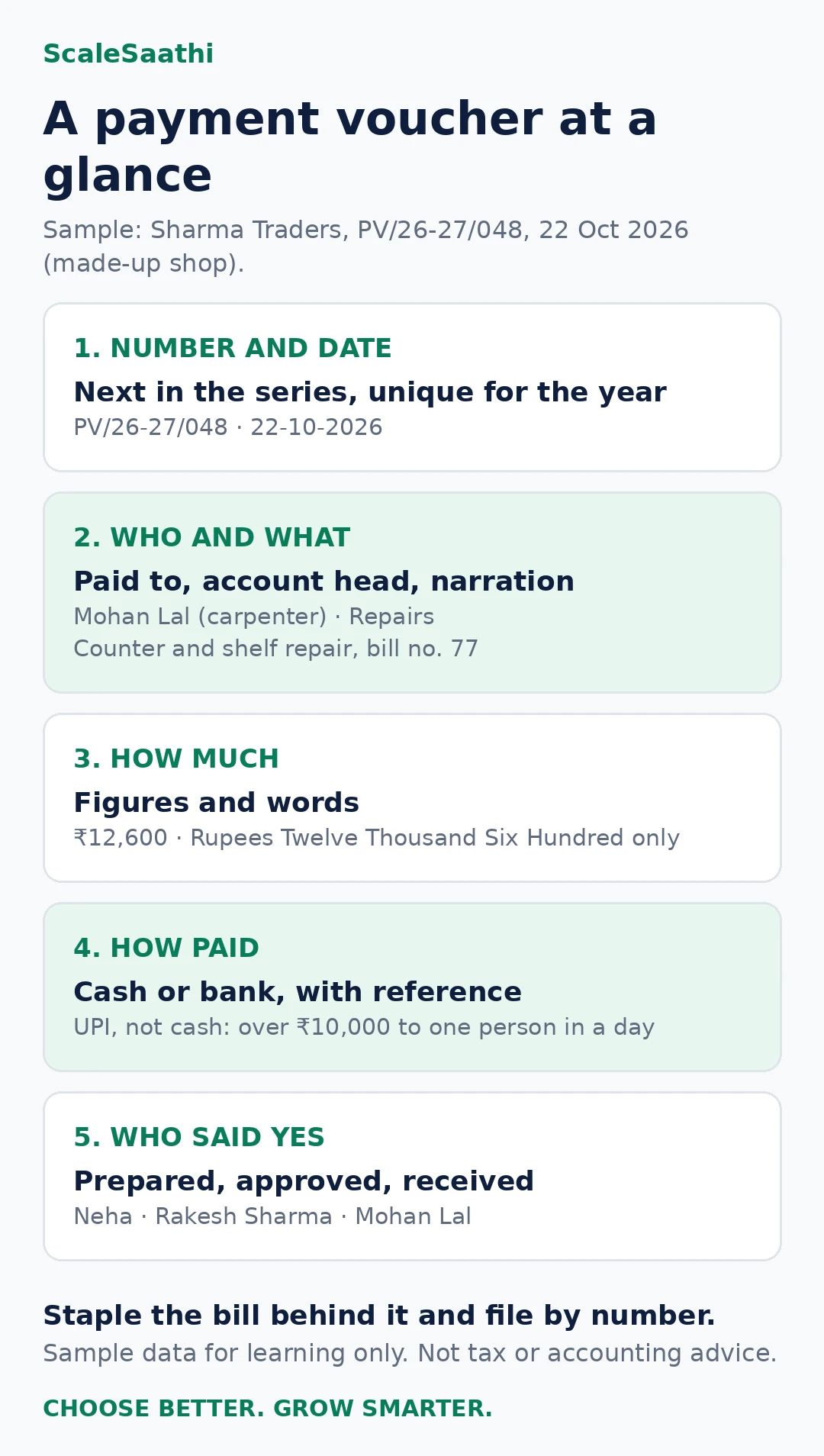
Short answer: a payment voucher is the slip you fill in every time money leaves the business. It says who was paid, how much, for what, by cash or bank, and it carries the signature of the person who approved it and the person who took the money. Attach the bill behind it, give it the next number in the series, and your accountant can post it to the cash book without asking you a single question. Here’s one, filled in:
| Payment voucher | Sharma Traders |
|---|---|
| Voucher no. and date | PV/26-27/048 · 22-10-2026 |
| Paid to | Mohan Lal (carpenter) |
| Debit (account head) | Repairs and maintenance |
| Amount | ₹12,600 |
| Amount in words | Rupees Twelve Thousand Six Hundred only |
| Mode of payment | Bank (UPI), UPI ref. 4291 8830 5512 |
| Being (narration) | Counter and shelf repair, labour and material. Bill no. 77 attached. |
| Prepared by / Approved by / Received by | Neha (accounts) / Rakesh Sharma (owner) / Mohan Lal |
Sharma Traders is a made-up shop we use across our accounting guides. Educational information only, not tax, accounting or legal advice; see our disclaimer.
On this page
- Free downloads
- The format, field by field
- Cash, bank and petty cash vouchers
- The ₹10,000 cash rule
- GST payment voucher under reverse charge
- Worked example: a month at Sharma Traders
- Receipt, journal and contra vouchers
- Numbering, filing and how long to keep them
- Common mistakes
- FAQs
Free payment voucher format: Excel, Word and PDF
Free, no sign-up, nothing to install. These are our own educational templates. Outside the GST reverse charge case, no law gives a fixed layout for a payment voucher, so you can add your logo and change the wording.
Excel: voucher, register and checks
A printable payment voucher, a monthly voucher register that totals itself by account head and by cash or bank, a petty cash sheet that works out the top-up, and a Checks sheet that flags any cash payment over ₹10,000. Blank receipt, journal, contra and GST reverse charge vouchers included. Download Excel (.xlsx)
Word: blank and filled
Two blank payment vouchers per page, a petty cash voucher, the other voucher types, and the filled Sharma Traders voucher as a guide. Download Word (.docx)
PDF: print and fill by hand
The same pages on A4. Print a pad’s worth, number them in advance, and keep them by the cash box. Download PDF (.pdf)
The payment voucher format, field by field
A good voucher is boring on purpose. Each box is there because someone, usually your CA or a tax officer, will one day ask the question it answers.
| Field | What to write | Why it matters |
|---|---|---|
| Business name and address | Printed at the top | Shows whose expense this is |
| Voucher number | Next number in the series, e.g. PV/26-27/048 | A gap or repeat in numbers is the first thing an auditor notices |
| Date | Date the money actually went out | Decides which month and year the expense falls in |
| Paid to | Full name of the person or firm | Needed to check the cash limit, which works per person per day |
| Debit (account head) | Rent, Wages, Freight inward, a supplier’s name… | Tells the accountant which ledger to post it to |
| Amount in figures and words | ₹12,600 and “Rupees Twelve Thousand Six Hundred only” | Words make it hard to change 1,260 into 12,600 later |
| Mode of payment | Cash, or bank with cheque no. / UTR / UPI reference | Cash vouchers go to the cash book, the rest to the bank column |
| Narration (“Being…”) | One line: what it was for, and the bill number | Six months on, nobody remembers what “Mohan, 12,600” was |
| Bill or proof attached | Tick box, plus the bill number | The voucher is your note; the bill is the proof |
| Prepared by | Whoever filled it in | Separates the person writing from the person approving |
| Approved by | Owner or partner | Stops staff paying out without permission |
| Received by (payee’s signature) | Signature of the person who took the cash | Your only proof a cash payment really reached them |
| TDS / GST details (if any) | TDS deducted, or reverse charge tax | Only when it applies; see the GST section below |
For bank and UPI payments, the payee’s signature is optional because the bank statement proves the payment. Write the UTR or UPI reference instead. That one number also makes your monthly bank reconciliation far quicker.
Cash, bank and petty cash vouchers
Most businesses use one payment voucher design and just tick “cash” or “bank”. Some prefer two pads in different colours, which is fine too. Petty cash is the one that genuinely works differently.
| Voucher | Use it for | Posted to |
|---|---|---|
| Cash payment voucher | Wages, tempo hire, small supplier bills paid in notes | Cash column of the cash book |
| Bank payment voucher | NEFT, RTGS, cheque, UPI or card payments | Bank column of the cash book |
| Petty cash voucher | Tea, courier, stationery, packing: small daily spends from a petty cash box | Petty cash book, then one summary entry when you top up |
How petty cash works (the imprest system)
Give one person a fixed float, say ₹3,000. Every time they spend from it, they fill a small petty cash voucher and keep the bill with it. At the end of the period, add up the vouchers, and hand over exactly that amount so the box is back to ₹3,000. If the vouchers plus the cash left don’t add up to the float, you know straight away.
| Date | Petty cash voucher | For | Paid to | ₹ |
|---|---|---|---|---|
| 05-10-2026 | PCV/26-27/031 | Packing material | Kumar Packaging | 1,240 |
| 14-10-2026 | PCV/26-27/032 | Tea and stationery | Various | 860 |
| 25-10-2026 | PCV/26-27/033 | Courier | DTDC counter | 450 |
| Total spent | 2,550 | |||
| Cash left in the box | 450 | |||
| Top-up on 31-10-2026 | 2,550 |
₹2,550 spent + ₹450 left = ₹3,000, the float. The top-up of ₹2,550 is recorded once in the main cash book format, split across packing, tea and stationery, and courier.
The ₹10,000 cash rule you should know about
This is the main reason a payment voucher matters at tax time. Under the Income-tax Act, 2025, which has applied since 1 April 2026, if you pay one person more than ₹10,000 in a day for a business expense in cash (or any way other than an account payee cheque, bank draft, or an electronic bank transfer such as NEFT or UPI), that expense is not allowed as a deduction (section 36(4)). For hiring or leasing goods carriages, the limit is ₹35,000 (section 36(6)). Older books and CAs will call this section 40A(3) of the 1961 Act; the old Act had the same ₹10,000 rule (1961 text).
Two things catch people out. The limit is per person per day, so two cash vouchers of ₹6,000 to the same carpenter on the same day add up to ₹12,000 and cross it. And the law allows some exceptions, which are listed in the income-tax rules; ask your CA before relying on one.
That’s why Sharma Traders paid the carpenter’s ₹12,600 bill by UPI, not cash. Our Excel Checks sheet flags any cash voucher above ₹10,000 so you catch it before you pay.
GST payment voucher under reverse charge
Here the law does set the format. If you are GST-registered and you pay for something on which you, the buyer, must pay the GST under reverse charge, you must issue a payment voucher “at the time of making payment to the supplier” (CGST Act, section 31(3)(g)). Rule 52 of the CGST Rules lists what it must contain (Rule 52):
- Name, address and GSTIN of the supplier, if registered
- A consecutive serial number, up to 16 characters (letters, numbers, hyphen or slash), unique for the financial year
- Date of issue
- Name, address and GSTIN of the recipient (you)
- Description of the goods or services
- Amount paid
- Rate of tax (central, State, integrated, Union territory tax or cess)
- Amount of tax payable on the taxable goods or services
- Place of supply with the State name and code, for an inter-State supply
- Signature or digital signature of the supplier or their authorised representative
Which purchases fall under reverse charge, and at what rate, depends on GST notifications that change from time to time, so we haven’t listed them here. Ask your CA which of your regular payments are covered. Our Excel and Word files include a blank voucher with all ten Rule 52 fields. Keep it as a separate series from your ordinary payment vouchers.
Worked example: a month of payment vouchers at Sharma Traders
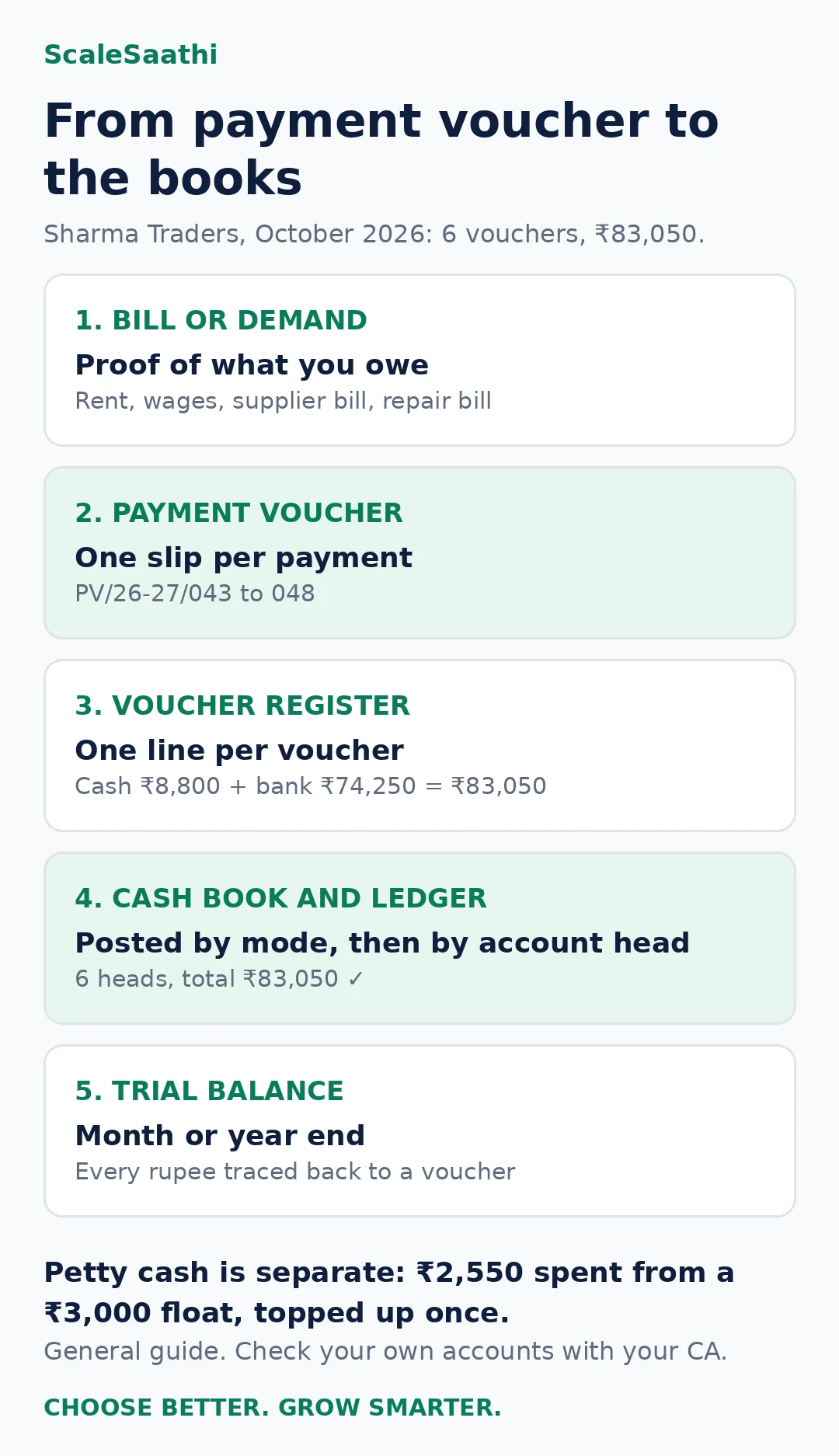
Here’s every payment voucher Sharma Traders wrote in October 2026, copied into the voucher register. The register is just a list, one line per voucher, and it’s what your accountant actually types from.
| Date | Voucher no. | Paid to | Account head | Mode | ₹ |
|---|---|---|---|---|---|
| 01-10-2026 | PV/26-27/043 | Mr Suresh Mehra (landlord) | Shop rent | Bank (NEFT) | 10,000 |
| 03-10-2026 | PV/26-27/044 | Ramesh Yadav | Wages | Cash | 6,000 |
| 07-10-2026 | PV/26-27/045 | Electricity board | Electricity | Bank (UPI) | 3,150 |
| 10-10-2026 | PV/26-27/046 | Agarwal Distributors | Sundry creditors | Bank (NEFT) | 48,500 |
| 18-10-2026 | PV/26-27/047 | Shiv Tempo Service | Freight inward | Cash | 2,800 |
| 22-10-2026 | PV/26-27/048 | Mohan Lal (carpenter) | Repairs and maintenance | Bank (UPI) | 12,600 |
| Total | 83,050 |
Now total it two ways. Both must give the same answer, which is exactly what the Excel Checks sheet tests.
| By mode | ₹ | By account head | ₹ |
|---|---|---|---|
| Cash | 8,800 | Sundry creditors (Agarwal Distributors) | 48,500 |
| Bank (NEFT and UPI) | 74,250 | Repairs and maintenance | 12,600 |
| Shop rent | 10,000 | ||
| Wages | 6,000 | ||
| Electricity | 3,150 | ||
| Freight inward | 2,800 | ||
| Total | 83,050 | Total | 83,050 |
₹8,800 goes to the cash column and ₹74,250 to the bank column of the cash book format. Each account head then gets its own line in the ledger format. The ₹48,500 to Agarwal Distributors isn’t a new expense. It clears money already owed for September’s stock, so it reduces the creditor’s balance. All six cash payments stay under ₹10,000 per person per day.
Receipt, journal and contra vouchers
If you’ve used Tally or another accounting app, you’ll know vouchers come in a family. Each type is just a slip for a different kind of entry. Our downloads include a blank for each.
| Voucher | When | Example at Sharma Traders |
|---|---|---|
| Payment voucher | Money goes out | Rent ₹10,000 paid by NEFT |
| Receipt voucher | Money comes in | ₹15,000 received from a customer against an old bill |
| Contra voucher | Money moves between your own cash and bank | ₹20,000 cash deposited in the bank |
| Journal voucher | No cash or bank involved | Depreciation, or a credit purchase, or correcting a wrong posting |
An internal receipt voucher is not the same as the receipt you hand a customer, and neither is the GST receipt voucher for an advance under Rule 50. Those are explained in our cash receipt format guide. Journal vouchers are explained with examples in our journal entry format guide.
Numbering, filing and how long to keep vouchers
- One series per financial year. Start again from 001 every 1 April, with the year in the number: PV/26-27/001. Use a separate series for petty cash (PCV) and for reverse charge vouchers.
- Never skip or reuse a number. If you spoil one, write CANCELLED across it and keep it in the file.
- Staple the bill behind the voucher and file by number, month by month. For UPI payments, a screenshot printout with the reference number works as proof.
- Keep them for years, not months. GST-registered businesses must keep their accounts and records for 72 months from the due date of the annual return for that year, and longer if there’s an appeal or investigation (CGST Act, section 36). Income-tax has its own record-keeping rules, so ask your CA how long to keep yours if you’re not registered under GST.
Common mistakes
- Writing the voucher days later from memory. Fill it when the money goes out.
- No payee signature on a cash voucher. Without it, you can’t prove the person got the money.
- Amount in words left blank, which makes it easy to alter the figure.
- Splitting one large cash payment into several vouchers on the same day. The ₹10,000 limit counts the total to that person for the day.
- Using “Sundry expenses” as the account head for everything. Your P&L then tells you nothing.
- Losing the bill. The voucher on its own is weak evidence.
- Mixing petty cash spends into the main cash book one by one, and then recording the top-up as well. That counts the expense twice.
- Forgetting the separate Rule 52 voucher when you pay for a reverse charge purchase.
Frequently asked questions
What is a payment voucher?
A payment voucher is a document made inside the business every time money is paid out. It records the voucher number, date, who was paid, the amount, the account head, cash or bank, a short narration and the signatures of the person approving and the person receiving the money.
Is a payment voucher format prescribed by law in India?
For ordinary payments, no. Any clear format works. The exception is GST reverse charge: a registered person who pays tax under reverse charge must issue a payment voucher with the particulars listed in Rule 52 of the CGST Rules.
What is the difference between a payment voucher and a receipt?
A payment voucher is made by the business that pays the money, for its own records. A receipt is given by the person who receives the money, as proof to the payer. For a cash payment, the payee signing the voucher works as an acknowledgement.
Who signs a payment voucher?
Usually three people: the person who prepared it, the owner or partner who approved it, and, for a cash payment, the person who received the money. For bank and UPI payments, writing the transaction reference is enough instead of the payee signature.
Can I pay more than ₹10,000 in cash to one person?
You can, but under the Income-tax Act, 2025, a business expense paid to one person in a day above ₹10,000 otherwise than by account payee cheque, bank draft or an electronic bank mode is not allowed as a deduction. The limit is ₹35,000 for hiring goods carriages. Some exceptions are prescribed in the rules.
What is a petty cash voucher?
A petty cash voucher is a small voucher for minor spends such as tea, courier or stationery paid from a petty cash float. The vouchers are totalled at the end of the period and the float is topped up by the same amount.
What is the difference between payment, receipt, contra and journal vouchers?
A payment voucher records money going out and a receipt voucher records money coming in. A contra voucher records money moving between your own cash and bank accounts. A journal voucher records entries with no cash or bank, such as depreciation or credit purchases.
How should payment vouchers be numbered?
Use one continuous series for each financial year, such as PV/26-27/001, with no gaps or repeats. Keep separate series for petty cash and reverse charge vouchers. Under GST, the Rule 52 voucher number must not exceed sixteen characters and must be unique for the financial year.
How long should I keep payment vouchers?
A GST-registered business must keep its accounts and records for 72 months from the due date of the annual return for the year, or longer if there is an appeal or investigation. If you are not registered under GST, ask your CA about the income-tax record-keeping rules that apply to you.
Related guides
| Guide | Use it when |
|---|---|
| Cash book format | You post vouchers into the daily cash and bank record |
| Ledger format | You post each account head into its own account |
| Journal entry format | You record entries with no cash or bank |
| Cash receipt format | You give a customer a receipt, or need a GST advance receipt voucher |
| Bank reconciliation statement format | Your bank vouchers don’t match the bank statement |
| Trial balance format | You check the books at month or year end |
| Purchase order format | You order stock before the bill and payment arrive |
Sources and checked dates
- CBIC: CGST Act, 2017, section 31 (tax invoice; clause (3)(g) payment voucher). Checked 28 Oct 2026.
- CBIC: CGST Rules, 2017, Rule 52 (payment voucher). Checked 28 Oct 2026.
- CBIC: CGST Act, 2017, section 36 (period of retention of accounts). Checked 28 Oct 2026.
- Income Tax Department: Income-tax Act, 2025 as amended by the Finance Act, 2026, section 36(4) to (7). Checked 28 Oct 2026.
- Income-tax Act, 1961, section 40A(3) (India Code republication). Checked 28 Oct 2026.
How we researched this guide
ScaleSaathi publishes practical guides for Indian small businesses under LendLink Tech Private Limited. On 28 October 2026 we read section 31, section 36 and Rule 52 of the GST law on the CBIC tax information portal, and section 36 of the Income-tax Act, 2025 in the official Gazette text, checking that the Finance Act, 2026 did not change it. Sharma Traders is made up, and its October vouchers are new for this guide. We built the Excel file ourselves, recalculated it, and checked that the register totals by mode and by account head match. We haven’t listed reverse charge items or rates because they change by notification.