Last updated: 28 Oct 2026
Bank reconciliation statement in short
Short answer: a bank reconciliation statement (BRS) explains why the bank balance in your cash book is different from the balance on your bank statement on the same date. You start from one balance, add or subtract each difference, and should land exactly on the other. Some differences are just timing, such as a cheque you issued that the supplier has not yet deposited. Others are things only the bank knew about, such as bank charges, a UPI or NEFT receipt or a bounced cheque; these must be entered in your cash book. Below you get a free bank reconciliation statement format in Excel, Word and PDF, with both layouts, a full ₹ worked example and a checklist for when it does not tally.
| Part of the BRS | What goes in it |
|---|---|
| Balance as per cash book | Bank column balance in your books on the date |
| Add / less: bank-only items | Receipts and charges the bank recorded but you have not (enter these in your books) |
| Corrected cash book balance | The figure that goes in your accounts |
| Add: cheques issued, not yet presented | Money still in the bank until the cheque is cashed |
| Less: deposits not yet credited | Money you counted that the bank has not credited yet |
| Balance as per bank statement | Must equal the closing balance on the statement |
Educational information only. This page is general guidance for Indian small businesses. It is not tax, accounting or legal advice and is not a substitute for your CA or current official sources. See our disclaimer.
Free BRS format: Excel, Word and PDF downloads
Free, no sign-up. These are educational templates, not forms prescribed by the government, the RBI or the ICAI.
Excel: working BRS
Sheets for your cash book entries and bank statement entries (mark each line as matched or not), a BRS from the cash book, a BRS from the bank statement, an overdraft case and a checks sheet. Check cells say OK when the BRS lands on the actual balance. Download Excel (.xlsx)
Word: blank and filled
Blank formats for both layouts, the filled Sharma Traders example and the overdraft example. Download Word (.docx)
PDF: printable
The same pages to print and fill by hand at month end. Download PDF (.pdf)
BRS format: the two layouts
Both layouts give the same answer. Pick the one that starts from the balance you trust more. Most small businesses start from the cash book, because that is the figure they are trying to correct.
Layout 1: starting from the cash book balance
| Particulars | ₹ | ₹ |
|---|---|---|
| Balance as per cash book (Dr) | xxx | |
| Add: receipts credited by the bank, not in cash book (NEFT, RTGS, IMPS, UPI, interest) | xxx | |
| Less: amounts debited by the bank, not in cash book (charges + GST, ECS/NACH, bounced cheques) | (xxx) | xxx |
| Corrected cash book balance | xxx | |
| Add: cheques issued but not yet presented | xxx | |
| Less: cheques deposited but not yet credited | (xxx) | xxx |
| Balance as per bank statement | xxx |
Layout 2: starting from the bank statement balance
| Particulars | ₹ | ₹ |
|---|---|---|
| Balance as per bank statement (Cr) | xxx | |
| Less: cheques issued but not yet presented | (xxx) | |
| Add: cheques deposited but not yet credited | xxx | xxx |
| Corrected cash book balance | xxx | |
| Compare with cash book after entering bank-only items | must agree |
Watch the signs: a bank statement shows your deposit balance as a credit (you are the bank’s creditor), while your cash book shows it as a debit. That is normal, not an error.
Why your cash book and bank statement don’t match
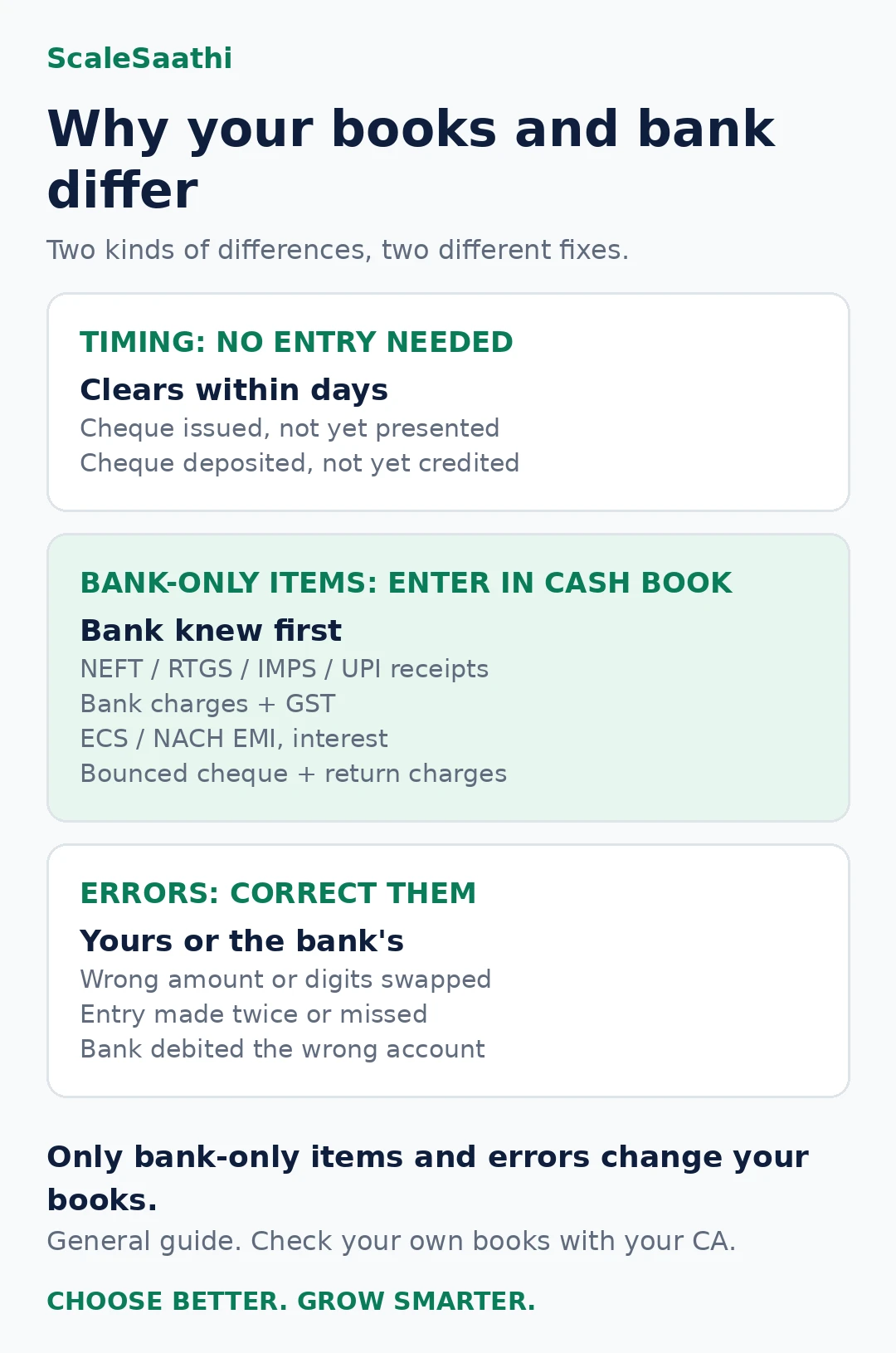
| Type | Examples | What you do |
|---|---|---|
| Timing difference | Cheque issued, not yet presented; cheque deposited, not yet credited | Nothing in the books. Show it in the BRS; it should clear in the next statement |
| Bank-only item | NEFT, RTGS, IMPS or UPI receipt you did not record; bank charges and GST; ECS/NACH EMI; interest credited or charged; bounced cheque and return charges | Enter it in your cash book, then it disappears from next month’s BRS |
| Error in your books | Wrong amount, digits swapped (5,400 as 4,500), entry missed or made twice | Pass a correcting entry |
| Error by the bank | Debit or credit that belongs to another account | Ask the bank in writing to reverse it; keep it in the BRS until they do |
Common Indian items
- UPI, NEFT, RTGS and IMPS: customers pay straight into your account. If you only learn of it from the statement, it is a bank-only receipt.
- ECS / NACH debits: loan EMIs, insurance premiums or SIPs taken by auto-debit, often missed in the cash book.
- Bank charges with GST: banks show GST on their service charges, often as separate lines. The GST rate schedule we checked lists financial and related services at 9% CGST, i.e. 18% with SGST (consolidated notification as amended to 1 April 2019); take the actual figures from your statement. Our example amounts are made-up.
- Bounced (returned) cheques: the bank reverses the deposit and usually debits a return charge too.
- Unpresented cheques: cheques you issued that have not been cashed yet.
- Deposits in transit: cheques deposited late in the month that the bank credits after the statement date.
- Stale cheques: since 1 April 2012, RBI tells banks not to pay cheques, drafts, pay orders or banker’s cheques presented more than three months after their date (RBI circular). If a cheque you issued is still unpresented after that, reverse it in your books and reissue if you still owe the money.
How to prepare a bank reconciliation statement, step by step
- Take the cash book bank column and the bank statement for the same period and closing date.
- Tick every entry that appears in both, by amount and cheque or UTR number.
- List the unticked statement entries: these are bank-only items. Enter them in the cash book and work out the corrected cash book balance.
- List the unticked cash book entries: usually unpresented cheques and deposits not yet credited.
- Start from the corrected cash book balance, add unpresented cheques, deduct deposits not credited.
- Compare the result with the statement’s closing balance. If it matches, sign and date the BRS. If not, use the checklist further down.
If you keep a cash book format with a bank column, this takes minutes each month. The corrected balance then flows into your ledger format and trial balance format. The reconciled year-end balance is also the closing bank figure in your cash flow statement.
Worked example: Sharma Traders, September 2026
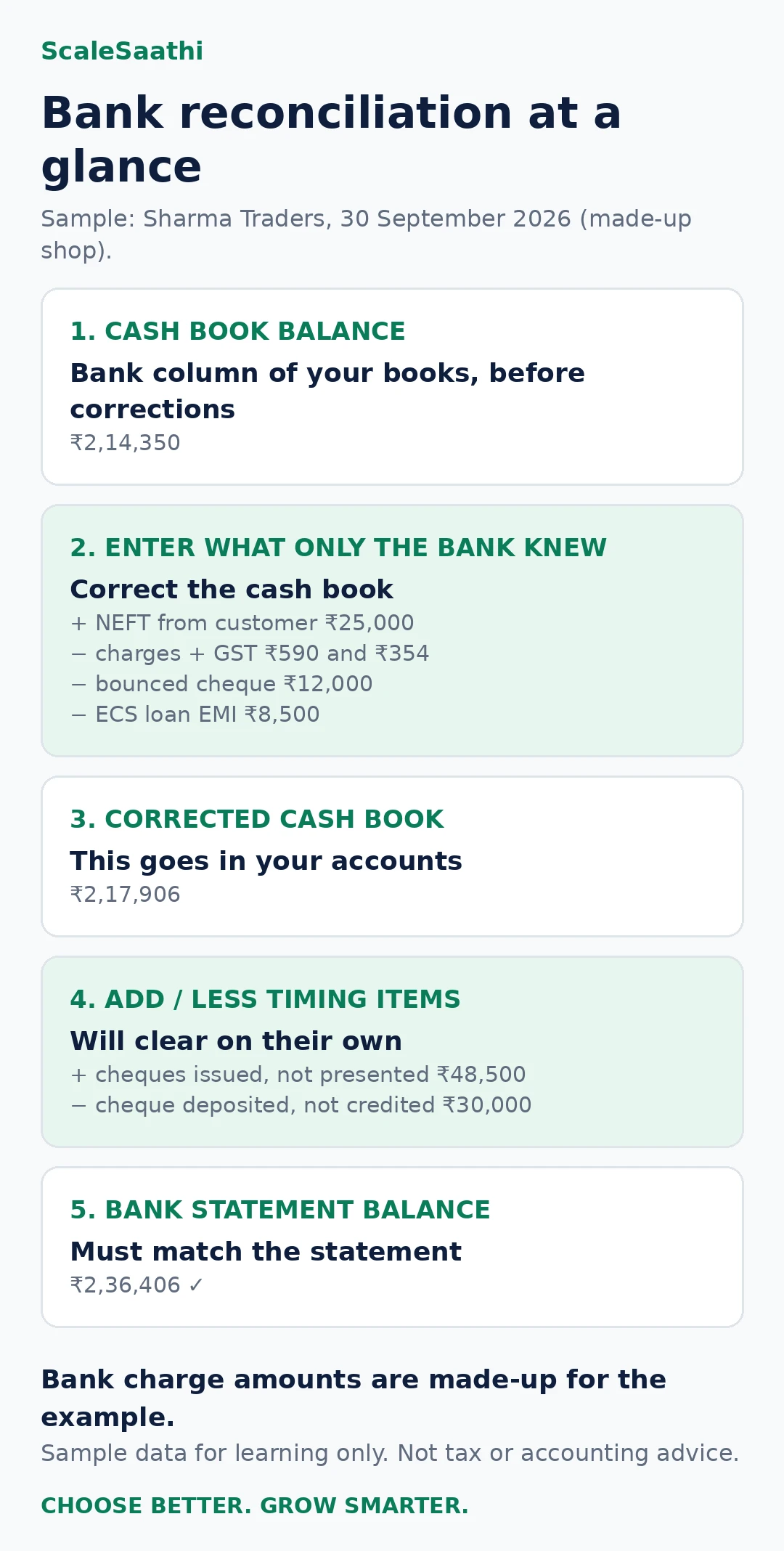
Sharma Traders is a made-up shop. This September 2026 example is separate from the FY 2025-26 Sharma Traders figures used in our other accounting guides. On 30 September 2026 the bank column of its cash book shows a debit balance of ₹2,14,350, but the bank statement shows ₹2,36,406. Bank charge amounts are made-up for illustration.
| Particulars | ₹ | ₹ |
|---|---|---|
| Balance as per cash book (Dr) | 2,14,350 | |
| Add: NEFT from Gupta Stores (customer) not yet entered | 25,000 | |
| Less: Bank charges ₹500 + GST ₹90 (made-up amounts) | (590) | |
| Less: Cheque from Verma Enterprises returned unpaid (bounced) | (12,000) | |
| Less: Cheque return charges ₹300 + GST ₹54 (made-up amounts) | (354) | |
| Less: ECS/NACH loan EMI debited, not yet entered | (8,500) | |
| Corrected cash book balance | 2,17,906 | |
| Add: Cheque no. 004512 to Mehta Suppliers, 27 Sep | 36,000 | |
| Add: Cheque no. 004513 to Rao Transport, 29 Sep | 12,500 | |
| Less: Cheque from Kapoor & Sons deposited 30 Sep, not yet credited | (30,000) | |
| Balance as per bank statement (Cr) | 2,36,406 |
Check: 2,14,350 + 25,000 − 590 − 12,000 − 354 − 8,500 = 2,17,906. Then 2,17,906 + 36,000 + 12,500 − 30,000 = 2,36,406, which matches the statement. Layout 2 gives the same result: 2,36,406 − 48,500 + 30,000 = 2,17,906.
Journal entries after reconciling
Only bank-only items and errors need entries. Timing items need none. For Sharma Traders:
| Item | Debit | Credit | ₹ |
|---|---|---|---|
| NEFT from Gupta Stores | Bank A/c Dr | Gupta Stores A/c Cr | 25,000 |
| Bank charges + GST | Bank charges A/c Dr 500; GST input A/c Dr 90 | Bank A/c Cr | 590 |
| Verma cheque bounced | Verma Enterprises A/c Dr | Bank A/c Cr | 12,000 |
| Cheque return charges + GST | Bank charges A/c Dr 300; GST input A/c Dr 54 | Bank A/c Cr | 354 |
| ECS/NACH loan EMI | Loan A/c Dr (principal); Interest on loan A/c Dr (interest) | Bank A/c Cr | 8,500 |
Split the EMI between principal and interest using the lender’s repayment schedule. Whether you can claim input tax credit on the GST in bank charges depends on your situation; ask your CA, and if you cannot claim it, book the full amount as bank charges.
Overdraft: BRS when the bank balance is negative
With an overdraft or cash credit account, the cash book shows a credit balance and the statement a debit balance. The adjustments flip: an unpresented cheque makes the bank overdraft smaller than your books, and a deposit not yet credited makes it bigger. Separate made-up numbers:
| Particulars | ₹ | ₹ |
|---|---|---|
| Overdraft as per cash book (Cr) | 45,000 | |
| Add: interest charged by bank, not in cash book (made-up) | 1,200 | |
| Corrected overdraft as per cash book | 46,200 | |
| Less: cheques issued, not yet presented | (15,000) | |
| Add: cheques deposited, not yet credited | 8,000 | |
| Overdraft as per bank statement (Dr) | 39,200 |
Check: 46,200 − 15,000 + 8,000 = 39,200.
Bounced cheques in the BRS
When a customer’s cheque bounces, the bank reverses the credit and usually charges a return fee. In your books: debit the customer again (they still owe you), credit bank, and record the return charge as a bank charge. In the BRS, both appear as amounts debited by the bank that are not yet in the cash book, until you enter them. If the sale itself is cancelled or reduced instead, record it with a credit note; see our credit note format guide.
A bounced cheque can also have legal consequences for the person who issued it under the Negotiable Instruments Act, 1881, with strict time limits. If a customer’s cheque bounces and they do not pay, speak to a lawyer early.
Bank reconciliation in Tally and other software
Tally Solutions’ help page for TallyPrime says you can import bank statements in Excel or CSV format from over 145 banks for automatic linking and reconciliation, with auto and manual bank reconciliation options (TallyPrime help). You still need to review unmatched lines yourself. For costs see our TallyPrime price guide, and for other options our guide to accounting software for small businesses. Even with software, the Excel template is useful to understand what the reconciliation is doing.
Common mistakes and a monthly checklist
Why your BRS doesn’t tally
- Statement and cash book dates do not match.
- Opening balances did not agree last month (fix last month first).
- A sign is the wrong way round: added something that should be deducted.
- A difference divisible by 9 often means swapped digits (e.g. 5,400 typed as 4,500).
- A difference equal to twice an amount often means a receipt posted as a payment, or the reverse.
- An entry was made twice in the cash book, or a bank line was counted twice.
- GST on a bank charge was left out because it sits on a separate statement line.
- An overdraft balance was treated as a deposit balance.
Monthly checklist
- Download the statement for the full month as soon as it is ready.
- Match every line; enter bank-only items in the cash book.
- Prepare the BRS and file it with the statement.
- Follow up deposits not credited within a few working days.
- Review cheques unpresented for close to three months; reverse stale ones.
- Ask the bank in writing to fix any bank error.
- Keep the BRS with your books; companies must keep books of account for at least eight financial years under section 128 of the Companies Act, 2013 (text).
Frequently asked questions
What is a bank reconciliation statement?
It is a statement that explains the difference between the bank balance in your cash book and the balance on your bank statement on the same date, item by item, so that one balance can be worked to the other.
Is a BRS part of the books of account?
No. It is a working statement prepared to check the books. Only the bank-only items and errors it uncovers are entered in the cash book.
How often should I prepare a BRS?
At least monthly, as soon as you have the statement. Businesses with many UPI or card receipts often reconcile weekly.
What is the difference between an unpresented cheque and an uncleared cheque?
An unpresented cheque is one you issued that the payee has not deposited yet. An uncleared cheque, or deposit not yet credited, is one you deposited that the bank has not credited yet.
Do I need a journal entry for unpresented cheques?
No. They are timing differences. They clear on their own when the cheque is cashed. Only bank-only items such as charges, interest, direct receipts and bounced cheques need entries.
What happens to a cheque that is never presented?
After three months from the cheque date, banks should not pay it under RBI instructions. Reverse it in your cash book and reissue it if you still owe the money.
How is an overdraft shown in a BRS?
Start from the credit (overdraft) balance in your cash book. Deduct unpresented cheques and add deposits not yet credited to reach the overdraft as per the bank statement, the reverse of a normal balance.
Where do bank charges and GST go in the BRS?
They are amounts debited by the bank that you have not entered yet, so they are deducted from the cash book balance. Then enter them in the cash book.
Related guides and sources
| Guide | Use it when |
|---|---|
| Cash book format | You want to record daily cash and bank entries |
| Ledger format | You are posting the corrected entries to accounts |
| Trial balance format | Your bank balance is reconciled and you are checking the books |
| Balance sheet format | You need the bank balance in the final accounts |
| Credit note format | A sale is cancelled or reduced |
| GST calculator | You need to split GST from a bank charge |
| Accounting software for small businesses | You want reconciliation done in software |
| Best GST billing software | You are choosing billing software |
| TallyPrime price | You are considering TallyPrime |
Sources and checked dates
- RBI circular on validity period of cheques (4 November 2011). Checked 28 Oct 2026.
- GST Council: Notification 11/2017-Central Tax (Rate), as amended to 1 April 2019. Checked 28 Oct 2026.
- ICSI e-book: Companies Act, 2013, section 128 (books of account). Checked 28 Oct 2026.
- Tally Solutions help: bank reconciliation in TallyPrime. Checked 28 Oct 2026.
How we researched this guide
ScaleSaathi publishes practical guides for Indian small businesses under LendLink Tech Private Limited. For this guide we read the RBI circular on cheque validity, the GST rate notification, section 128 of the Companies Act and Tally’s bank reconciliation help page on 28 October 2026. We built the Excel sheets ourselves and recalculated every total; the example figures, including bank charges, are made-up. Where a rule depends on your situation, we say so and suggest checking with your CA.