
Last updated: 28 Oct 2026
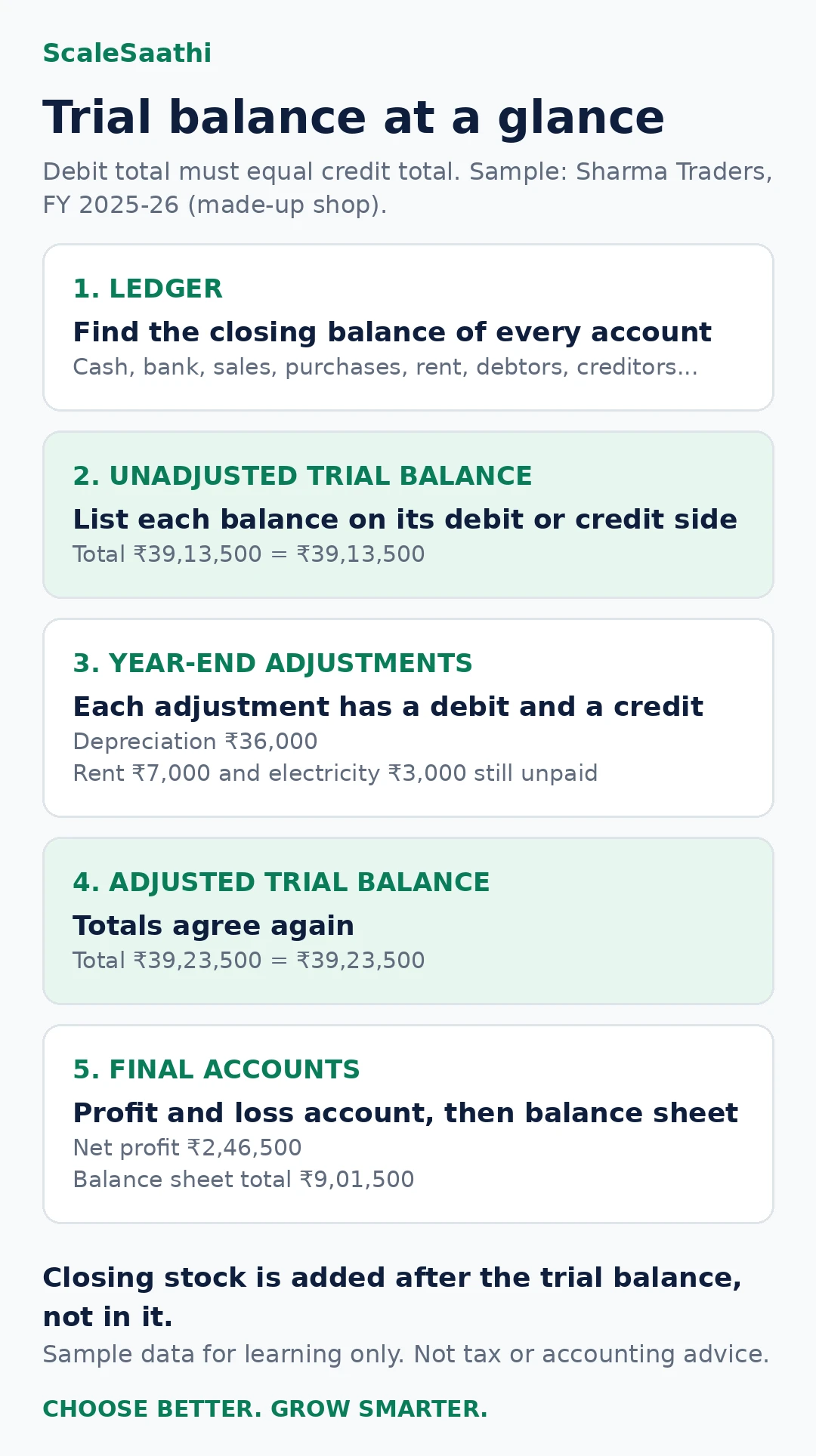
It is 31 March, the ledgers are posted, and the two columns of the trial balance refuse to agree. Or they agree on the first try and everyone relaxes too early. Both situations are worth understanding. A trial balance is simply a list of every ledger account’s closing balance on one date, debit balances in one column and credit balances in the other. Since every entry was posted as a debit and an equal credit, the two totals must be the same, and the trial balance format below is built around that one test. When the totals agree, your postings are arithmetically in balance and you can move on to the profit and loss account format and the balance sheet format. When they don’t, something went to one side only, was added wrongly or landed on the wrong side. What agreeing totals cannot tell you is whether the books are right: a bill that was never entered, or an entry sitting in the wrong account, leaves both columns untouched. Below are free Excel, Word and PDF formats, a full worked example and the checklist an accountant actually runs when the difference won’t go away.
When the two columns won’t agree
- Re-add both columns first. Most differences are adding mistakes, so rule out the cheapest explanation before anything else.
- Halve the difference and look for a balance of exactly that amount. A balance on the wrong side comes off one column and lands on the other, so the gap is double.
- Divide the difference by 9. If it divides exactly, look for swapped digits (₹5,400 written as ₹4,500) or a misplaced zero.
- Never adjust a figure to force the totals. If the deadline comes first, park the difference in a suspense account, note why, and clear it before you prepare the final accounts.
- Even when it tallies, don’t relax: a bill that was never entered, or an entry sitting in the wrong account, leaves both columns untouched.
| Column | What goes in it |
|---|---|
| S.No. | Running number |
| Name of account | Each ledger account: cash, bank, sales, purchases, rent, debtors, creditors, capital… |
| L.F. (ledger folio) | Page or code of the account in your ledger, so you can trace it |
| Debit (₹) | Debit balances: assets, expenses, losses, drawings, GST input tax credit |
| Credit (₹) | Credit balances: capital, income, gains, loans, creditors, GST output tax |
| Total | Debit total = credit total |
Educational information only. This page is general guidance for Indian small businesses. It is not tax, accounting or legal advice and is not a substitute for your CA or current official sources. See our disclaimer.
Download the trial balance format (Excel, Word, PDF)
Free, no sign-up. These are educational templates, not forms prescribed by the government or the ICAI, so adapt the account names to your own ledger rather than forcing your ledger to fit the sheet.
Excel: 5 working sheets
Blank trial balance for a proprietor or shop; trial balance with adjustments (unadjusted, adjustment debit and credit, adjusted) that works out gross profit, net profit and both sides of the balance sheet; partnership or LLP; company, grouped under Schedule III headings; and the Sharma Traders example. Check cells say OK when totals agree. Formula cells are locked without a password. Download Excel (.xlsx)
Word: blank and filled
A blank trial balance, a blank trial balance with adjustment columns, and the filled Sharma Traders example. Download Word (.docx)
PDF: printable
The same pages to print and fill by hand, handy for a first trial balance or for teaching a new accounts assistant. Download PDF (.pdf)
Using Google Sheets? Upload the Excel file to Google Drive and open it with Google Sheets; the formulas keep working. Yellow cells are for your figures; blue cells calculate.
Which side does each account go on?
Most wrong-side mistakes come from people memorising lists instead of the logic. The logic is short: what the business owns or spends carries a debit balance; what it owes, earns or received from the owner carries a credit balance. If you can say which of those an account is, you know its side. The table covers the lines that confuse Indian small businesses most often.
| Account | Usual side | Why |
|---|---|---|
| Cash in hand, bank (current account) | Debit | Assets. A bank overdraft or cash credit is a credit balance. |
| Sundry debtors (customers who owe you) | Debit | Assets: money to come in |
| Sundry creditors (suppliers you owe) | Credit | Liabilities: money to go out |
| Opening stock, purchases, wages, rent, electricity, interest, depreciation | Debit | Expenses and costs for the year |
| Sales, commission received, interest received | Credit | Income |
| Capital | Credit | The owner’s money in the business is owed back to the owner |
| Drawings | Debit | Money or goods the owner took out; reduces capital, not an expense |
| GST input tax credit (ITC) | Debit | Recoverable from the government, so an asset |
| GST output tax (GST collected on sales) | Credit | Owed to the government |
| Security deposit paid (shop rent, electricity) | Debit | Asset: you get it back |
| Bank term loan, loan from relatives | Credit | Liability |
| Furniture, computer, vehicles | Debit | Fixed assets (shown after depreciation) |
| Outstanding expenses (bills not yet paid) | Credit | Liability |
| Prepaid expenses | Debit | Asset: paid in advance |
| Returns inward (sales returns) | Debit | Reduces sales |
| Returns outward (purchase returns) | Credit | Reduces purchases |
Closing stock is usually not in the trial balance. This surprises students every year. The reason is that closing stock is not a ledger balance during the year; it is a figure you get by counting the shelves on the last day, and it enters at the final accounts stage. Tally’s own help page makes the same point: closing stock is not shown in its trial balance. The exception is books that already record closing stock (for example, through adjusted purchases). Then it appears inside the trial balance and opening stock does not, so make sure it is not counted twice.
Layouts: balance method, totals method and two-column
Balance method (use this)
Each account appears once, with only its closing balance on the debit or credit side. This is the one to use: final accounts are prepared from it, all our templates follow it, and accounting software produces it by default.
Totals method
Each account shows the total of its debit side and the total of its credit side. Both columns get large, but it can help spot a missing posting because the totals match the journal and cash book totals. If the totals don’t match, recheck each entry using our journal entry format guide; its Excel template checks that debits equal credits for every entry.
Combined (totals and balances)
Four columns: debit total, credit total, debit balance, credit balance. Mostly seen in textbooks and audits. Useful while learning, because you can see how each balance comes out of its totals.
Unadjusted, adjusted and post-closing
Unadjusted is straight from the ledger. Adjusted includes year-end entries such as depreciation and unpaid bills. Post-closing is taken after income and expense accounts are closed to profit and loss, so only assets, liabilities and capital remain.
How to prepare a trial balance, step by step
- Finish the books for the period. Post every bill, receipt and payment from your cash book format, sales and purchase records into the ledger format. A trial balance only checks what has been posted, so a half-posted month gives you a total that means nothing.
- Balance each ledger account. Add both sides; the difference is the closing balance. Write down whether it is a debit or credit balance as you go, because guessing the side later is where many differences start.
- List every account with a balance, including the small ones. Put cash and bank first, then the rest in ledger order. Following the ledger’s own order is the easiest way to be sure no account was skipped.
- Put each balance in one column only. An account has one closing balance, so it can only sit on one side. Use the side table above if unsure.
- Add both columns. If they agree, the trial balance “tallies”. Add each column twice; a casting mistake in the trial balance itself is more common than people admit.
- If they do not agree, use the checklist further down before you do anything else. Do not adjust a figure to force the totals; that just buries the real error.
- Pass year-end adjustments (depreciation, unpaid bills, prepaid amounts, bad debts) as journal entries and prepare the adjusted trial balance. These are the items the year’s day-to-day entries never recorded, and without them the profit is wrong even when the totals agree.
- Prepare the final accounts from the adjusted figures: trading and profit and loss account first, then the balance sheet. The order matters because net profit has to be known before it can be added to capital.
Many shops prepare a trial balance every month, not just in March, and it is a good habit. A difference found in May means searching one month of bills while everyone still remembers them; the same difference found in March means searching twelve. A monthly check also lines up with your monthly GST work.
Worked example: Sharma Traders, FY 2025-26
Sharma Traders is a made-up kirana and household-goods shop run by a sole proprietor, and its numbers are illustrative only. It uses the same figures as our balance sheet format and profit and loss account format guides, so you can follow one business from ledger to final accounts. The adjusted trial balance below is exactly the one those guides start from.
Unadjusted trial balance as on 31 March 2026
| Name of account | Debit (₹) | Credit (₹) |
|---|---|---|
| Capital account (opening, 1 Apr 2025) | 4,50,000 | |
| Drawings | 1,80,000 | |
| Sales | 30,70,000 | |
| Opening stock (1 Apr 2025) | 3,00,000 | |
| Purchases | 24,60,000 | |
| Wages to shop helper | 1,44,000 | |
| Shop rent | 1,13,000 | |
| Electricity | 33,000 | |
| Interest on bank loan | 26,000 | |
| Other expenses | 41,500 | |
| Furniture and fittings | 1,20,000 | |
| Computer and printer | 60,000 | |
| Sundry debtors | 1,85,000 | |
| Security deposit (shop rent) | 50,000 | |
| Bank (current account) | 1,60,800 | |
| Cash in hand | 21,700 | |
| GST input tax credit (ITC) | 18,500 | |
| Bank term loan | 2,10,000 | |
| Sundry creditors | 1,52,000 | |
| GST output tax | 31,500 | |
| Total | 39,13,500 | 39,13,500 |
The totals agree, so the postings are in balance. This is exactly the point where it is tempting to stop, and it would be a mistake. The trial balance is not yet ready for final accounts: no depreciation has been charged for the year, and March rent of ₹7,000 and the March electricity bill of ₹3,000 have not been paid or recorded. Nothing in the totals warns you about either.
Year-end adjustments
| Adjustment | Journal entry | Effect on the trial balance |
|---|---|---|
| Depreciation for the year ₹36,000 (furniture ₹12,000, computer ₹24,000) | Depreciation Dr 36,000; Furniture Cr 12,000; Computer Cr 24,000 | New expense line; the two assets fall to 1,08,000 and 36,000 |
| Rent ₹7,000 and electricity ₹3,000 due but unpaid | Rent Dr 7,000; Electricity Dr 3,000; Outstanding expenses Cr 10,000 | Rent 1,20,000, electricity 36,000; new liability line 10,000 |
| Total | Debits 46,000 = credits 46,000 | Both totals go up by 10,000 (the depreciation simply moves 36,000 from assets to expense) |
The depreciation amounts are sample figures for this example. Depreciation spreads an asset’s cost over its useful life, but the right method and rate for your assets depend on the accounting rules that apply to you and on income tax rules, and the two are different. Ask your CA.
Adjusted trial balance as on 31 March 2026
| Name of account | Debit (₹) | Credit (₹) |
|---|---|---|
| Capital account (opening, 1 Apr 2025) | 4,50,000 | |
| Drawings | 1,80,000 | |
| Sales | 30,70,000 | |
| Opening stock (1 Apr 2025) | 3,00,000 | |
| Purchases | 24,60,000 | |
| Wages to shop helper | 1,44,000 | |
| Shop rent | 1,20,000 | |
| Electricity | 36,000 | |
| Interest on bank loan | 26,000 | |
| Depreciation for the year | 36,000 | |
| Other expenses | 41,500 | |
| Furniture and fittings (cost 1,20,000 less depreciation 12,000) | 1,08,000 | |
| Computer and printer (cost 60,000 less depreciation 24,000) | 36,000 | |
| Sundry debtors | 1,85,000 | |
| Security deposit (shop rent) | 50,000 | |
| Bank (current account) | 1,60,800 | |
| Cash in hand | 21,700 | |
| GST input tax credit (ITC) | 18,500 | |
| Bank term loan | 2,10,000 | |
| Sundry creditors | 1,52,000 | |
| GST output tax | 31,500 | |
| Outstanding expenses (rent 7,000 + electricity 3,000) | 10,000 | |
| Total | 39,23,500 | 39,23,500 |
Closing stock of ₹3,40,000 is outside the trial balance; it was counted on 31 March 2026 and valued at the lower of cost and net realisable value (the price it can be sold for, less selling costs), as the ICAI accounting standard on inventories requires.
From the adjusted trial balance to the final accounts
| Step | Working | Result |
|---|---|---|
| Cost of goods sold | Opening stock 3,00,000 + purchases 24,60,000 − closing stock 3,40,000 | 24,20,000 |
| Gross profit | Sales 30,70,000 − cost of goods sold 24,20,000 | 6,50,000 |
| Expenses | Wages 1,44,000 + rent 1,20,000 + electricity 36,000 + interest 26,000 + depreciation 36,000 + other 41,500 | 4,03,500 |
| Net profit | 6,50,000 − 4,03,500 | 2,46,500 |
| Closing capital | Opening capital 4,50,000 + net profit 2,46,500 − drawings 1,80,000 | 5,16,500 |
| Balance sheet total | Capital 5,16,500 + term loan 2,10,000 + creditors 1,52,000 + GST payable 13,000 (31,500 − 18,500) + outstanding expenses 10,000 | 9,01,500 |
The assets side agrees: furniture 1,08,000 + computer 36,000 + security deposit 50,000 + closing stock 3,40,000 + debtors 1,85,000 + bank 1,60,800 + cash 21,700 = ₹9,01,500. The full statements are in the profit and loss account format and balance sheet format guides. In the Excel file, sheet 5 does all of this with formulas and shows OK in each check cell.
Variation: two more common adjustments
These are separate numbers, not part of Sharma Traders. Prepaid insurance: a shop pays ₹12,000 on 1 January for a year of cover; on 31 March, ₹9,000 relates to next year. Entry: Prepaid insurance Dr 9,000; Insurance Cr 9,000. Bad debt: a customer who owes ₹5,000 has shut down and will not pay. Entry: Bad debts Dr 5,000; Sundry debtors Cr 5,000. Each entry has equal debits and credits, so the adjusted trial balance still agrees.
What a trial balance does not catch
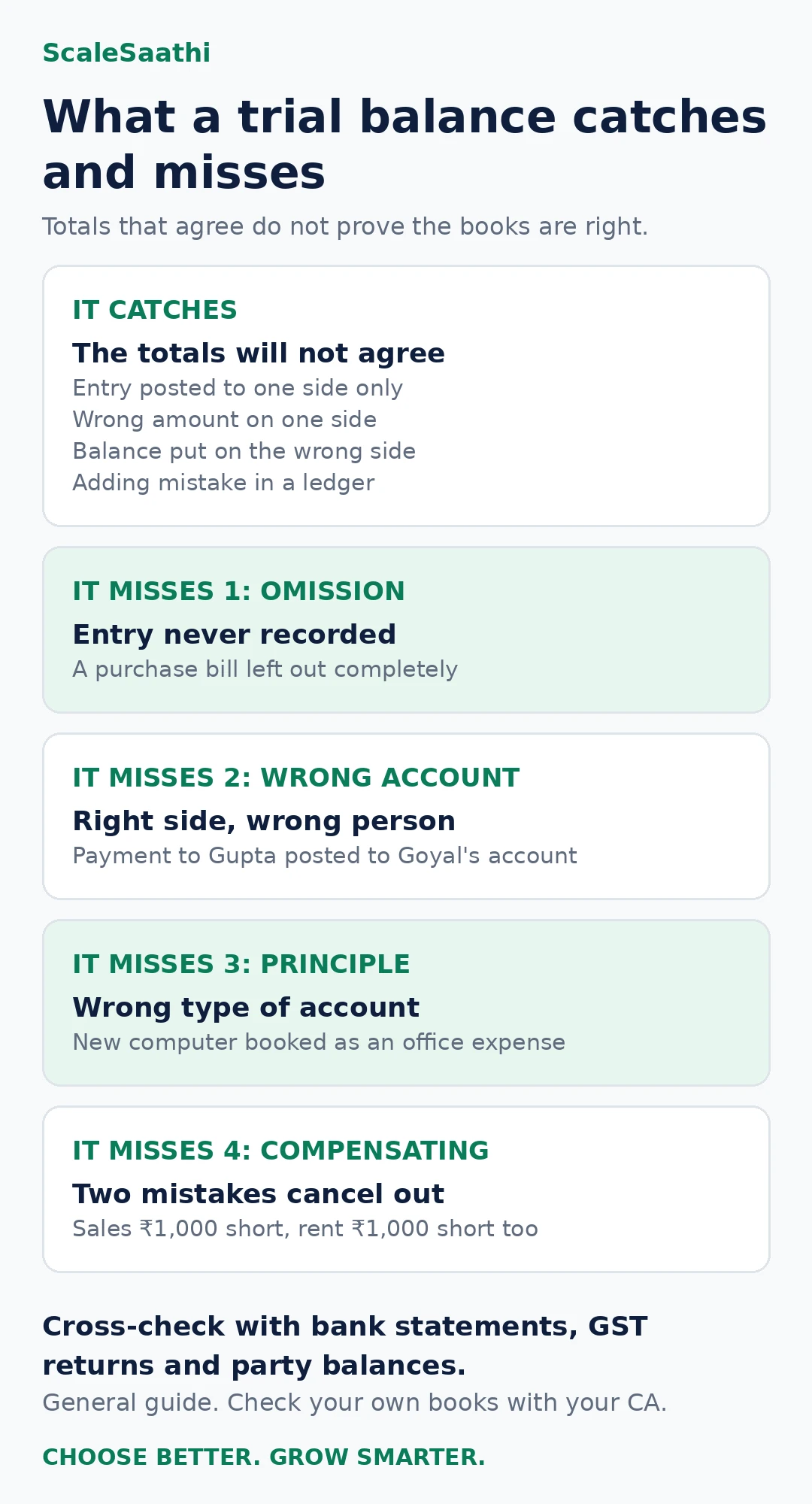
A trial balance that tallies proves one thing: debits equal credits. It says nothing about whether the right amount went into the right account, or whether everything was entered at all. That is why an accountant who sees a tallied trial balance still reconciles the bank and checks the party balances. These are the mistakes that leave the totals equal and slip straight through:
| Error | What happened | Example |
|---|---|---|
| Omission | An entry was never recorded at all | A purchase bill of ₹8,000 left in a drawer |
| Wrong account (commission) | Right amount, right side, wrong person’s account | Payment to Gupta posted to Goyal’s account |
| Error of principle | Recorded in the wrong type of account | A new computer of ₹60,000 booked as an office expense |
| Compensating errors | Two mistakes of the same amount cancel out | Sales added ₹1,000 short and rent added ₹1,000 short |
| Same wrong amount on both sides | The original entry was wrong | A bill of ₹4,500 entered as ₹5,400 on both sides |
Errors that do show up as a difference are the one-sided kind: posting to one side only, a different amount on each side, putting a balance on the wrong side, adding mistakes in a ledger, and leaving an account out of the list. Each of them disturbs only one column, which is exactly what the trial balance is designed to notice.
Trial balance not tallying? A checklist
- Re-add both columns. Most differences are adding mistakes, so rule out the cheapest explanation first.
- Halve the difference and look for a balance of exactly that amount. A balance on the wrong side is removed from one column and added to the other, so the difference is double the amount.
- Divide the difference by 9. If it divides exactly, look for swapped digits (₹5,400 written as ₹4,500) or a misplaced zero.
- Look for the exact difference as a balance that was left out or an entry posted to one side only.
- Check opening balances carried from last year, especially capital, stock, debtors and creditors.
- Check carry-forwards from one ledger page to the next.
- Compare cash and bank with the cash book and the bank statement.
- Compare debtors and creditors totals with the party-wise lists.
- Check GST accounts against the tax on your sales and purchase registers.
- Re-post a sample of the month’s journal entries if nothing else works. It is slow, which is why it comes last.
The suspense account
Sometimes the deadline arrives before the error is found. Then the difference can go into a temporary account called the suspense account, so that the totals agree and work can continue. Example: a cash sale of ₹500 was entered in the cash book but never posted to the sales account. Credits are ₹500 short, so you show Suspense account ₹500 on the credit side. When you find the mistake, pass the correcting entry Suspense Dr 500; Sales Cr 500, and the suspense account closes at zero.
Treat suspense as a parking place, not a home. Note every amount you put there and why, and clear it before you prepare the final accounts. A suspense balance left in the balance sheet tells a banker or auditor the books were never fully checked.
Partnership, LLP and company trial balances
The method does not change with the type of business. What changes is the owner’s side of the list: the account names for capital, and where profit sharing is worked out.
- Partnership firm or LLP: each partner has a capital account (credit) and often a current account, which can be a debit or credit balance. Each partner’s drawings are listed separately on the debit side. Interest on capital, partner salary and profit shares are worked out later in the profit and loss appropriation account, so they are not in the trial balance (sheet 3 of the Excel file).
- Company: share capital and reserves and surplus replace the owner’s capital, and there are no drawings. Grouping each ledger under the Schedule III headings (share capital, long-term borrowings, trade payables, property, plant and equipment, inventories, trade receivables, revenue from operations, employee benefits expense, finance costs and so on) makes the statements quicker to prepare (sheet 4).
- Service business with no stock: no opening or closing stock and no purchases; fees received is the main credit line.
Getting a trial balance from Tally, Zoho Books or Vyapar
If you keep books in software, you do not type a trial balance; you open a report. The arithmetic is done for you, so the job shifts from adding columns to reading what the report shows. The menu paths below are from each company’s own help pages, checked on 28 Oct 2026; menus can change between versions.
| Software | Where the report is | Worth knowing |
|---|---|---|
| TallyPrime | Gateway of Tally, then Display More Reports, then Trial Balance (or press Alt+G and search) | Shows group-wise or ledger-wise balances; closing stock is not shown in the trial balance |
| Zoho Books (India) | Reports, then Accountant, then Trial Balance | Can show opening and closing balances; year-end entries can be passed as adjustment journals |
| Vyapar | Reports, then Transaction Reports, then Trial Balance Report | Option to show a working trial balance; can be exported to Excel or PDF |
Software keeps debits and credits equal for every entry, but it cannot know you picked the wrong ledger. So read the report before you trust it: look for suspense or “difference in opening balances” lines, negative cash, and debtors or creditors on the wrong side. Choosing software? See accounting software for small businesses and Tally vs Zoho Books.
Common mistakes to avoid
- Putting drawings on the credit side or treating them as an expense. Drawings are a debit that reduces capital.
- Including GST in sales or purchases when you are a regular GST dealer. Keep GST output tax and input tax credit as separate accounts.
- Adding closing stock to an unadjusted trial balance that already has opening stock and purchases. It comes in at the final accounts stage.
- Leaving out opening stock, which is a debit balance for the year.
- Swapping debtors and creditors: debtors are debit, creditors are credit.
- Booking a computer or furniture purchase as an expense instead of an asset.
- Showing the whole loan instalment as an expense. Only interest is an expense; the principal reduces the loan.
- Forgetting unpaid March bills, so expenses are understated.
- Leaving a balance in the suspense account at the year end.
- Using a bank overdraft as a debit. An overdraft is money owed to the bank: a credit balance.
Does the law require a trial balance?
People often assume the trial balance is a statutory form. It is not: no law asks you to file one. The laws we checked ask you to keep proper books and accounts; none of them sets out a trial balance format or asks you to file one. The trial balance is the working check accountants use to prepare the final accounts from those books. What the law does require:
- Companies: section 128 of the Companies Act, 2013 requires books of account on an accrual basis under the double-entry system, which may be kept electronically, and kept for at least eight financial years (text).
- GST-registered businesses: section 35(1) of the CGST Act requires true and correct accounts of supplies, stock, input tax credit and output tax (text).
- Income tax: under section 62 of the Income-tax Act, 2025, in force from 1 April 2026, a business must keep books if its income is above ₹1,20,000 or its turnover above ₹10 lakh in any of the three preceding years (₹2,50,000 and ₹25 lakh for individuals and HUFs). FY 2025-26 still falls under the 1961 Act, so check the limits for your year with your CA (Act).
In practice, though, a tax auditor, a bank or a CA preparing your return will often ask for the trial balance first, because it is the quickest way to see the whole set of books on one page. Keep one with your year-end papers even though no form asks for it.
Frequently asked questions
What is a trial balance in simple words?
It is a list of all ledger account balances on one date, with debit balances in one column and credit balances in the other. If the two totals are equal, the books are arithmetically in balance and you can move on to the final accounts.
What is the difference between a trial balance and a balance sheet?
A trial balance lists every account, including income and expenses, and is an internal check. A balance sheet shows only assets, liabilities and capital on one date, after profit has been worked out and added to capital. The trial balance comes first.
Is closing stock shown in the trial balance?
Usually not. Opening stock and purchases are in the trial balance; closing stock is counted at the year end and added in the final accounts. If your books already record closing stock through an adjustment, it appears in the trial balance and opening stock does not.
My trial balance tallies. Can the accounts still be wrong?
Yes. An entry that was never made, an entry in the wrong person’s account, an error of principle such as booking an asset as an expense, and compensating errors all leave the totals equal. That is why the trial balance is followed by checks against bank statements, GST returns and party balances.
What is a suspense account?
A temporary account that holds an unexplained difference so the trial balance agrees while you look for the error. Once you find the mistake, a correcting entry clears it. It should be back to zero before final accounts are prepared.
On which side do drawings go?
On the debit side. Drawings reduce the owner’s capital; they are not an expense and do not go in the profit and loss account.
Where do GST input tax credit and GST output tax go?
Input tax credit is a debit balance, because it is recoverable. Output tax collected on sales is a credit balance, because it is owed to the government. In the balance sheet they are often set off to show one net figure.
What is an adjusted trial balance?
It is the trial balance after year-end adjustments such as depreciation, unpaid expenses, prepaid expenses and bad debts. Final accounts are prepared from the adjusted trial balance.
How often should I prepare a trial balance?
At least once a year before final accounts, but monthly is better. A monthly trial balance catches posting mistakes while the bills are still fresh, and it fits in with monthly GST work.
Do I need a trial balance if I use presumptive tax under section 44AD?
The ITR-4 form does not ask for one. But you still need basic records of turnover, debtors, creditors, stock and cash, and a trial balance is an easy way to check them. If you declare profit below the presumptive rate, full books may be needed.
Related guides
| Guide | Use it when |
|---|---|
| Ledger format | You are posting entries and balancing accounts before the trial balance |
| Cash book format | You want to record daily cash and bank entries |
| Profit and loss account format | Your trial balance agrees and you need the profit |
| Balance sheet format | You have the net profit and need the balance sheet |
| Stock register format | You need to back up your closing stock figure |
| GST invoice format | You issue bills to customers |
| Accounting software for small businesses | You want the trial balance generated automatically |
| Tally vs Zoho Books | You are choosing between the two |
Sources and checked dates
- ICSI e-book: Companies Act, 2013, section 128 (books of account). Checked 28 Oct 2026.
- CBIC: CGST Act, 2017, section 35 (accounts and other records). Checked 28 Oct 2026.
- Income-tax Act, 2025 as amended by Finance Act 2026 (section 62). Checked 28 Oct 2026.
- ICAI: AS 2 Valuation of Inventories. Checked 28 Oct 2026.
- ICAI: Guidance Note on Division I, Schedule III to the Companies Act, 2013. Checked 28 Oct 2026.
- Tally Solutions help: Trial Balance in TallyPrime. Checked 28 Oct 2026.
- Zoho Books India help: trial balance report. Checked 28 Oct 2026.
- Vyapar guide: transaction reports, including trial balance. Checked 28 Oct 2026.
How we researched this guide
ScaleSaathi publishes practical guides for Indian small businesses under LendLink Tech Private Limited. For this guide we read the Companies Act, CGST Act and Income-tax Act sources above, the ICAI material on inventories and Schedule III, and the trial balance help pages of Tally, Zoho Books and Vyapar on 28 October 2026. We built the Excel sheets ourselves, recalculated every total, and used the same Sharma Traders figures as our balance sheet and profit and loss guides so all three pages agree. Where a rule depends on your year or situation, we say so and suggest checking with your CA.