
Last updated: 28 Oct 2026
Short answer: a balance sheet lists what a business owns (assets) and where the money for it came from (the owner’s capital and outside liabilities) on one date, usually 31 March. Both sides must be equal: Assets = Capital + Liabilities. For a company the same idea is written as Assets = Equity + Liabilities. Below you get free Excel, Word and PDF formats for a proprietor, a partnership or LLP, and a private limited company, plus a worked example that goes from trial balance to a balance sheet that tallies.
Educational information only. This page is general guidance for Indian small businesses, traders, shopkeepers and students. It is not tax, legal or financial advice and it is not a substitute for a chartered accountant or current official sources. Rules and forms change; verify before you file, pay or sign.
Download the balance sheet format (Excel, Word, PDF)
No sign-up, phone number or WhatsApp needed. All three files are free.
Excel: totals that add themselves
Five sheets: proprietor (vertical), proprietor (T-format), partnership/LLP with capital and current accounts, company in Schedule III layout, and the Sharma Traders worked example from trial balance to balance sheet. Totals and a “Both sides match” check cell work automatically. Formula cells are locked (no password) so you do not overwrite them by mistake; the How to use sheet explains how to unlock them. Download Excel (.xlsx)
Word: editable layouts
The filled Sharma Traders balance sheet and blank T-format, partnership/LLP and Schedule III layouts. Word does not add up totals; fill them by hand or from the Excel file. Download Word (.docx)
PDF: print and practise
The same layouts as the Word file in a fixed format, for printing or for students to practise by hand. Download PDF (.pdf)
Using Google Sheets? Upload the .xlsx file to Google Drive and open it with Google Sheets. The formulas and the match check keep working. Locked cells become a warning instead of a hard lock there.
These are educational templates, not prescribed government forms. Sharma Traders and all its figures are sample data for a made-up business.
What a balance sheet is (and what it is not)
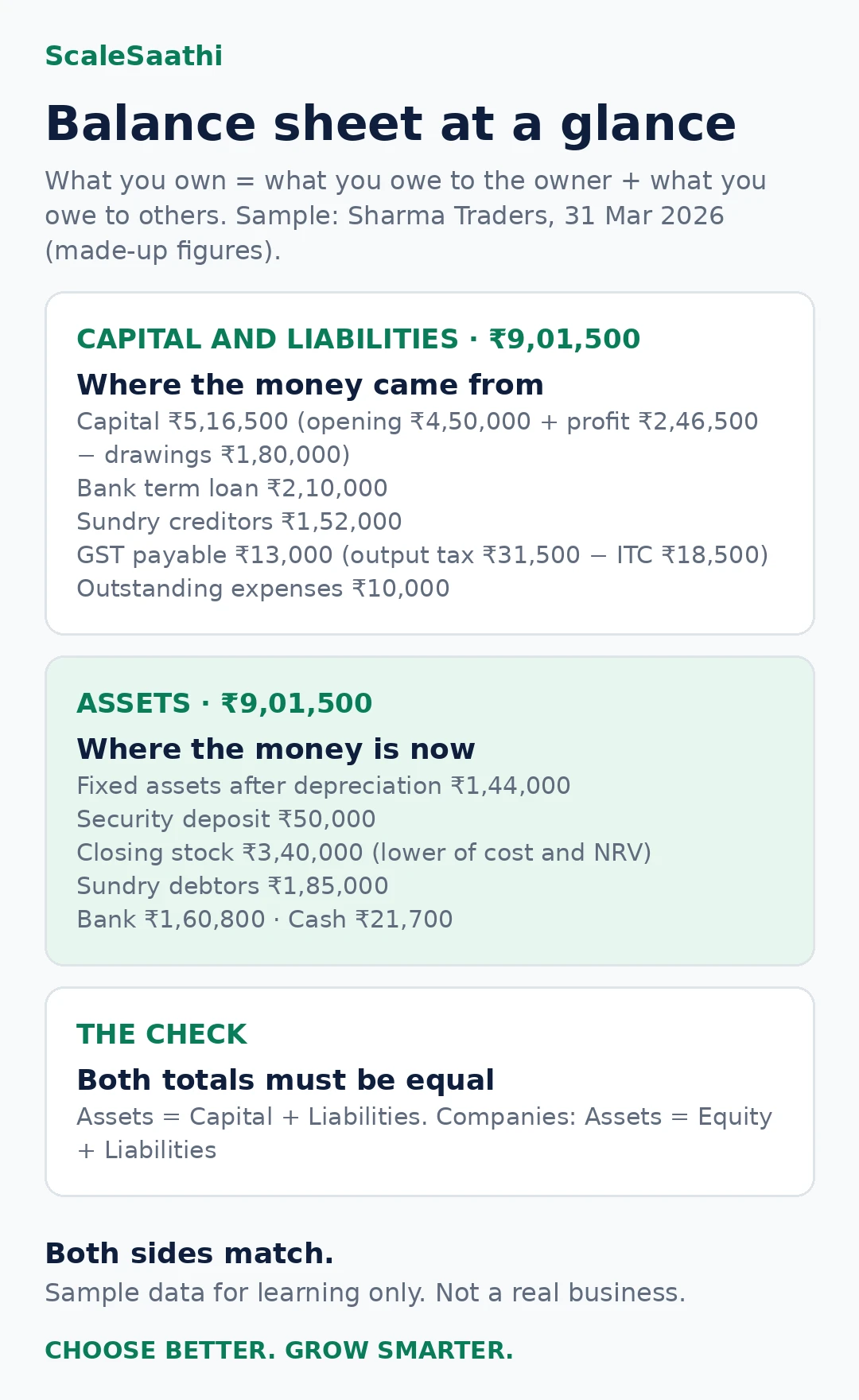
A balance sheet is a snapshot. It shows the position of the business at the close of one day, such as 31 March 2026. It does not show how much you sold or earned during the year; that is the job of the trading and profit and loss account. The two are linked: the year’s net profit is added to the owner’s capital on the balance sheet. To see how cash moved between two balance sheet dates, use our cash flow statement format.
Think of it as two questions with the same answer:
- Where is the money now? Assets: shop furniture, computer, stock, money customers owe you (debtors), bank and cash.
- Where did that money come from? The owner’s capital (including profit kept in the business) and liabilities: loans, money owed to suppliers (creditors), GST payable, unpaid bills.
Because every rupee in the business came from somewhere, the two totals must be equal. If they are not, there is a mistake somewhere. The section on why it does not tally below lists where to look.
The three versions you will need
The idea is the same for every business. The capital side changes with the type of business.
| Business type | How the owner’s side looks | Format used |
|---|---|---|
| Proprietor (one owner) | One capital account: opening capital + profit − drawings | T-format (horizontal) or vertical; both are fine for your own books |
| Partnership firm or LLP | Each partner’s capital account, often with a separate current account for profit share, interest, salary and drawings | T-format or vertical; LLPs file accounts with the Registrar on Form 8 |
| Private limited company | Share capital and reserves and surplus (“shareholders’ funds”) | Vertical, in the Schedule III layout under the Companies Act, 2013 |
1. Proprietor: T-format and vertical
The T-format (also called horizontal) puts capital and liabilities on the left and assets on the right, with totals at the bottom of each side. Many textbooks and older accountants still use it. The vertical format lists capital and liabilities first and assets below, one column of figures. It is easier to read on a phone and is closer to how company accounts look. Both sheets are in the Excel file.
If you file income tax return ITR-3 for business income, the return has its own balance sheet section (Part A-BS) with headings like proprietor’s fund, loan funds, fixed assets, inventories, sundry debtors, cash and bank, and current liabilities. If you use presumptive taxation and file ITR-4, the form asks for a shorter set of figures as on 31 March: for AY 2026-27, sundry creditors, inventories, sundry debtors, bank balance and cash in hand are mandatory, and the rest are filled if available. Keeping a simple balance sheet makes both easy. Which return you file is a question to check with your CA.
2. Partnership firm or LLP: capital and current accounts
Many firms keep each partner’s capital account fixed at the amount agreed in the deed and run a separate current account for the year’s movements: interest on capital, salary or remuneration to partners, share of profit, and drawings. The balance sheet shows both. A current account can go into debit if a partner draws more than their share; the template shows that as a negative figure.
An LLP files its accounts with the Registrar on Form 8 (Statement of Account and Solvency) under rule 24 of the LLP Rules, 2009. The usual deadline is around the end of October; confirm the current due date and any audit requirement with your CA.
3. Private limited company: Schedule III layout
A company that follows the regular Indian accounting standards uses Division I of Schedule III to the Companies Act, 2013. The main headings are:
| I. Equity and liabilities | II. Assets |
|---|---|
| (1) Shareholders’ funds: share capital; reserves and surplus; money received against share warrants | (1) Non-current assets: property, plant and equipment and intangible assets (including capital work-in-progress); non-current investments; deferred tax assets (net); long-term loans and advances; other non-current assets |
| (2) Share application money pending allotment | (2) Current assets: current investments; inventories; trade receivables; cash and cash equivalents; short-term loans and advances; other current assets |
| (3) Non-current liabilities: long-term borrowings; deferred tax liabilities (net); other long-term liabilities; long-term provisions | |
| (4) Current liabilities: short-term borrowings; trade payables (shown separately for micro and small enterprises and for others); other current liabilities; short-term provisions |
An item is current if it is expected to be settled or used within the business’s operating cycle or 12 months; otherwise it is non-current. Real company accounts also need notes, previous-year figures and many disclosures, and must be audited. The template gives you the skeleton; your CA prepares the final accounts.
Worked example: Sharma Traders, FY 2025-26 (sample data)
Sharma Traders is a made-up proprietor business: a small wholesale shop with one helper, a bank term loan and GST registration. The year runs from 1 April 2025 to 31 March 2026. All figures are sample data for learning.
Step 1: start from the adjusted trial balance
The trial balance below already includes year-end adjustments: depreciation has been charged and the outstanding rent and electricity bill has been booked. Closing stock is not in the trial balance; it is counted and valued at year-end and added in step 2. To see the trial balance before these adjustments (₹39,13,500 each side) and the entries that turn it into this one, including rent of ₹7,000 and electricity of ₹3,000 still unpaid, see our trial balance format guide.
| Account | Debit (₹) | Credit (₹) |
|---|---|---|
| Capital account (opening, 1 Apr 2025) | 4,50,000 | |
| Drawings | 1,80,000 | |
| Sales | 30,70,000 | |
| Opening stock (1 Apr 2025) | 3,00,000 | |
| Purchases | 24,60,000 | |
| Wages to shop helper | 1,44,000 | |
| Shop rent | 1,20,000 | |
| Electricity | 36,000 | |
| Interest on bank loan | 26,000 | |
| Depreciation for the year | 36,000 | |
| Other expenses | 41,500 | |
| Furniture and fittings (cost 1,20,000 less depreciation 12,000) | 1,08,000 | |
| Computer and printer (cost 60,000 less depreciation 24,000) | 36,000 | |
| Sundry debtors | 1,85,000 | |
| Security deposit (shop rent) | 50,000 | |
| Bank (current account) | 1,60,800 | |
| Cash in hand | 21,700 | |
| GST input tax credit (ITC) | 18,500 | |
| Bank term loan | 2,10,000 | |
| Sundry creditors | 1,52,000 | |
| GST output tax | 31,500 | |
| Outstanding expenses | 10,000 | |
| Total | 39,23,500 | 39,23,500 |
Step 2: work out the profit
- Closing stock counted on 31 March 2026 and valued at the lower of cost and net realisable value: ₹3,40,000.
- Cost of goods sold = opening stock 3,00,000 + purchases 24,60,000 − closing stock 3,40,000 = ₹24,20,000.
- Gross profit = sales 30,70,000 − 24,20,000 = ₹6,50,000.
- Expenses = wages 1,44,000 + rent 1,20,000 + electricity 36,000 + interest 26,000 + depreciation 36,000 + other 41,500 = ₹4,03,500.
- Net profit = 6,50,000 − 4,03,500 = ₹2,46,500.
Step 3: build the balance sheet
Every balance left in the trial balance after the income and expense accounts are closed goes to the balance sheet. Two figures are combined: capital takes in profit and drawings, and the GST output tax and ITC are set off to one net figure.
| Capital and liabilities | ₹ | Assets | ₹ |
|---|---|---|---|
| Capital: opening 4,50,000 | Furniture and fittings (net) | 1,08,000 | |
| Add: net profit 2,46,500 | Computer and printer (net) | 36,000 | |
| Less: drawings 1,80,000 | 5,16,500 | Security deposit | 50,000 |
| Bank term loan | 2,10,000 | Closing stock | 3,40,000 |
| Sundry creditors | 1,52,000 | Sundry debtors | 1,85,000 |
| GST payable (31,500 − 18,500) | 13,000 | Bank balance | 1,60,800 |
| Outstanding expenses | 10,000 | Cash in hand | 21,700 |
| Total | 9,01,500 | Total | 9,01,500 |
Both sides are ₹9,01,500, so the balance sheet tallies. The Excel file’s “Sharma Traders example” sheet does the same steps with formulas: change any trial balance figure and you will see the check cell change.
Each line explained
Capital. What the owner has put in, plus profits left in the business. Closing capital = opening capital + fresh capital + net profit − drawings (or − loss).
Drawings. Money or goods the owner takes out for personal use, such as household expenses or personal tax paid from the business account. They reduce capital; they are not a business expense.
Loans. Bank term loans, overdraft or cash credit balances, and loans from relatives. Show the amount outstanding on 31 March as per the lender’s statement. Interest for the year goes to profit and loss, not here.
Sundry creditors. Suppliers you still have to pay. Match each party’s balance with your ledger and, if you can, with the supplier’s statement.
GST payable and GST ITC. Output tax collected on sales is a liability; input tax credit on purchases is an asset. After setting one off against the other, show the net: a payable if output tax is more, or an unused credit under current assets if ITC is more. Your GST returns and electronic ledgers on the GST portal should support the figure; for rules on set-off and eligibility, check with your CA. Tax invoices behind these figures follow the GST invoice format.
Outstanding expenses. Bills for the year not yet paid on 31 March, such as March rent or electricity. Booking them makes profit correct and adds a liability.
Fixed assets. Furniture, computers, vehicles, machinery. Show cost less depreciation to date. Depreciation in your books and depreciation allowed for income tax can differ; check with your CA on rates.
Security deposits. Rent or electricity deposits you have paid and expect to get back. They are assets, not expenses.
Closing stock. Goods on hand on 31 March, counted physically. Under ICAI’s accounting standard AS 2, inventories are valued at the lower of cost and net realisable value (roughly, the price you can sell at less costs to sell). A stock register makes the count and valuation much easier.
Sundry debtors. Customers who owe you money. Remove amounts you are sure you will never recover, and record returns and discounts through a credit note so the balance is right.
Bank balance. The balance in your books after reconciling with the bank statement for 31 March. Cheques issued but not cleared explain most differences. Our bank reconciliation statement format shows how to work from one balance to the other.
Cash in hand. The closing balance of your cash book. It should match the cash actually counted. It can never be negative.
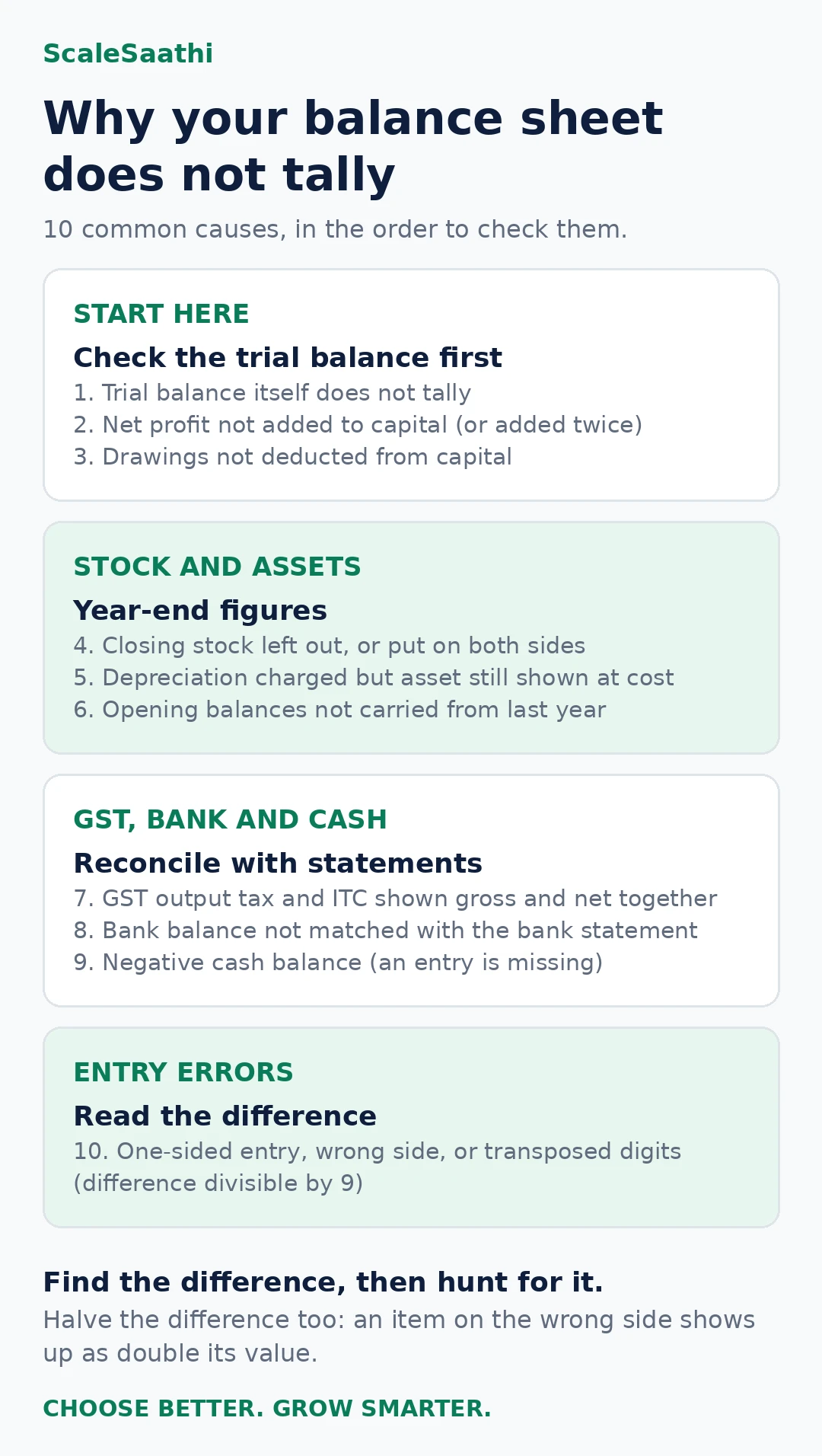
Why your balance sheet does not tally: 10 things to check
- The trial balance does not tally. Fix this first. If debits and credits differ, the balance sheet cannot match.
- Net profit not added to capital, or added twice, or a loss added instead of deducted.
- Drawings not deducted from capital, or shown as an expense and deducted again.
- Closing stock left out of the balance sheet, or put on both sides.
- Depreciation charged in profit and loss but the asset still shown at full cost.
- Opening balances not carried forward correctly from last year’s balance sheet.
- GST shown twice: both gross output tax and ITC, plus the net figure.
- Bank balance not reconciled with the bank statement, or a bank charge or interest entry missing.
- Negative cash balance: a cash receipt is missing or a payment was entered in cash instead of bank.
- Entry errors: a one-sided entry, an amount on the wrong side, or digits swapped (if the difference divides exactly by 9, look for swapped digits; an item on the wrong side makes the difference twice its value).
When you need a balance sheet
- Income tax return. ITR-3 has a full balance sheet section for business income. ITR-4 (presumptive income) asks for key balance sheet figures as on 31 March. Which return applies to you depends on your income and choices; check with your CA.
- Books of account and tax audit. Income tax law requires many businesses to keep books of account, and businesses above certain turnover limits need a tax audit by a chartered accountant. These limits are set out in the Income-tax Act (summarised in the next section).
- Bank loans and overdraft limits. Lenders usually ask for financial statements. The exact list (and whether they want CA-certified or audited statements) varies by bank and loan; ask your bank for its document list.
- Companies and LLPs. A company prepares its balance sheet in the Schedule III format and files it with the Registrar. An LLP files Form 8. Check with your ca on deadlines and audit.
- Your own control. Even if nobody asks, a balance sheet each year shows whether the business is growing your money, how much you owe, and how much is stuck in stock and debtors.
Self-prepared or CA-certified?
You can prepare your own balance sheet for your records and for many small-business purposes. A chartered accountant is needed, or strongly advised, when:
- Your business needs a tax audit under the Income-tax Act.
- You are a company: company accounts must be audited and follow Schedule III.
- A bank or lender asks for CA-certified or audited statements.
- Your figures involve judgement you are unsure about: stock valuation, depreciation rates, GST credit eligibility or old debtors.
A practical route: keep your books and a draft balance sheet in the template through the year, then give it to your CA with the trial balance, bank statements, stock list and GST returns. It saves time and fees. If you are choosing software to keep the books, see accounting software for small businesses or the free options.
Tax rules that decide how formal your accounts must be
From 1 April 2026 the Income-tax Act, 2025 is in force and uses the term “tax year”. The accounts for FY 2025-26 (ending 31 March 2026) are still filed for assessment year 2026-27 under the earlier Income-tax Act, 1961, using the ITR forms for AY 2026-27. In short, for the new Act:
- Presumptive income (section 58): eligible small businesses with turnover up to ₹2 crore (₹3 crore if cash receipts are no more than 5%) can declare 6% of receipts received through banking or digital modes and 8% of the rest as profit, or more. This mirrors section 44AD of the 1961 Act.
- Books of account (section 62): required for a business whose income exceeds ₹1,20,000 or turnover exceeds ₹10 lakh in any of the three preceding years; for individuals and HUFs the limits are ₹2,50,000 and ₹25 lakh. They also apply if you declare profit below the presumptive rate.
- Tax audit (section 63): for business turnover above ₹1 crore, or ₹10 crore if cash receipts and cash payments are each no more than 5%; for professions above ₹50 lakh; and in some cases where profit lower than the presumptive rate is declared.
These are summaries. Conditions and exceptions matter, so check with your CA before relying on any limit.
Frequently asked questions
What is the basic balance sheet formula?
Assets = Capital + Liabilities. For a company it is written as Assets = Equity + Liabilities. Both sides of the balance sheet must always be equal.
Is the T-format or the vertical format correct?
Both are correct for a proprietor or partnership. The T-format shows liabilities on the left and assets on the right; the vertical format lists them one below the other. Companies use the vertical Schedule III layout.
Where does closing stock go in a balance sheet?
Closing stock is a current asset. Count it on the last day of the year and value it at the lower of cost and net realisable value, as ICAI’s AS 2 requires.
Are drawings shown as an expense?
No. Drawings are money or goods the owner takes for personal use. They are deducted from capital on the balance sheet, not charged to profit and loss.
How do I show GST in the balance sheet?
Set off GST output tax against input tax credit and show the net: GST payable as a current liability, or unused input tax credit as a current asset. Check eligibility and set-off with your CA.
Can I use this Excel balance sheet in Google Sheets?
Yes. Upload the .xlsx file to Google Drive and open it with Google Sheets. The formulas and the both-sides-match check keep working.
Does a proprietor need a CA-certified balance sheet?
Not always. You can prepare it yourself for your records. A CA is needed for a tax audit, and lenders may ask for CA-certified statements. Check with your CA and your bank.
What is the balance sheet format for a private limited company?
A company following regular Indian accounting standards uses Division I of Schedule III to the Companies Act, 2013: equity and liabilities (shareholders’ funds, non-current and current liabilities) and assets (non-current and current).
Why does my balance sheet not tally?
Common causes are an untallied trial balance, profit not added to capital, drawings not deducted, closing stock missed, depreciation not reduced from assets, or GST shown twice. Start with the trial balance.
What is the difference between a trial balance and a balance sheet?
A trial balance lists every ledger balance to check that debits equal credits. A balance sheet uses only the asset, liability and capital balances, after profit is worked out, to show the position on one date.
Related guides
| Guide | Use it when |
|---|---|
| Ledger format | You need party-wise and account-wise balances for the trial balance |
| Cash book format | You want a daily cash and bank record that gives your closing cash |
| Stock register format | You need item-wise stock and a valuation for closing stock |
| GST invoice format | You issue tax invoices that drive GST output tax |
| Credit note format | You need to adjust a sale for returns or discounts |
| Accounting software for small businesses | You want software to prepare the balance sheet for you |
| Free accounting software | You want to start without paying |
Sources and checked dates
- Income-tax Act, 2025 (as amended): sections 1, 3, 58, 62 and 63. Checked 28 Oct 2026.
- Income Tax Department: section 44AD (Income-tax Act, 1961). Checked 28 Oct 2026.
- Income Tax e-filing portal: ITR for business or profession (AY 2026-27). Checked 28 Oct 2026.
- ITR-4 form for AY 2026-27 (financial particulars of the business). Checked 28 Oct 2026.
- ITR-3 form for AY 2026-27 (Part A-BS balance sheet). Checked 28 Oct 2026.
- ICAI Guidance Note on Division I, Schedule III to the Companies Act, 2013 (revised 2022). Checked 28 Oct 2026.
- ICAI: AS 2 Valuation of Inventories. Checked 28 Oct 2026.
- Ministry of Corporate Affairs: LLP Form 8. Checked 28 Oct 2026.
How we researched this guide
ScaleSaathi publishes practical guides for Indian small businesses under LendLink Tech Private Limited. For this guide we read the income tax forms and Acts, the ICAI guidance on Schedule III and AS 2, and the MCA Form 8 page listed above on 28 October 2026. We built and tested the templates so the worked example tallies. Where we could not confirm a rule on an official source, we say so and suggest you check with your CA.