Last updated: 28 Oct 2026
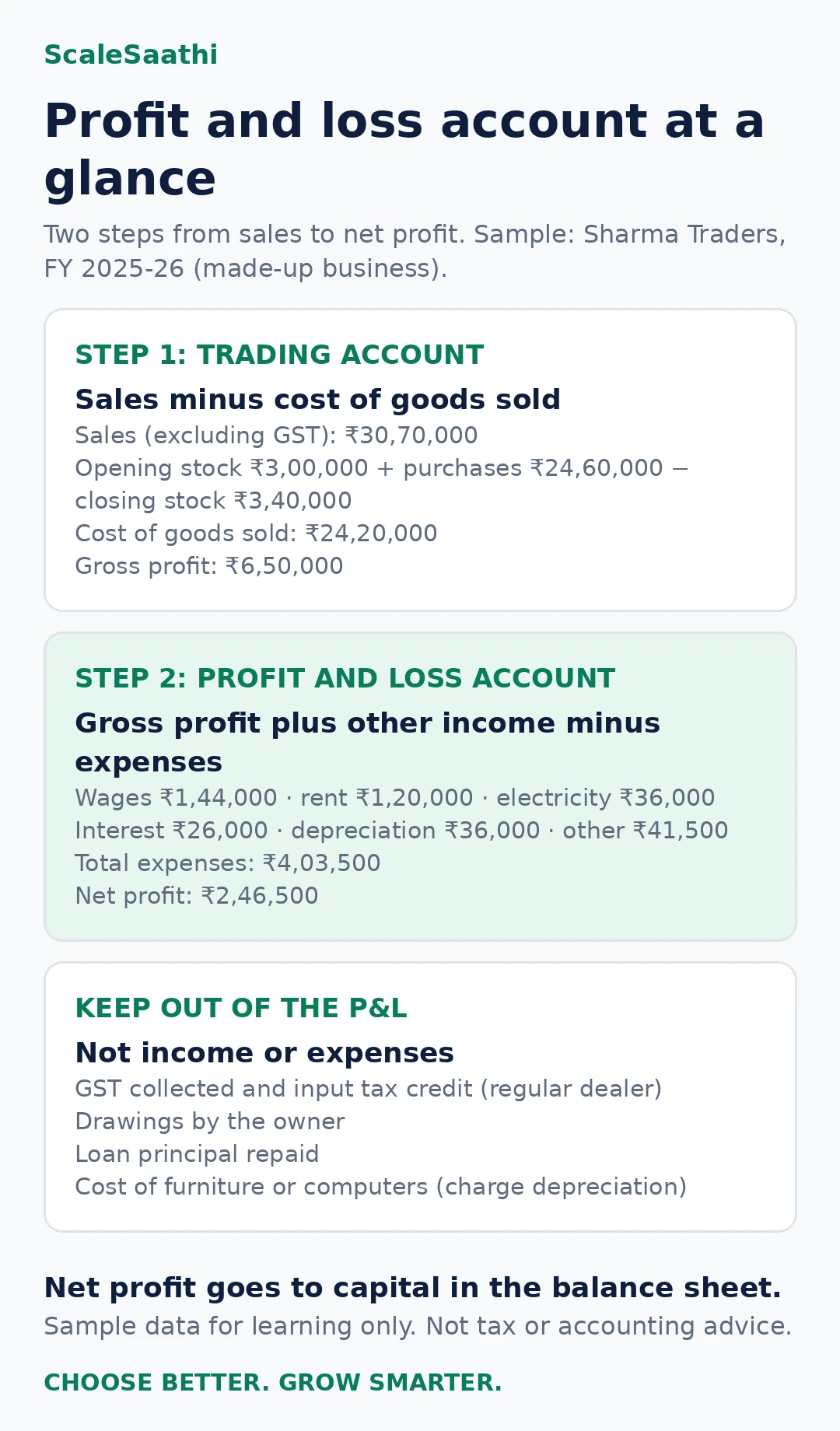
Short answer: a profit and loss account shows what your business earned and spent in a year, and the profit (or loss) left over. The format has two steps: sales minus cost of goods sold = gross profit, then gross profit plus other income minus all other expenses = net profit. Cost of goods sold is opening stock plus purchases (and direct expenses) minus closing stock. Sole proprietors and partnership firms usually prepare a trading and profit and loss account; companies prepare a “statement of profit and loss” in the Schedule III format. Below you get all three formats, free Excel, Word and PDF files, and a full worked example that ties to our balance sheet format guide.
| Step | Formula | Sharma Traders FY 2025-26 |
|---|---|---|
| Cost of goods sold | Opening stock + purchases + direct expenses − closing stock | ₹3,00,000 + ₹24,60,000 − ₹3,40,000 = ₹24,20,000 |
| Gross profit | Sales − cost of goods sold | ₹30,70,000 − ₹24,20,000 = ₹6,50,000 |
| Net profit | Gross profit + other income − indirect expenses | ₹6,50,000 − ₹4,03,500 = ₹2,46,500 |
Educational information only. This page is general guidance for Indian small businesses. It is not tax, accounting or legal advice and is not a substitute for your CA or current official sources. See our disclaimer.
Download the profit and loss account format (Excel, Word, PDF)
Free, no sign-up. These are educational templates, not forms prescribed by the government or the ICAI.
Excel: 6 ready formats
Proprietor T-format (trading and P&L account), proprietor vertical, partnership with appropriation account, company statement of profit and loss (Schedule III, with previous-year column), monthly shop P&L (12 months and total) and the Sharma Traders example. Totals and check cells work automatically; formula cells are locked without a password. Download Excel (.xlsx)
Word: editable formats
Blank T-format, vertical and company formats plus the filled Sharma Traders example, ready to type into. Download Word (.docx)
PDF: printable
The same formats to print and fill by hand, or to show a new accountant how your books are laid out. Download PDF (.pdf)
Using Google Sheets? Upload the Excel file to Google Drive and open it with Google Sheets; the formulas keep working. Want a quick margin on one product rather than a full year? Use the profit margin calculator.
Trading account, P&L account and statement of profit and loss: which one you need
| Name | Who uses it | What it looks like |
|---|---|---|
| Trading account | Proprietors and firms that buy and sell goods | First half: sales, opening and closing stock, purchases and direct expenses. Ends at gross profit. |
| Profit and loss account | Proprietors, partnership firms, most small businesses | Second half: starts from gross profit, adds other income, deducts indirect expenses. Ends at net profit. |
| Trading and profit and loss account | The usual combined statement for shops and traders | Both of the above, in T-format (debit and credit sides) or vertical form |
| Statement of profit and loss | Companies (Pvt Ltd, OPC, public) | Vertical format set by Schedule III of the Companies Act, 2013, with the previous year shown alongside |
| Income and expenditure account | Trusts, societies, clubs (not-for-profit) | Same idea, but ends in “surplus” or “deficit” instead of profit |
A service business with no stock (a consultant, agency or clinic) can skip the trading account: start with fees received, deduct expenses, and you have net profit.
Format 1: trading and profit and loss account (proprietor or firm)
T-format (traditional)
The traditional layout has a debit side (expenses and losses) and a credit side (income and gains). Both sides of each part must total the same. Here it is with the Sharma Traders figures for the year ended 31 March 2026.
Trading account
| Dr (debit side) | ₹ | Cr (credit side) | ₹ |
|---|---|---|---|
| To Opening stock | 3,00,000 | By Sales (excluding GST) | 30,70,000 |
| To Purchases (excluding GST) | 24,60,000 | By Closing stock | 3,40,000 |
| To Gross profit c/d | 6,50,000 | ||
| Total | 34,10,000 | Total | 34,10,000 |
Profit and loss account
| Dr | ₹ | Cr | ₹ |
|---|---|---|---|
| To Wages to shop helper | 1,44,000 | By Gross profit b/d | 6,50,000 |
| To Shop rent | 1,20,000 | ||
| To Electricity | 36,000 | ||
| To Interest on term loan | 26,000 | ||
| To Depreciation (furniture ₹12,000 + computer ₹24,000) | 36,000 | ||
| To Other expenses (phone, transport, stationery) | 41,500 | ||
| To Net profit (transferred to capital) | 2,46,500 | ||
| Total | 6,50,000 | Total | 6,50,000 |
“c/d” means carried down to the next part and “b/d” means brought down. Wages here are for a shop helper who sells, so they sit in the P&L account. Wages for making or loading goods (factory, packing, carriage on purchases) are direct expenses and go in the trading account.
Vertical format
Most software, banks and new accountants prefer the vertical layout. It is the same numbers, top to bottom.
| Particulars | ₹ | ₹ |
|---|---|---|
| Sales (excluding GST) | 30,70,000 | |
| Less: cost of goods sold | ||
| Opening stock | 3,00,000 | |
| Add: purchases | 24,60,000 | |
| Less: closing stock | (3,40,000) | |
| Cost of goods sold | (24,20,000) | |
| Gross profit | 6,50,000 | |
| Add: other income | 0 | |
| Less: indirect expenses | ||
| Wages to shop helper | 1,44,000 | |
| Shop rent | 1,20,000 | |
| Electricity | 36,000 | |
| Interest on term loan | 26,000 | |
| Depreciation (furniture ₹12,000 + computer ₹24,000) | 36,000 | |
| Other expenses (phone, transport, stationery) | 41,500 | |
| Total indirect expenses | (4,03,500) | |
| Net profit | 2,46,500 |
Partnership firms: the appropriation account
A firm adds one more step after net profit: the profit and loss appropriation account. It shows how the profit is split, in the order the partnership deed sets: interest on partners’ capital, salary or commission to working partners, then the balance in the profit-sharing ratio. Example (made-up firm, Mehta and Rao Traders, net profit before partner payments ₹6,00,000, capital ₹5,00,000 and ₹3,00,000, interest 10%, salary ₹1,20,000 each, ratio 60:40):
| Dr | ₹ | Cr | ₹ |
|---|---|---|---|
| To Interest on capital: Mehta | 50,000 | By Net profit b/d | 6,00,000 |
| To Interest on capital: Rao | 30,000 | ||
| To Salary: Mehta | 1,20,000 | ||
| To Salary: Rao | 1,20,000 | ||
| To Share of profit: Mehta (60%) | 1,68,000 | ||
| To Share of profit: Rao (40%) | 1,12,000 | ||
| Total | 6,00,000 | Total | 6,00,000 |
For income tax, what the firm can deduct for partner salary and interest has limits. Under the Income-tax Act, 2025 (section 35(e)), interest on capital is allowed up to 12% a year, and working partners’ salary up to ₹3,00,000 or 90% of the first ₹6,00,000 of book profit (whichever is higher), plus 60% of the rest, only if the deed allows it. In this example book profit is ₹5,20,000 (net profit after interest, before salary), so the limit is ₹4,68,000 and the ₹2,40,000 paid is within it. For FY 2025-26, filed under the older 1961 Act, confirm the limits for your year with your CA.
Format 2: statement of profit and loss for companies (Schedule III)
A private limited company must use the vertical format in Division I of Schedule III to the Companies Act, 2013, with the previous year’s figures in a second column. The main lines are:
| No. | Particulars | Note | Current year | Previous year |
|---|---|---|---|---|
| I | Revenue from operations | |||
| II | Other income | |||
| III | Total income (I + II) | |||
| IV | Expenses: cost of materials consumed; purchases of stock-in-trade; changes in inventories of finished goods, work-in-progress and stock-in-trade; employee benefits expense; finance costs; depreciation and amortisation expense; other expenses | |||
| Total expenses | ||||
| V | Profit before exceptional and extraordinary items and tax (III − IV) | |||
| VI | Exceptional items | |||
| VII | Profit before extraordinary items and tax | |||
| VIII | Extraordinary items | |||
| IX | Profit before tax | |||
| X | Tax expense: current tax, deferred tax | |||
| XI | Profit for the period from continuing operations | |||
| XII–XIV | Profit or loss from discontinuing operations (after tax) | |||
| XV | Profit (loss) for the period | |||
| XVI | Earnings per equity share: basic, diluted |
- Notes carry the detail. Revenue is split into sale of products, sale of services and other operating revenue; employee costs into salaries, provident fund contributions and staff welfare; finance costs into interest and other borrowing costs.
- Large items are shown separately: any income or expense above 1% of revenue or ₹1,00,000, whichever is higher.
- Payments to the auditor are split: as auditor, for taxation matters, company law matters and other services.
- Ind AS companies use Division II. That applies mainly to listed companies and larger companies (net worth ₹250 crore or more) and their group companies. Most small private companies stay on Division I.
- Approval and signing: the board approves the financial statements; they are signed by the chairperson (if authorised) or two directors, one of them the managing director if there is one, and by the CEO, CFO and company secretary where appointed (one director for a One Person Company). They then go to the auditor and are filed with the Registrar in Form AOC-4.
Format 3: simple monthly profit and loss for a shop
You do not need to wait for the year end. A monthly P&L tells you early if margins are slipping. The Excel file has a 12-month sheet with a total column. Here is Sharma Traders by quarter; cost of goods sold for each quarter is estimated at the year’s average margin (in your own sheet, use actual stock counts if you take them). The quarters add up to the annual figures exactly.
| Quarter | Sales | Cost of goods sold | Gross profit | Expenses | Net profit |
|---|---|---|---|---|---|
| Apr–Jun | 6,60,000 | 5,20,300 | 1,39,700 | 1,00,875 | 38,825 |
| Jul–Sep | 7,10,000 | 5,59,700 | 1,50,300 | 1,00,875 | 49,425 |
| Oct–Dec | 8,90,000 | 7,01,600 | 1,88,400 | 1,00,875 | 87,525 |
| Jan–Mar | 8,10,000 | 6,38,400 | 1,71,600 | 1,00,875 | 70,725 |
| Year | 30,70,000 | 24,20,000 | 6,50,000 | 4,03,500 | 2,46,500 |
Gross margin is about 21% (₹6,50,000 on ₹30,70,000) and net margin about 8%. To test a price change on one product, the profit margin calculator is quicker.
Worked example: Sharma Traders, FY 2025-26
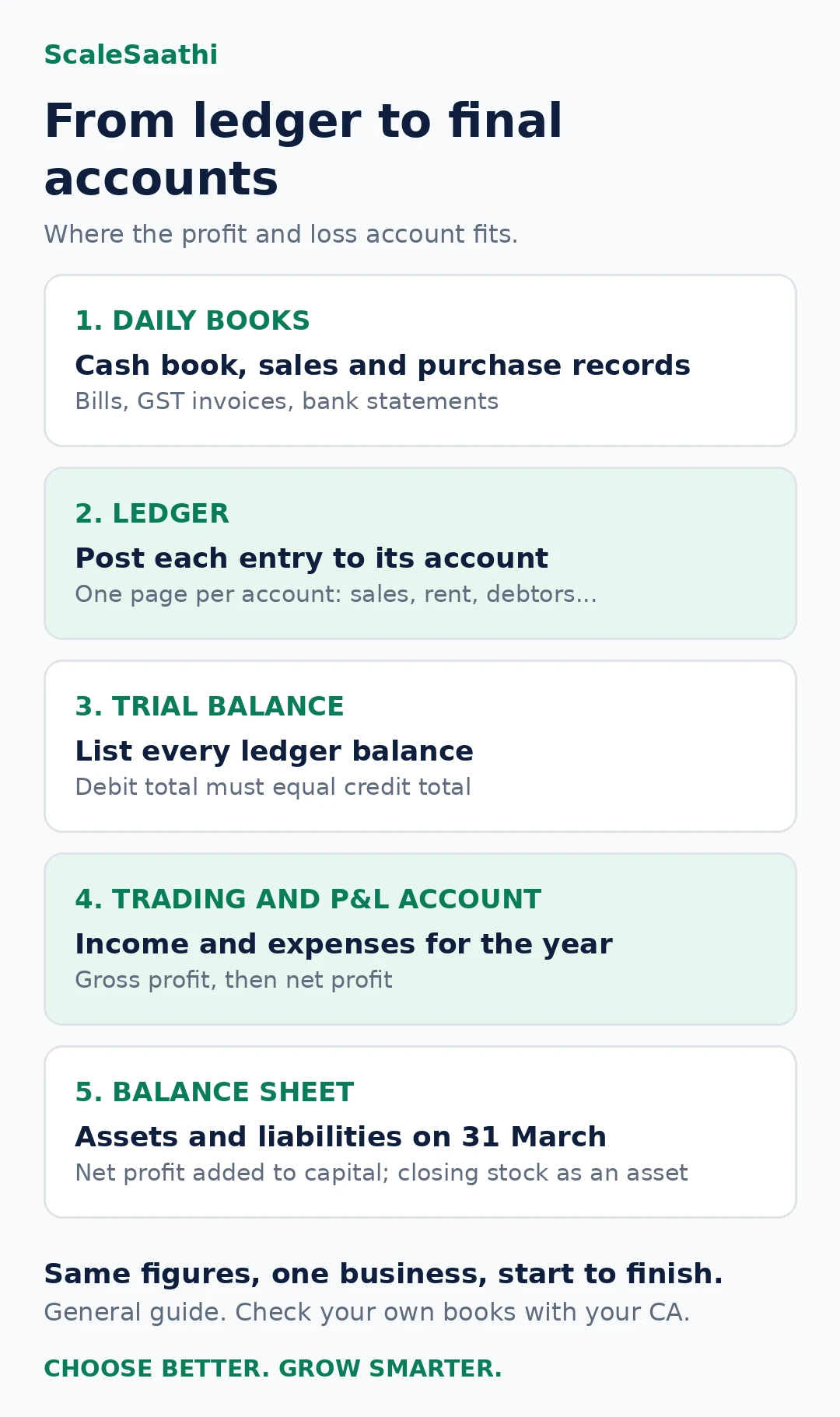
Sharma Traders is a made-up kirana and household-goods shop run by a sole proprietor, Rakesh Sharma, registered under GST. These are the same figures as the trial balance in our balance sheet format guide, so you can follow one business from ledger to final accounts. The trial balance format guide shows how that trial balance is built and adjusted.
- Sales: ₹30,70,000, excluding the GST collected (output GST is a liability, not income).
- Opening stock ₹3,00,000; purchases ₹24,60,000 excluding GST (input tax credit is an asset, not a cost); closing stock counted on 31 March 2026 and valued at ₹3,40,000 at the lower of cost and realisable value.
- Expenses: wages ₹1,44,000, rent ₹1,20,000 (including ₹10,000 for March still unpaid on 31 March, shown as outstanding), electricity ₹36,000, loan interest ₹26,000, depreciation ₹36,000 at sample rates (furniture 10%, computer 40%), other ₹41,500.
- Drawings of ₹1,80,000 are not an expense and do not appear in the P&L at all.
Result: gross profit ₹6,50,000, total indirect expenses ₹4,03,500, net profit ₹2,46,500. In the balance sheet this profit is added to capital: opening capital ₹4,50,000 + net profit ₹2,46,500 − drawings ₹1,80,000 = closing capital ₹5,16,500. See the full balance sheet built from the same figures, which totals ₹9,01,500 on both sides.
Variation (not part of the example above): if Sharma Traders had also received a ₹5,000 cash discount from a supplier, it would be shown as other income on the credit side of the P&L. Net profit would become ₹2,51,500, closing capital ₹5,21,500, and the cash or creditor balance in the balance sheet would change by the same ₹5,000.
Line-by-line: what goes where
| Item | Where it goes | Why |
|---|---|---|
| Purchases, carriage inward, freight on purchases, packing for sale | Trading account (direct) | They are part of the cost of the goods you sell |
| Rent, salaries, electricity, phone, advertising, bank charges | P&L account (indirect) | Costs of running the business, not of the goods |
| Closing stock | Credit side of trading account (or deducted in cost of goods sold), and as an asset in the balance sheet | Goods not yet sold belong to next year |
| Depreciation | P&L account | Spreads the cost of furniture, computers and vehicles over their life; the asset itself goes in the balance sheet |
| GST collected and GST paid (regular dealer) | Not in the P&L | Output GST is a liability and input tax credit an asset. Use the GST calculator to split GST out of a price |
| GST paid by a composition dealer | Usually part of the cost of purchases | Composition dealers cannot collect GST or claim input tax credit; check the treatment with your CA |
| Drawings (cash or goods taken by the owner) | Balance sheet, deducted from capital | They are not a business expense |
| Loan principal repaid | Balance sheet | Only the interest is an expense |
| Expenses due but unpaid (outstanding) / paid in advance (prepaid) | Add to or deduct from the expense; show as a liability or asset | The P&L must show the full year’s expense, no more, no less |
| Income tax of a proprietor | Not in the P&L | It is the owner’s personal tax; companies show tax expense in their statement |
Common mistakes to avoid
- Including GST in sales or purchases when you are a regular GST dealer. It inflates turnover and makes the figures disagree with your GST returns.
- Treating drawings as an expense. Personal spending reduces capital, not profit.
- Booking the full cost of a computer or furniture as an expense. Record it as an asset and charge depreciation.
- Forgetting closing stock or valuing it at selling price. Use the lower of cost and realisable value; keep a stock register format to back the count.
- Showing loan repayments as expenses. Only interest belongs in the P&L.
- Ignoring outstanding and prepaid items, such as March rent paid in April.
- Mixing direct and indirect expenses, which distorts gross profit and makes margins meaningless.
- Leaving unpaid bills to micro or small suppliers past the payment time limit under the MSMED Act. The income tax return asks about these, and such amounts may not be allowed as a deduction until paid.
- Not matching sales to GST returns and bank statements. Reconcile before you file; differences raise questions.
- Not keeping last year’s figures alongside, so you cannot spot changes. Companies must show them; it helps everyone.
How the P&L connects to your balance sheet, income tax return and GST
- Balance sheet: net profit is added to capital (or to reserves and surplus for a company), and closing stock moves to current assets. Prepare the P&L first, then the balance sheet; our balance sheet format guide shows the second step.
- ITR-3: proprietors who keep books file a trading account and profit and loss account in ITR-3 (for FY 2025-26, AY 2026-27), with sales and purchases shown net of GST and expense heads listed one by one. If you did not keep regular books, ITR-3 asks only for gross receipts, gross profit, expenses and net profit.
- Presumptive tax (44AD and 44ADA): ITR-4 does not ask for a P&L. A business with turnover up to ₹2 crore (₹3 crore if cash receipts are 5% or less) declares at least 6% of turnover (8% of cash receipts) as profit; a specified profession up to ₹50 lakh (₹75 lakh) declares 50%. ITR-4 still asks for your GST turnover and balances such as debtors, creditors, stock and cash. From tax year 2026-27 the same scheme sits in section 58 of the Income-tax Act, 2025. If you declare a lower profit and your income is above the basic exemption limit, books and a tax audit are needed.
- Tax audit: a business with turnover above ₹1 crore (₹10 crore if cash receipts and payments are each 5% or less) needs a tax audit, and the auditor reports on the P&L. Audited returns also need quantity details of stock.
- GST: sales in the P&L should reconcile with the outward supplies in your GST returns, after adjusting for credit notes (see the credit note format guide) and timing. Issue proper bills using a GST invoice format.
Keeping the books right through the year makes the P&L almost automatic. Start with a cash book format and a ledger format, or let accounting software for small businesses generate the statement for you; our Tally vs Zoho Books comparison helps you pick. Profit is not the same as cash, and a cash flow statement shows where the difference went.
Frequently asked questions
What is the difference between a profit and loss account and a balance sheet?
The profit and loss account shows income, expenses and profit for a period, such as 1 April 2025 to 31 March 2026. The balance sheet shows what the business owns and owes on one date, such as 31 March 2026. Net profit from the P&L is added to capital in the balance sheet.
Does a small shop need to prepare a profit and loss account?
If you must keep books of account under income tax rules (based on your income or turnover) or file ITR-3, you need one. Even if you use presumptive tax and file ITR-4, a simple yearly or monthly P&L tells you whether the shop is really making money and helps with bank loans.
I use presumptive tax under section 44AD. Do I need a P&L?
ITR-4 does not ask for a profit and loss account; you declare profit at the presumptive rate. But it asks for turnover, GST turnover and balances such as debtors, creditors, stock and cash, so basic records are still needed. If you declare profit below the presumptive rate, full books and a tax audit can apply.
What is the difference between gross profit and net profit?
Gross profit is sales minus the cost of the goods sold. Net profit is gross profit plus other income minus all other expenses such as rent, salaries, interest and depreciation. Sharma Traders has gross profit of ₹6,50,000 and net profit of ₹2,46,500.
Should GST be included in sales in the profit and loss account?
Not for a regular GST-registered dealer. GST collected is owed to the government and input tax credit is recoverable, so both stay out of income and expenses. A composition dealer cannot collect GST or claim input tax credit, so the tax paid on purchases usually becomes part of cost.
Where do drawings go in the profit and loss account?
Nowhere. Drawings are money or goods the owner takes for personal use. They are deducted from capital in the balance sheet, not charged as an expense.
Can I prepare a profit and loss account monthly?
Yes. A monthly P&L helps you spot falling margins or rising costs early. Use actual stock counts if you can; otherwise estimate cost of goods sold using your usual margin and correct it at the year end.
Is a P&L made in Excel acceptable, or do I need Tally or Zoho Books?
An Excel P&L is fine for your own use and for most small proprietors, as long as it is backed by proper books and bills. Accounting software produces the P&L automatically from your entries, which saves time and reduces errors as the business grows.
Who signs the profit and loss statement of a private limited company?
The board approves it first. It is then signed by the chairperson, if authorised, or by two directors (one of them the managing director, if there is one), and by the CEO, CFO and company secretary where appointed. A One Person Company needs one director. The auditor’s report is attached.
Which companies use the Ind AS format (Division II)?
Companies that follow Ind AS: mainly listed companies, companies with net worth of ₹250 crore or more, and their holding, subsidiary, joint venture and associate companies. Most small private companies use Division I.
Related guides and tools
| Guide or tool | Use it when |
|---|---|
| Balance sheet format | You have the net profit and need the balance sheet |
| Ledger format | You are posting entries to accounts before the trial balance |
| Cash book format | You want to record daily cash and bank entries |
| Stock register format | You need to back up your closing stock figure |
| GST invoice format | You issue bills to customers |
| Profit margin calculator | You want margin or markup on a product |
| GST calculator | You need to add or remove GST from a price |
| Accounting software for small businesses | You want the P&L generated automatically |
| Tally vs Zoho Books | You are choosing between the two |
Sources and checked dates
- ICAI: Guidance Note on Division I, Schedule III to the Companies Act, 2013 (statement of profit and loss). Checked 28 Oct 2026.
- Income Tax Department: ITR-3 form for AY 2026-27 (trading account, P&L, no-account case). Checked 28 Oct 2026.
- Income Tax Department: ITR-4 (Sugam) form for AY 2026-27 (sections 44AD, 44ADA). Checked 28 Oct 2026.
- Income Tax Department: section 44AD. Checked 28 Oct 2026.
- Income-tax Act, 2025 as amended by Finance Act 2026 (sections 35, 58, 62, 63). Checked 28 Oct 2026.
- CBIC: CGST Act, 2017, section 10 (composition levy). Checked 28 Oct 2026.
- ICSI e-book: Companies Act, 2013, section 134 (approval and signing). Checked 28 Oct 2026.
- MCA: Form AOC-4 (filing financial statements). Checked 28 Oct 2026.
- Companies (Indian Accounting Standards) Rules, 2015, rule 4 (G.S.R. 111(E)). Checked 28 Oct 2026.
How we researched this guide
ScaleSaathi publishes practical guides for Indian small businesses under LendLink Tech Private Limited. For this guide we read the ICAI guidance note on Schedule III, the ITR-3 and ITR-4 forms for AY 2026-27, the Income-tax Act, 2025, the CGST Act and the Companies Act sources listed above on 28 October 2026. We built the Excel formats ourselves, recalculated every total, and used the same Sharma Traders figures as our balance sheet guide so both pages agree. Where a rule depends on your year or situation, such as partner remuneration limits under the older 1961 Act, we say so and suggest checking with your CA.