
Last updated: 28 October 2026
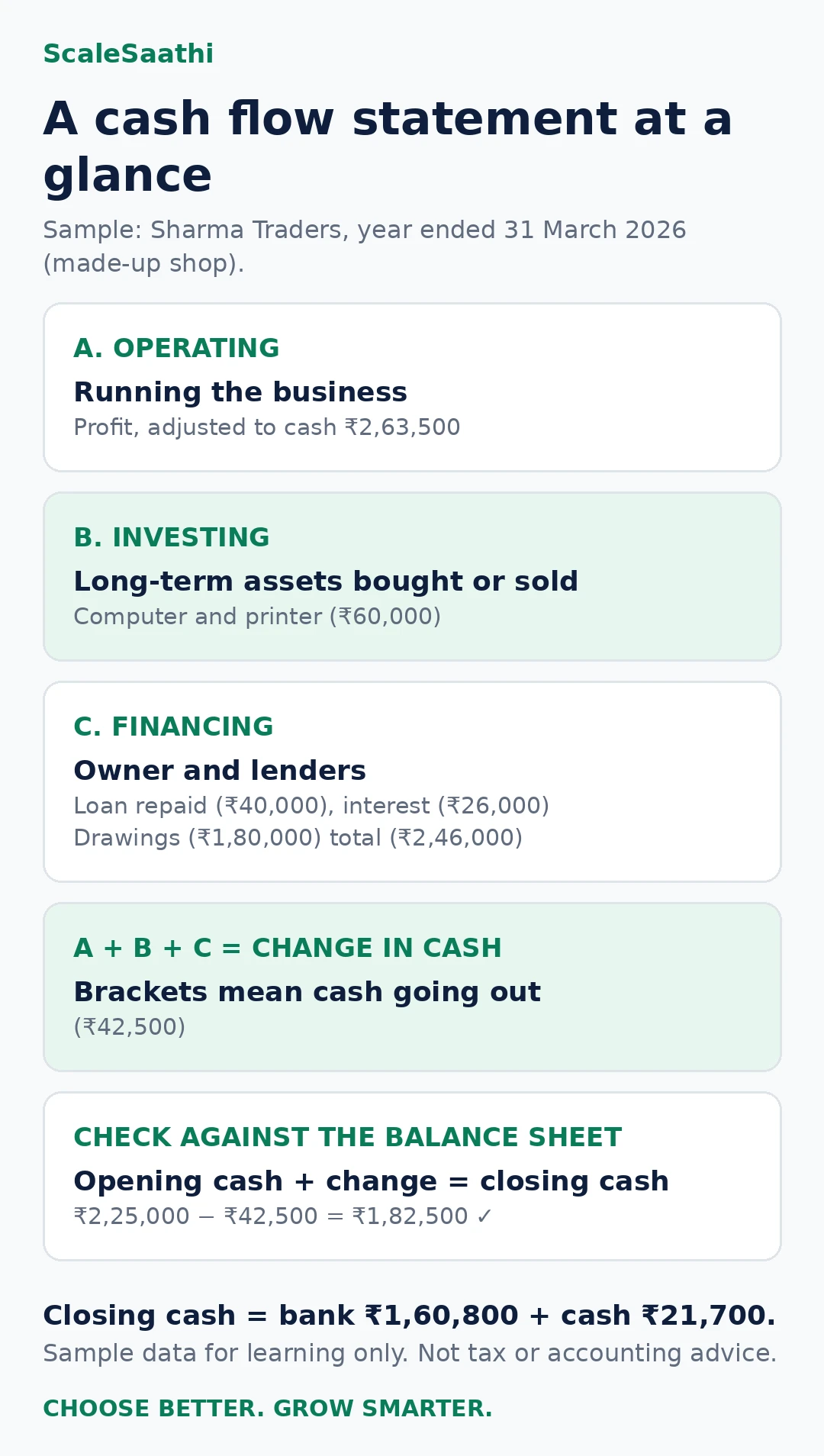
Short answer: a cash flow statement shows where your cash came from and where it went during the year, sorted into three groups: operating (running the business), investing (buying or selling long-term assets) and financing (loans, capital and drawings). Add the three, and you get the change in cash. Add that to the opening cash and bank balance, and you must land exactly on the closing cash and bank in your balance sheet. If you don’t, something is missing.
| Cash flow statement for the year ended 31 March 2026 | ₹ |
|---|---|
| A. Cash flow from operating activities | 2,63,500 |
| B. Cash flow from investing activities | (60,000) |
| C. Cash flow from financing activities | (2,46,000) |
| Net increase / (decrease) in cash (A + B + C) | (42,500) |
| Add: cash and bank at the start of the year | 2,25,000 |
| Cash and bank at the end of the year | 1,82,500 |
Figures are from our made-up Sharma Traders example below. Brackets mean money going out. Educational information only, not tax, accounting or legal advice; see our disclaimer.
On this page
- Free downloads
- Who actually needs one
- The three activities, in plain words
- The format, line by line (indirect method)
- The direct method format
- Worked example: Sharma Traders, both methods
- How to prepare one from your books in 6 steps
- Cash flow statement vs cash book vs P&L
- Common mistakes
- FAQs
Free cash flow statement format: Excel, Word and PDF
Free, no sign-up. These are educational templates. Neither the government nor the ICAI prescribes them.
Excel: builds itself from your two balance sheets
Type last year’s and this year’s balance sheet and four P&L figures in the yellow cells. The indirect method statement fills in, the direct method works out from the same numbers, and a Checks sheet tells you whether closing cash matches your balance sheet cash and bank. Blank indirect and direct formats included. Download Excel (.xlsx)
Word: blank and filled
Blank indirect and direct formats you can type into, plus the filled Sharma Traders statement with working notes. Download Word (.docx)
PDF: printable
The same pages on A4, to fill by hand or to hand over with a loan file. Download PDF (.pdf)
Who actually needs a cash flow statement?
Fewer people than you’d think, at least as a legal requirement. Here’s the honest picture:
- Companies: under the Companies Act, 2013, a company’s “financial statements” include a cash flow statement. The ICAI notes that for a one person company, small company or dormant company, the financial statements may leave it out (ICAI, AS 3). Listed and larger companies on Ind AS follow Ind AS 7, which treats the statement as an integral part of the accounts (ICAI on Ind AS 7).
- Proprietors, partnerships and other non-company businesses: AS 3 is not mandatory for micro, small and medium non-company entities (ICAI’s Level II, III and IV), though the ICAI encourages them to follow it. In practice, most shop owners and small firms are never required to prepare one by law.
- When you’ll still be asked for one: banks and NBFCs often want past or projected cash flow when you apply for a term loan, cash credit limit or a Mudra loan, and some tenders and investors ask for it too. It’s not a legal form in those cases, just the clearest way to show you can repay. Ask the lender exactly which years and which format they want.
Even when nobody asks, it is worth doing once a year. Profit and cash are not the same thing. Sharma Traders, below, made ₹2,46,500 profit and still ended the year with ₹42,500 less in the bank. The cash flow statement shows why in ten lines.
The three activities, in plain words
AS 3, the Indian accounting standard on cash flow statements, sorts every rupee into one of three groups (AS 3, para 5). Here’s what each means for a small business:
| Activity | What AS 3 says | What it means in a shop | Typical lines |
|---|---|---|---|
| Operating | “the principal revenue-producing activities of the enterprise and other activities that are not investing or financing activities” | Buying and selling goods, paying staff, rent and bills | Cash from customers, paid to suppliers, wages, rent, GST, income tax |
| Investing | “the acquisition and disposal of long-term assets and other investments not included in cash equivalents” | Buying or selling things you’ll use for years | Furniture, computer, vehicle, machinery, fixed deposits over 3 months, interest received |
| Financing | “activities that result in changes in the size and composition of the owners’ capital … and borrowings” | Money coming from or going back to the owner and lenders | Capital brought in, drawings, loans taken or repaid, interest paid |
Two rules from AS 3 trip people up. First, for an ordinary business (not a bank or NBFC), interest paid goes under financing, and interest and dividends received go under investing (para 30). Second, income tax paid sits in operating unless it clearly belongs to an investing or financing item (para 34). “Cash” means cash in hand and demand deposits with banks; short-term investments that mature within about three months of purchase count as cash equivalents (paras 5–6).
For a proprietor, the owner’s income tax is usually paid personally, so it shows up as drawings rather than as a separate tax line. Partnerships and companies show tax paid in operating.
The format, line by line (indirect method)
The indirect method starts from net profit and adjusts it back to cash. It’s the one almost every Indian set of accounts uses, because you can build it straight from the P&L and two balance sheets. AS 3 allows either method (para 18).
| Line | What to put in | Sign |
|---|---|---|
| A. Operating activities | ||
| Net profit (before tax, for a firm or company) | From the P&L. For a proprietor, net profit as shown. | + |
| Add: depreciation and amortisation | Expenses that used no cash this year | + |
| Add: interest paid (moved to financing) | Taken out here, shown below in C | + |
| Less: interest or dividend received (moved to investing) | Taken out here, shown below in B | − |
| Add / less: loss or profit on sale of assets | The sale proceeds go in B instead | ± |
| Operating profit before working capital changes | Subtotal | |
| Increase in stock, debtors, advances | Cash tied up | − |
| Decrease in stock, debtors, advances | Cash released | + |
| Increase in creditors, outstanding expenses, GST payable | Cash you haven’t paid out yet | + |
| Decrease in creditors, outstanding expenses, GST payable | You paid off old dues | − |
| Less: income tax paid | Firms and companies | − |
| Net cash from operating activities (A) | ||
| B. Investing activities | ||
| Purchase of fixed assets | Furniture, computers, vehicles, machines | − |
| Sale of fixed assets | Amount actually received | + |
| Fixed deposits made / matured, interest received | Deposits over three months | ± |
| Net cash from investing activities (B) | ||
| C. Financing activities | ||
| Capital introduced / drawings | Owner’s money in, owner’s money out | + / − |
| Loans taken / repaid | Term loans, loans from relatives; cash credit if not treated as cash | + / − |
| Interest paid | On loans | − |
| Net cash from financing activities (C) | ||
| Net increase / (decrease) in cash (A + B + C) | ||
| Opening cash and bank | From last year’s balance sheet | + |
| Closing cash and bank | Must equal this year’s balance sheet | = |
The working capital lines confuse almost everyone at first, so here’s the trick: an asset going up means cash went into it (minus). A liability going up means you held on to someone else’s money (plus). Debtors rose by ₹25,000? That’s ₹25,000 of sales you haven’t been paid for yet, so knock it off.
The direct method format
The direct method lists actual receipts and payments, which is closer to how a shop owner thinks. AS 3 actually calls it “more appropriate” because it shows things the indirect method hides (para 19). Only the operating section changes; investing and financing are the same.
| Line | How to work it out from your books |
|---|---|
| Cash received from customers | Sales − increase in debtors (or + decrease) |
| Cash paid to suppliers | Purchases − increase in creditors (or + decrease) |
| Cash paid for wages and expenses | Expenses (except depreciation and interest) − increase in outstanding expenses |
| Net GST paid / (held) | Change in GST payable, if sales and purchases are shown without GST |
| Income tax paid | Firms and companies |
| Net cash from operating activities | Must equal the indirect method figure |
If both methods don’t give the same operating figure, one of your working capital changes is wrong. That’s a useful check on its own.
Worked example: Sharma Traders, both methods
Sharma Traders is the made-up wholesale shop we follow through our trial balance format, profit and loss account format and balance sheet format guides: net profit ₹2,46,500 for FY 2025-26 and a balance sheet of ₹9,01,500 on 31 March 2026. To build a cash flow statement you also need last year’s balance sheet, so we’ve added one for 31 March 2025. The opening capital (₹4,50,000) and opening stock (₹3,00,000) are the same as in the earlier guides; the other opening figures are new and made up for this example.
Step 1: put the two balance sheets side by side
| Item | 31 Mar 2025 (₹) | 31 Mar 2026 (₹) | Change (₹) |
|---|---|---|---|
| Furniture and fittings (net) | 1,20,000 | 1,08,000 | (12,000) |
| Computer and printer (net) | 0 | 36,000 | 36,000 |
| Security deposit (shop rent) | 50,000 | 50,000 | 0 |
| Stock | 3,00,000 | 3,40,000 | 40,000 |
| Sundry debtors | 1,60,000 | 1,85,000 | 25,000 |
| Bank balance | 2,05,000 | 1,60,800 | (44,200) |
| Cash in hand | 20,000 | 21,700 | 1,700 |
| Total assets | 8,55,000 | 9,01,500 | |
| Capital | 4,50,000 | 5,16,500 | 66,500 |
| Bank term loan | 2,50,000 | 2,10,000 | (40,000) |
| Sundry creditors | 1,40,000 | 1,52,000 | 12,000 |
| GST payable (net) | 9,000 | 13,000 | 4,000 |
| Outstanding expenses | 6,000 | 10,000 | 4,000 |
| Total capital and liabilities | 8,55,000 | 9,01,500 |
A few facts from the year that the balance sheet doesn’t show on its own: the furniture was already there at the start (₹1,20,000) and only lost ₹12,000 to depreciation. The computer and printer were bought this year for ₹60,000 and depreciated by ₹24,000. ₹40,000 of the bank loan was repaid, all ₹26,000 of loan interest was paid, and Mr Sharma took ₹1,80,000 in drawings. Sales and purchases in the P&L are without GST.
Step 2: the indirect method
| Sharma Traders: cash flow statement for the year ended 31 March 2026 | ₹ |
|---|---|
| A. Operating activities | |
| Net profit for the year | 2,46,500 |
| Add: depreciation | 36,000 |
| Add: interest on bank loan (shown under financing) | 26,000 |
| Operating profit before working capital changes | 3,08,500 |
| Increase in stock (3,00,000 → 3,40,000) | (40,000) |
| Increase in sundry debtors (1,60,000 → 1,85,000) | (25,000) |
| Increase in sundry creditors (1,40,000 → 1,52,000) | 12,000 |
| Increase in GST payable (9,000 → 13,000) | 4,000 |
| Increase in outstanding expenses (6,000 → 10,000) | 4,000 |
| Net cash from operating activities (A) | 2,63,500 |
| B. Investing activities | |
| Computer and printer bought | (60,000) |
| Net cash used in investing activities (B) | (60,000) |
| C. Financing activities | |
| Bank term loan repaid (2,50,000 → 2,10,000) | (40,000) |
| Interest paid on bank loan | (26,000) |
| Drawings by the proprietor | (1,80,000) |
| Net cash used in financing activities (C) | (2,46,000) |
| Net decrease in cash and bank (A + B + C) | (42,500) |
| Cash and bank on 1 April 2025 (2,05,000 + 20,000) | 2,25,000 |
| Cash and bank on 31 March 2026 (1,60,800 + 21,700) | 1,82,500 |
It ties. ₹2,25,000 less ₹42,500 is ₹1,82,500, which is exactly the bank balance of ₹1,60,800 plus cash in hand of ₹21,700 in the balance sheet.
Step 3: the direct method, same numbers
| Operating activities (direct method) | Working | ₹ |
|---|---|---|
| Cash received from customers | Sales 30,70,000 − increase in debtors 25,000 | 30,45,000 |
| Cash paid to suppliers | Purchases 24,60,000 − increase in creditors 12,000 | (24,48,000) |
| Cash paid for wages, rent, electricity and other expenses | 1,44,000 + 1,20,000 + 36,000 + 41,500 − increase in outstanding 4,000 | (3,37,500) |
| GST collected but not yet paid over | Increase in net GST payable | 4,000 |
| Net cash from operating activities | 2,63,500 |
Same 2,63,500, so both methods agree. Investing and financing don’t change.
What the statement tells Mr Sharma
The business itself threw off healthy cash: ₹2,63,500. But ₹40,000 went into extra stock and another ₹25,000 is sitting with customers. Then ₹60,000 on a computer, ₹66,000 to the bank for the loan and interest, and ₹1,80,000 home. Profit was fine. Drawings and loan repayments were simply bigger than what the shop earned in cash after buying the computer. Chasing debtors a little harder, or spreading the computer over EMIs, would have closed most of the gap.

How to prepare a cash flow statement from your books in 6 steps
- Get two balance sheets and one P&L. Last year-end, this year-end, and the P&L in between. Check both balance sheets tally first.
- Find the cash. Cash in hand plus bank balances, at both dates. Overdrafts and cash credit: decide whether you treat them as loans (financing) and stick to it.
- Start from net profit and add back depreciation and interest paid. Take out any profit on selling an asset.
- Work the changes in stock, debtors, creditors, GST and outstanding bills, using the plus/minus trick above.
- List the big one-offs: assets bought or sold (investing), and loans, capital and drawings (financing). Your fixed asset register and loan statement have these.
- Check it lands. Opening cash + the net change must equal closing cash. If it’s off, the difference is usually an asset purchase you netted against depreciation, or drawings you forgot.
If closing cash itself looks wrong, reconcile the bank first with our bank reconciliation statement format guide.
Cash flow statement vs cash book vs P&L vs fund flow
| What it shows | When you make it | |
|---|---|---|
| Cash book | Every cash and bank receipt and payment, in date order | Daily |
| Profit and loss account | Income earned and expenses incurred, whether paid or not | Year-end (or monthly) |
| Balance sheet | What you own and owe on one date | Year-end |
| Cash flow statement | Why cash changed between two balance sheets, in three groups | Year-end, or for a loan |
| Fund flow statement | Changes in working capital and long-term funds. An older statement, now mostly seen in exams | Rarely, today |
The names sound alike, but a cash book is a daily register and a cash flow statement is a year-end summary. You don’t need one to keep the other; your cash book format guide covers the daily side. Entries that never touch cash, like depreciation or credit sales, live in the journal: see our journal entry format guide.
Common mistakes
- Adding the closing depreciation figure from the balance sheet instead of this year’s depreciation charge from the P&L.
- Getting the working capital signs backwards. Debtors up is a minus, creditors up is a plus.
- Netting the computer purchase against depreciation. Show the ₹60,000 purchase in investing and add the ₹24,000 depreciation back in operating.
- Putting interest paid in operating. Under AS 3, an ordinary business shows it under financing.
- Forgetting drawings, or showing them as an expense.
- Counting a fixed deposit of six months as cash. Only very short-term ones (around three months or less) are cash equivalents.
- Not checking the final line against the balance sheet. It must match to the rupee.
Frequently asked questions
What is the format of a cash flow statement?
A cash flow statement has three sections: cash from operating activities, cash from investing activities and cash from financing activities. Their total is the net increase or decrease in cash, which is added to opening cash and bank to give closing cash and bank.
What is the difference between the direct and indirect method?
The indirect method starts from net profit and adjusts for depreciation, interest and changes in stock, debtors and creditors. The direct method lists actual cash received from customers and paid to suppliers and for expenses. Both give the same cash from operating activities.
Which method is used in India?
AS 3 allows both and calls the direct method more appropriate, but most Indian businesses and companies use the indirect method because it can be built from the profit and loss account and two balance sheets.
Is a cash flow statement mandatory for a proprietorship?
No law requires a proprietor to prepare one in most cases. The ICAI says AS 3 is not mandatory for micro, small and medium non-company entities, though it encourages them to follow it. Banks may still ask for one with a loan application.
Do small companies need a cash flow statement?
The ICAI notes that under the Companies Act, 2013, the financial statements of a one person company, small company or dormant company may not include a cash flow statement. Other companies must include one.
Where does interest paid go in a cash flow statement?
For an ordinary business, AS 3 puts interest paid under financing activities and interest received under investing activities. For a bank or other financial enterprise, both go under operating activities.
Why is my cash lower when I made a profit?
Profit counts sales and expenses when they happen, not when cash moves. Cash can be lower because of more stock, customers paying late, assets bought, loans repaid or drawings. The cash flow statement shows each of these.
Is a cash flow statement the same as a cash book?
No. A cash book records every cash and bank transaction day by day. A cash flow statement is a summary prepared at the year end that explains why cash changed between two balance sheets.
Can I prepare a cash flow statement in Excel?
Yes. Enter the opening and closing balance sheets and a few figures from the profit and loss account, and formulas can work out each line. Our free Excel template does this and checks that closing cash matches the balance sheet.
Related guides
| Guide | Use it when |
|---|---|
| Balance sheet format | You need the two balance sheets this statement is built from |
| Profit and loss account format | You need the year’s net profit |
| Trial balance format | You want to check the ledger before final accounts |
| Cash book format | You record daily cash and bank entries |
| Bank reconciliation statement format | Your bank balance doesn’t match the statement |
| Journal entry format | You are recording depreciation, outstanding bills and other non-cash entries |
| Ledger format | You are posting entries into accounts |
Sources and checked dates
How we researched this guide
ScaleSaathi publishes practical guides for Indian small businesses under LendLink Tech Private Limited. On 28 October 2026 we read the full text of AS 3 on the ICAI’s standards site, including its note on which entities it applies to, and the ICAI’s summary of Ind AS 7. Sharma Traders is made up; its closing figures match our balance sheet, P&L and trial balance guides, and the opening balance sheet was added for this example. We built the Excel file ourselves and recalculated every figure, and both methods were checked to give the same answer. What lenders ask for varies, so we haven’t quoted any bank’s requirements.