
Last updated: 30 Oct 2026
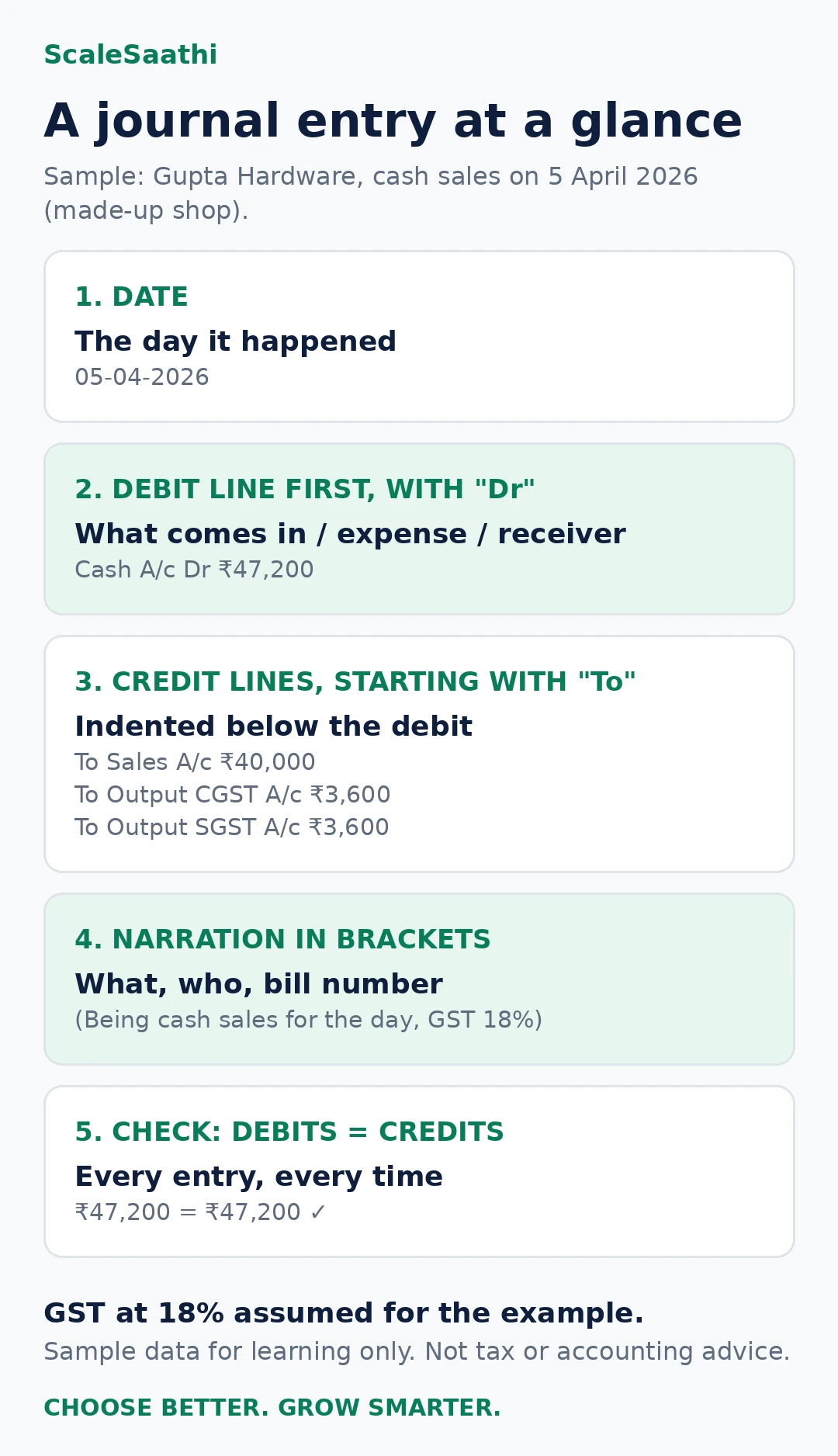
A journal entry is one transaction written down in date order: which account is debited, which is credited, the amount and a one-line narration saying why. Total debit must equal total credit, every time. The Indian format has five columns: Date | Particulars | L.F. | Debit (₹) | Credit (₹). Below: a free Excel journal that checks each entry and builds the trial balance, a printable Word and PDF page, the debit and credit rules, and a month of shop entries with GST. The usual errors aren’t the format; they are the wrong side and a missing reason.
Four checks before you post an entry
- Does it balance? Total debit must equal total credit. A purchase with CGST and SGST is one compound entry, not several small ones that each fail to balance.
- Would the auditor understand it? “Being goods bought from Singh Steel, bill SS/112” answers the question before it is asked. “Purchase” alone means a phone call and a hunt for the bill.
- Is GST in its own account? GST paid on purchases goes to Input CGST and Input SGST, not into Purchases or Furniture. A sale to a buyer in another state carries IGST, not CGST + SGST.
- Did the owner take something? Cash or goods taken home are Drawings, not a shop expense. Goods come out of Purchases at cost.
| Date | Particulars | L.F. | Debit (₹) | Credit (₹) |
|---|---|---|---|---|
| 05-04-2026 | Cash A/c Dr | 47,200 | ||
| To Sales A/c | 40,000 | |||
| To Output CGST A/c | 3,600 | |||
| To Output SGST A/c | 3,600 | |||
| (Being cash sales for the day, GST 18%) |
Educational information only. This page is general guidance for Indian small businesses. It is not tax, accounting or legal advice and is not a substitute for your CA or current official sources. See our disclaimer.
On this page
- Free downloads
- The journal entry format, column by column
- Which side to debit: the rules
- How to write a journal entry in 4 steps
- Worked example: a month at Gupta Hardware
- Journal entry examples for Indian businesses
- GST in journal entries
- Journal vs day book vs voucher vs ledger
- Do you have to keep a journal?
- Common mistakes
- FAQs
Free journal entry format: Excel, Word and PDF
Free, no sign-up. These are educational templates, not forms prescribed by the government or the ICAI.
Excel: journal that checks itself
Type each entry line by line. Every entry is checked for debit = credit, account balances fill in on their own, and a trial balance is built from them with an OK/CHECK cell. Also has the rules of debit and credit and a blank printable journal. Download Excel (.xlsx)
Word: blank and filled
A blank journal page in the classic layout, the full Gupta Hardware month, its trial balance and a one-page rules sheet. Download Word (.docx)
PDF: printable
The same pages to print and write by hand. A4 size. Download PDF (.pdf)
The journal entry format, column by column
| Column | What you write |
|---|---|
| Date | The day the transaction happened, not the day you got round to writing it. |
| Particulars | The account to be debited, followed by “Dr”. On the next line, a little indented, “To” and the account to be credited. Then the narration in brackets. |
| L.F. (ledger folio) | The page number of that account in your ledger. Filled in when you post the entry, so you can trace it later. |
| Debit (₹) | The amount against the debit account. |
| Credit (₹) | The amount against the credit account. Each page’s debit total equals its credit total. |
That “To” is only a convention telling the reader which line is the credit. The narration is where people cut corners, and it costs them at year end. “Being goods bought from Singh Steel, bill SS/112” answers the auditor’s question before it is asked. “Purchase” alone means a phone call and a hunt for the bill.
One debit and one credit is a simple entry. When a transaction touches three or more accounts, like a purchase with CGST and SGST, write one compound entry, not several small ones that each fail to balance. The rule stays the same: debits add up to credits.
Which side to debit: the rules
Indian textbooks teach the golden rules, built on three kinds of account. Most software, and most CAs in practice, think in the modern rules. Both always give the same answer, so pick the one you find easier and stick with it.
| Type of account | Debit | Credit | Examples |
|---|---|---|---|
| Personal (people, firms, banks) | The receiver | The giver | Singh Steel, Patel Builders, Capital, Bank |
| Real (things you own) | What comes in | What goes out | Cash, stock, furniture, machinery |
| Nominal (expenses, incomes) | Expenses and losses | Incomes and gains | Rent, salary, sales, commission received |
| Modern rule | Debit when it… | Credit when it… |
|---|---|---|
| Asset | goes up | goes down |
| Liability | goes down | goes up |
| Capital | goes down (drawings, losses) | goes up (owner brings money, profit) |
| Income | goes down | goes up |
| Expense | goes up | goes down |
Quick test: you pay rent by UPI. Rent is an expense and it goes up, so debit rent. The bank balance is an asset and it goes down, so credit bank. The golden rules agree: debit the expense, credit the giver, which is the bank. Debiting bank for a payment means a side is swapped.
How to write a journal entry in 4 steps
- Name the accounts. Which two or more accounts does this transaction change? Paying a supplier changes the supplier’s account and your bank.
- Decide the type of each. Asset, liability, capital, income or expense (or personal, real, nominal).
- Apply the rule. Work out which one is debited and which is credited.
- Write it and check it. Debit line first, then “To” credit line, narration, and confirm the totals match. The Excel template does this check for you.
Worked example: a month at Gupta Hardware
Gupta Hardware is a made-up hardware shop in Indore that opened on 1 April 2026. GST is taken at 18% to keep the maths simple; your goods may carry a different rate, so check each item. Below is every April entry as it would sit in the journal book, month-end entries included.
| Date | Particulars | Debit (₹) | Credit (₹) |
|---|---|---|---|
| 01-04-2026 | Bank A/c Dr | 3,00,000 | |
| To Capital A/c | 3,00,000 | ||
| (Owner brought in capital by bank transfer) | |||
| 02-04-2026 | Purchases A/c Dr | 1,00,000 | |
| Input CGST A/c Dr | 9,000 | ||
| Input SGST A/c Dr | 9,000 | ||
| To Singh Steel A/c | 1,18,000 | ||
| (Goods bought on credit from Singh Steel, Indore, bill no. SS/112 (GST 18%)) | |||
| 05-04-2026 | Cash A/c Dr | 47,200 | |
| To Sales A/c | 40,000 | ||
| To Output CGST A/c | 3,600 | ||
| To Output SGST A/c | 3,600 | ||
| (Cash sales for the day (GST 18%)) | |||
| 08-04-2026 | Patel Builders A/c Dr | 70,800 | |
| To Sales A/c | 60,000 | ||
| To Output IGST A/c | 10,800 | ||
| (Goods sold on credit to Patel Builders, Vadodara, invoice GH/014 (IGST 18%)) | |||
| 10-04-2026 | Rent A/c Dr | 15,000 | |
| To Bank A/c | 15,000 | ||
| (Shop rent for April paid by UPI) | |||
| 12-04-2026 | Furniture A/c Dr | 25,000 | |
| Input CGST A/c Dr | 2,250 | ||
| Input SGST A/c Dr | 2,250 | ||
| To Bank A/c | 29,500 | ||
| (Display racks bought, paid by NEFT (GST 18%)) | |||
| 15-04-2026 | Singh Steel A/c Dr | 1,18,000 | |
| To Bank A/c | 1,18,000 | ||
| (Paid Singh Steel in full by NEFT) | |||
| 20-04-2026 | Bank A/c Dr | 70,800 | |
| To Patel Builders A/c | 70,800 | ||
| (Received from Patel Builders by NEFT) | |||
| 22-04-2026 | Drawings A/c Dr | 10,000 | |
| To Cash A/c | 10,000 | ||
| (Cash taken by owner for home) | |||
| 25-04-2026 | Bank A/c Dr | 30,000 | |
| To Cash A/c | 30,000 | ||
| (Cash deposited into bank) | |||
| 30-04-2026 | Salary A/c Dr | 12,000 | |
| To Bank A/c | 12,000 | ||
| (Salary paid to shop helper for April) | |||
| 30-04-2026 | Electricity A/c Dr | 3,000 | |
| To Electricity Payable A/c | 3,000 | ||
| (April electricity bill received, to be paid in May) | |||
| 30-04-2026 | Drawings A/c Dr | 2,000 | |
| To Purchases A/c | 2,000 | ||
| (Goods taken by owner for personal use (at cost)) | |||
| Total | 8,26,300 | 8,26,300 |
These are the entries that usually go wrong in real books:
- 2 April and 12 April: GST you pay on purchases goes to Input CGST and Input SGST, not into Purchases or Furniture. That is the credit you set off against the GST you collect.
- 8 April: the buyer is in Gujarat, so it is an inter-state sale and the tax is IGST, not CGST + SGST.
- 25 April: cash deposited in your own bank is a contra entry. Both accounts are yours; nothing is earned or spent.
- 30 April, electricity: the bill arrived but you’ll pay in May. You still record the expense in April and show the amount as payable. This is accrual (mercantile) accounting.
- 30 April, goods for home: goods the owner takes are drawings, not an expense, and are taken out of purchases at cost. If you had claimed input tax credit on those goods, ask your CA whether it needs to be reversed.
From journal to trial balance
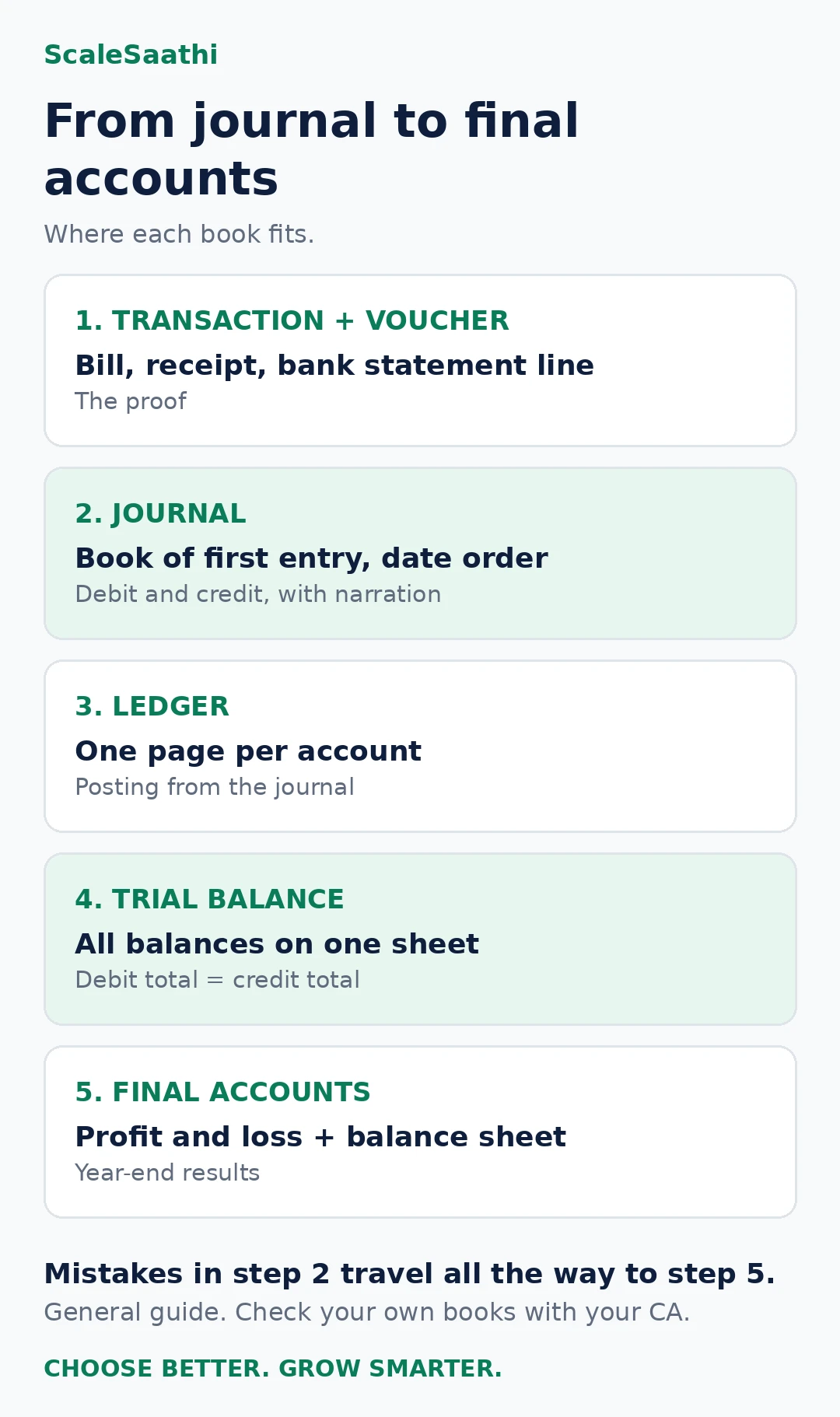
Each line is then posted to its own account in the ledger (see our ledger format guide). Total each account and carry the balances into a trial balance. If the journal was right, it tallies:
| Account | Debit (₹) | Credit (₹) |
|---|---|---|
| Bank A/c | 2,26,300 | |
| Capital A/c | 3,00,000 | |
| Purchases A/c | 98,000 | |
| Input CGST A/c | 11,250 | |
| Input SGST A/c | 11,250 | |
| Cash A/c | 7,200 | |
| Sales A/c | 1,00,000 | |
| Output CGST A/c | 3,600 | |
| Output SGST A/c | 3,600 | |
| Output IGST A/c | 10,800 | |
| Rent A/c | 15,000 | |
| Furniture A/c | 25,000 | |
| Drawings A/c | 12,000 | |
| Salary A/c | 12,000 | |
| Electricity A/c | 3,000 | |
| Electricity Payable A/c | 3,000 | |
| Total | 4,21,000 | 4,21,000 |
Check: bank works out to 3,00,000 − 15,000 − 29,500 − 1,18,000 + 70,800 + 30,000 − 12,000 = 2,26,300, and cash to 47,200 − 10,000 − 30,000 = 7,200. The journal totals 8,26,300 on each side, and the trial balance 4,21,000 on each side. The Excel file gets the same figures with formulas. If yours doesn’t tally, our trial balance format guide shows where to look.
Journal entry examples for Indian businesses
These are the 20 entries small businesses pass most often. Amounts are left out on purpose, because the accounts and the sides are what you need to get right.
| Transaction | Debit | Credit |
|---|---|---|
| Owner starts the business with money in the bank | Bank A/c | Capital A/c |
| Goods bought for cash | Purchases A/c (+ Input GST) | Cash A/c |
| Goods bought on credit | Purchases A/c (+ Input GST) | Supplier A/c |
| Goods sold for cash or UPI | Cash / Bank A/c | Sales A/c (+ Output GST) |
| Goods sold on credit | Customer A/c | Sales A/c (+ Output GST) |
| Payment to supplier | Supplier A/c | Bank / Cash A/c |
| Money received from customer | Bank / Cash A/c | Customer A/c |
| Goods returned by a customer | Sales Return A/c (+ Output GST reversed) | Customer A/c |
| Goods returned to a supplier | Supplier A/c | Purchase Return A/c (+ Input GST reversed) |
| Rent, electricity, phone paid | Expense A/c | Bank / Cash A/c |
| Salary paid | Salary A/c | Bank / Cash A/c |
| Expense due but not paid (outstanding) | Expense A/c | Expense Payable A/c |
| Rent paid in advance (prepaid) | Prepaid Rent A/c | Bank A/c |
| Furniture, computer or machine bought | Asset A/c (+ Input GST if eligible) | Bank / Supplier A/c |
| Depreciation for the year | Depreciation A/c | Asset A/c |
| Owner takes cash for home | Drawings A/c | Cash A/c |
| Owner takes goods for home | Drawings A/c | Purchases A/c |
| Cash deposited into bank (contra) | Bank A/c | Cash A/c |
| Bank charges deducted | Bank Charges A/c | Bank A/c |
| Loan taken from bank | Bank A/c | Bank Loan A/c |
| Interest received on deposit | Bank A/c | Interest Received A/c |
| Customer who will never pay (bad debt) | Bad Debts A/c | Customer A/c |
Returns and price cuts on GST invoices are normally backed by a credit or debit note; see our credit note format guide. On the bank side, our bank reconciliation statement format guide covers the charges, bounced cheques and NEFT receipts you only find on the statement.
GST in journal entries
Keep GST in its own accounts. On a purchase, debit Input CGST and Input SGST (or Input IGST for an inter-state purchase). On a sale, credit Output CGST and Output SGST (or Output IGST). At return time, the output tax is set off against the input tax and you pay the rest. Lump GST into Purchases or Sales and both your profit and your GST figures will be wrong.
Generally, a sale within your state carries CGST + SGST and a sale to another state carries IGST. Whether you can take input tax credit on a particular purchase depends on what it is and how you use it, so check with your CA for anything unusual (cars, food, gifts, goods for personal use). To split a GST-inclusive amount, use our GST calculator; for what an invoice must show, see our GST invoice format guide.
Journal vs day book vs voucher vs ledger
| Book or document | What it is | Order |
|---|---|---|
| Voucher | The proof behind an entry: a bill, receipt, payment voucher. In Tally, every entry is made through a voucher type (payment, receipt, sales, purchase, contra, journal). | One per transaction |
| Journal | The book of first entry. Every transaction with its debit and credit. | By date |
| Day book | A day-wise list of all entries. In practice, many shops and software use “day book” for what textbooks call the journal. | By date |
| Cash book | Only cash (and bank) receipts and payments. Works as journal and ledger for cash at once. | By date |
| Ledger | One page per account, collecting every entry for that account. | By account |
Where you keep a separate cash book, sales book and purchase book, the journal proper is only for entries that fit nowhere else: credit purchases of assets, outstanding and prepaid expenses, depreciation, corrections and opening entries. In software these go through the journal voucher. Don’t route cash or bank movements through journals; that is how cash books stop matching the drawer. For the daily cash side, see our cash book format guide. Money that actually leaves the business goes through a payment voucher; our payment voucher format shows the slip and how it differs from a journal voucher.
Do you have to keep a journal?
- Companies: section 128 of the Companies Act, 2013 requires books of account kept on an accrual basis and under the double entry system, and kept for at least eight financial years (text). In practice that means journal entries, whether on paper or in software.
- Specified professionals (legal, medical, engineering, architecture, accountancy, technical consultancy, interior decoration and a few others): Rule 6F of the Income-tax Rules, 1962 listed a cash book, a journal “if the accounts are maintained according to the mercantile system of accounting”, and a ledger, above a receipts threshold (Rule 6F). From 1 April 2026 the Income-tax Rules, 2026 apply, and the Income Tax Department’s navigator maps old Rule 6F to new Rule 46, “Maintenance of books of accounts” (navigator). Check the current wording of Rule 46 with your CA.
- Other businesses: whether you need full books depends on your income, turnover and the tax scheme you use. Even when it isn’t required, a simple journal makes year-end accounts, bank loans and GST returns far less painful.
Common mistakes
- Debit and credit swapped, often on receipts from customers (debit bank, credit the customer, not the other way).
- GST added into purchases or sales instead of separate input and output accounts.
- Owner’s personal spending booked as a shop expense instead of drawings.
- Expenses recorded only when paid, so an unpaid April bill lands in May.
- No narration, or “misc” as the narration.
- One compound entry split into two that don’t each balance.
- A cash deposit into your own bank recorded as income.
A balanced journal can still be wrong: the right amount on the wrong account passes every check. So can forgotten depreciation or accruals. Read the narrations monthly, keep a note behind every adjustment, and never backdate entries after closing. Then see the profit and loss account format and balance sheet format guides for the final accounts.
Frequently asked questions
What is the format of a journal entry?
A journal entry has five columns: date, particulars, ledger folio (L.F.), debit amount and credit amount. The debit account is written first with “Dr”, the credit account below it starting with “To”, followed by a short narration in brackets.
What are the golden rules of accounting?
For personal accounts, debit the receiver and credit the giver. For real accounts, debit what comes in and credit what goes out. For nominal accounts, debit all expenses and losses and credit all incomes and gains.
What is a compound journal entry?
It is a single entry with more than one debit or more than one credit, such as a purchase with CGST and SGST. The total of the debits must still equal the total of the credits.
How do I record GST in a journal entry?
Put the GST in separate accounts. On purchases debit Input CGST and Input SGST, or Input IGST for an inter-state purchase. On sales credit Output CGST and Output SGST, or Output IGST for an inter-state sale.
What is the difference between a journal and a ledger?
The journal records each transaction in date order with its debit and credit. The ledger collects all entries for one account in one place so you can see its balance. Entries go into the journal first and are then posted to the ledger.
Is the journal the same as the day book?
In many Indian shops and in software, “day book” means the day-wise list of all entries, which is close to what textbooks call the journal. Strictly, the journal is the book of original entry with debits and credits.
Where do I record goods taken by the owner for personal use?
Debit Drawings and credit Purchases at cost. It is not a business expense. If input tax credit was claimed on those goods, ask your CA whether it needs to be reversed.
Can I keep my journal in Excel?
Yes, for a small business. Use one row per account line, give every line of an entry the same entry number, and check that each entry balances. Our free Excel template does those checks and builds the trial balance.
Related guides and sources
| Guide | Use it when |
|---|---|
| Ledger format | You are posting journal entries into accounts |
| Trial balance format | You want to check the ledger balances agree |
| Cash book format | You record daily cash and bank entries |
| Profit and loss account format | You are working out the year’s profit |
| Balance sheet format | You need the year-end position |
| Bank reconciliation statement format | Your bank balance doesn’t match the statement |
| Credit note format | A sale is returned or reduced |
| GST invoice format | You need the bill behind a sales entry |
| GST calculator | You need to split GST from an amount |
| Accounting software for small businesses | You want entries made through software |
Sources and checked dates
- Income Tax Department: Rule 6F, Income-tax Rules, 1962 (books of account for certain professions). Checked 28 Oct 2026.
- Income Tax Department: navigator, Income-tax Rules 2026 (old 6F → new Rule 46). Checked 28 Oct 2026.
- ICSI e-book: Companies Act, 2013, section 128 (books of account). Checked 28 Oct 2026.
How we researched this guide
ScaleSaathi publishes practical guides for Indian small businesses under LendLink Tech Private Limited. For this guide we read Rule 6F and the Income-tax Rules 2026 navigator on the Income Tax Department’s site and section 128 of the Companies Act on 28 October 2026. Gupta Hardware and all its figures are made-up, and the 18% GST rate is an assumption for the example. We built the Excel journal ourselves and recalculated every total.