Last updated 30 October 2026 · Prices seen 30 October 2026 on the official pages of Shopify, WooCommerce, Razorpay and Hostinger.
Most Shopify vs WooCommerce debates are written for American stores paying in dollars through Stripe. An Indian shop owner has a different set of problems. Your customers pay by UPI or want cash on delivery. Your gateway is Razorpay or something like it. Your accountant asks for GST invoices with HSN codes. And the free WooCommerce plugin that sounds so cheap still needs someone to keep a WordPress site fast and backed up.
The costs that aren’t on the pricing page
- Shopify Basic adds 2% on every prepaid order taken through Razorpay, on top of Razorpay’s own fee. COD orders skip it.
- The ₹1,499 Basic price is for yearly billing; month to month it is ₹1,994. The trial is 3 days, then ₹20 a month for 3 months.
- Add your GSTIN to Shopify’s billing profile before the first bill. It stops GST on future bills, but GST already charged is not reversed.
- WooCommerce is free; the upkeep isn’t. Choose daily backups for a store. Hostinger Unlimited is ₹9,552 for 48 months (₹199 a month) and renews at ₹649 a month.
- Switching either way? Set a 301 redirect for every old product URL.
Prices seen 30 October 2026, before GST.
So we will compare the two the way you will actually live with them: what leaves your bank account each month, who fixes things when checkout breaks, and which kind of seller each one suits. Prices come from the companies’ own pages; order volumes in the examples are illustrations you can change.
Disclosure: Some links on this page are affiliate links. If you buy through them, ScaleSaathi may earn a commission at no extra cost to you. This does not change our recommendations. Read our affiliate disclosure.
Our verdict: if you sell mainly through prepaid online payments and nobody on your team is comfortable with WordPress, Shopify gets you selling fastest, but on the Basic plan you pay Shopify an extra 2% on every Razorpay order. If you can look after a WordPress site, or already pay someone who does, WooCommerce on decent hosting usually costs much less over three years. In our example store it came to about ₹76,662 against ₹1,83,182 for Shopify. COD-heavy sellers narrow that gap, because Shopify does not charge its 2% fee on cash on delivery orders.
In this comparison
Which one fits your kind of shop
Before any prices, be honest about two things: how much of your selling is prepaid online, and who will handle the technical side. Those two answers decide this more than any feature list.
First store, one person, no developer
Shopify. Hosting, security updates and checkout are Shopify’s problem, not yours. You can open a store in an evening and spend your time on photos and product descriptions.
Budget for the 2% third-party fee on prepaid orders from day one; it is the cost of that convenience.
Already have a WordPress site or blog
WooCommerce. You add a shop to a site that already ranks and already has your content, instead of running two sites on two domains.
Move to a hosting plan with daily backups before you take your first order.
Mostly COD, lower order values
Look closely at both. Shopify’s 2% fee does not apply to COD orders, so a mostly-COD store pays less extra on Shopify than a prepaid one.
WooCommerce still wins on fixed costs if you can run it.
Wholesale, B2B pricing or unusual products
WooCommerce, usually. You own the code, so custom pricing rules, GST-specific invoice fields or a quotation flow can be built without hitting a platform limit.
Expect to pay a developer for that work; it is not free just because the plugin is.
Two quick reality checks. Shopify includes hosting, SSL and unlimited bandwidth in every plan, so there is no server to manage. WooCommerce is software you install on WordPress; it runs on more than 7 million sites according to WooCommerce’s WordPress.org page, but your store is only as good as the hosting and care behind it.
What each one charges, in rupees and dollars
Shopify prices its India plans in rupees. WooCommerce’s own price list is in US dollars. We have kept each in the currency the company uses; rupee conversions for dollar items appear only in the cost table, where we state the exchange rate we assumed.
| Item | Shopify (India page) | WooCommerce |
|---|---|---|
| Platform fee | Basic ₹1,499/month paid yearly, ₹1,994 paid monthly Grow ₹5,599 yearly / ₹7,447 monthly Advanced ₹22,680 yearly / ₹30,164 monthly |
Free plugin, no monthly fee, 0% revenue share |
| Hosting | Included | Your own host. WooCommerce’s page says $25–$350/month for most stores (a global figure; Indian shared hosting is far cheaper, see below) |
| Extra fee on third-party gateways (Razorpay etc.) | 2% Basic, 1% Grow, 0.6% Advanced | None |
| Themes | 24 free themes; paid themes typically $170–$380 (examples from the first page of the theme store, not a full range) | Storefront theme free; paid themes sold on WooCommerce.com in USD |
| Add-ons | Apps, priced by each developer, billed in USD and converted to INR with a 1.5% conversion fee | Extensions $29–$299/year each (WooCommerce’s range), plus free plugins on WordPress.org |
| GST on the platform’s own bill | Shopify charges GST on its fees for Indian stores unless you add your GSTIN | Not applicable to the free plugin; your host’s bill carries GST (Hostinger lists prices without GST) |
Shopify’s page also offers a 3-day free trial and then ₹20 a month for the first three months on most plans, so trying it costs almost nothing. Full details for every Shopify plan are in our Shopify pricing in India guide.
On the WooCommerce side, the hosting figure is the one Indian sellers should ignore. That $25–$350 range is WooCommerce’s global estimate. For a small Indian store, Hostinger’s WordPress hosting listed its Unlimited plan at ₹9,552 for 48 months (₹199 a month) on 28 October 2026, renewing at ₹649 a month, before GST. For a one-year term we used ₹3,588 for 12 months, the price shown when we selected the 12-month term on 28 October 2026; the page loads the 48-month term by default, so check the 12-month figure at checkout. We picked Unlimited rather than the cheaper Premium because it includes daily backups, and a shop that takes orders every day should not live on weekly backups.
Razorpay, UPI and COD: where the 2% comes from
This is the part most comparisons get wrong for India. Shopify’s cheapest card rates come through Shopify Payments, but India is not on Shopify’s list of countries where Shopify Payments is available. An Indian store therefore uses a third-party provider such as Razorpay, and Shopify’s pricing page lists a third-party transaction fee for that: 2% on Basic, 1% on Grow, 0.6% on Advanced.
That fee is Shopify’s, and it sits on top of what Razorpay charges. Razorpay’s Standard plan fee in India is 2% on domestic methods, plus 18% GST on the fee. So on a ₹1,000 prepaid order on Shopify Basic, you lose roughly ₹20 to Shopify and ₹23.60 to Razorpay. On WooCommerce, the same order costs you the ₹23.60 to Razorpay and nothing to the platform. Two footnotes from the same Razorpay page: new sign-ups currently get 0% gateway fees for the first 90 days, and a credit card paid through UPI carries a 2.15% + GST platform fee. Our cost model uses the standard 2% throughout.
Where Shopify’s fee does not apply
Shopify’s help centre says manual payment methods do not attract third-party transaction fees, and cash on delivery is one of the manual methods it lists. If 60% of your orders are COD, only the prepaid 40% carries the 2%. This is why a COD-heavy seller in a smaller town and a prepaid D2C brand can reach opposite conclusions from the same comparison.
Setting up Razorpay on each
On WooCommerce, Razorpay maintains an official plugin on WordPress.org (100,000+ active installations) that enables UPI, cards, netbanking and wallets. It needs WooCommerce 4.0 or higher and PHP 7.0 or higher, which any current host meets. On Shopify, Razorpay’s docs point you to its “All-in-one Razorpay Payment Gateway” app, which connects with your Razorpay owner login instead of API keys, and Razorpay asks that your website is reviewed before you integrate. Either way, your Razorpay KYC and settlement times are the same. Our Razorpay charges guide and Razorpay vs PayU comparison cover the gateway side in detail.
1-year and 3-year cost for an example Indian store
Example seller (an illustration, not a real business): a small home-décor store with 40 prepaid orders a month at an average of ₹1,200, so ₹5,76,000 of sales a year, all paid online through Razorpay. Shopify Basic paid yearly with a free theme and about $10 a month of apps (a GST invoice app, reviews, that sort of thing). WooCommerce on Hostinger Unlimited with the free Storefront theme and one paid extension at $79 a year. We converted dollars at an assumed ₹88 per US$ and added 18% GST to every vendor price that excludes it, including the $79 extension. Shopify confirms GST applies to its fees for Indian stores but prints no rate, so 18% is the standard Indian GST rate we assumed; we could not confirm how WooCommerce.com charges Indian GST, so without GST on the extension WooCommerce comes to ₹24,779 in year 1 and ₹72,908 over 3 years. Domain costs are left out of both, since you need a domain either way.
| Cost (example store) | Shopify Basic | WooCommerce + Hostinger |
|---|---|---|
| Year 1 | ||
| Platform / hosting | ₹17,988 (₹1,499 × 12) | ₹4,234 (₹3,588 for the 12-month term + GST) |
| Shopify 2% third-party fee | ₹11,520 | ₹0 |
| GST on Shopify’s bill (no GSTIN added) | ₹5,311 | — |
| Apps / extensions | ₹12,648 ($10/month, incl. 1.5% conversion and GST) | ₹8,203 ($79 extension + GST) |
| Theme | ₹0 (free theme) | ₹0 (Storefront) |
| Razorpay 2% + GST | ₹13,594 | ₹13,594 |
| Year 1 total | ₹61,061 | ₹26,031 |
| 3 years | ||
| Platform / hosting | ₹53,964 | ₹11,271 (₹9,552 for 48 months + GST, paid upfront) |
| Shopify 2% fee + GST on Shopify bills | ₹50,494 | ₹0 |
| Apps / extensions | ₹37,943 | ₹24,610 |
| Razorpay 2% + GST | ₹40,781 | ₹40,781 |
| 3-year total | ₹1,83,182 | ₹76,662 |
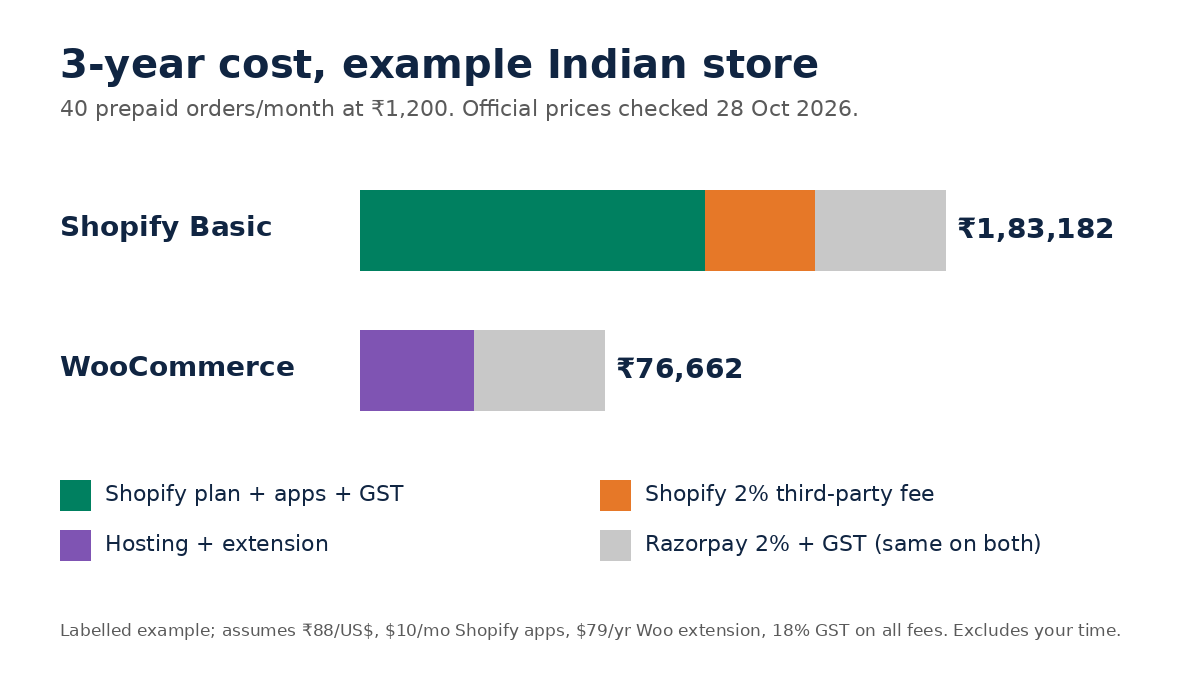
Read this table carefully, because the gap is mostly not the subscription. Razorpay costs the same on both. What separates them is Shopify’s 2% on prepaid orders, the GST on Shopify’s bill, and apps priced in dollars. Two changes shrink the gap quickly: adding your GSTIN to Shopify (which stops the GST on future Shopify bills, and your CA can tell you how that affects input credit), and taking more COD orders.
What the table cannot price is your time. WooCommerce’s lower number assumes that someone, you or a freelancer, spends a few hours a month on updates and checks. If you would pay a developer a monthly retainer for that, put the figure into the calculator before you decide. For a wider view of building a store from scratch, see our e-commerce website cost guide.
GST invoices, HSN codes and the tax on your bills
Global comparisons skip this entirely, and it is where Indian sellers lose evenings.
Invoices to your customers
Shopify’s own India GST FAQ is blunt: Shopify does not create a GST-compliant bill, and you should use a local GST invoicing service or an app from the Shopify App Store. Its tax settings also cannot hold two tax lines, so you set the combined CGST plus SGST rate for in-state sales and IGST for other states, and you must change the defaults (CGST 9%, IGST 18%) to match what you actually sell.
WooCommerce has no GST invoice in the core plugin either. You add one: WordPress.org lists several free GST invoice plugins for India, and WooCommerce sells a Print Invoices & Packing Lists extension at $79 a year. The advantage is control. If your CA wants the buyer’s GSTIN, the HSN code, and the CGST/SGST split laid out a certain way, a developer can make the invoice match exactly. Our GST invoice format guide lists the fields to check.
HSN codes on products
Whichever platform you choose, store the HSN code against each product from day one, as a product field or attribute. Adding HSN codes to 300 products later, when the accountant asks, is a miserable afternoon.
GST on the platform’s own bill
Shopify charges GST on its fees to stores located in India, shown on the monthly or yearly bill, and stops charging it on future bills once you add your GSTIN under Settings → Billing → Billing profile. Shopify says GST already charged on earlier bills cannot be reversed. Hostinger shows its prices without GST, so its checkout adds it. Shopify bills plans directly in rupees, and you can pay by UPI, or a co-branded debit or credit card via Visa, Mastercard or RuPay. Shopify confirms GST applies but prints no rate; 18% is the standard Indian GST rate, and that is what we assumed in the cost table.
The work nobody prices: speed, updates and backups
With Shopify you rent a finished shop. Shopify handles servers, SSL, PCI compliance (it states Level 1 PCI DSS) and traffic spikes during a festival sale. You cannot break the server because you never touch it.
With WooCommerce you own the shop, and the maintenance comes with ownership. In practice that means:
- Updates: WordPress, WooCommerce, your theme and every plugin release updates. Update on a staging copy first if your host gives you one, especially before Diwali.
- Backups: daily, and tested. A weekly backup can lose six days of orders.
- Speed: every extra plugin adds weight. Ten well-chosen plugins on good hosting will beat forty on cheap hosting.
- Security: strong admin passwords, two-factor login and removing plugins you no longer use.
None of this is hard, but it has to happen every month. If that sentence made you tired, that is useful information. Our managed WordPress hosting guide covers hosts that take some of this off your hands, and best WordPress hosting in India compares the options.
Staff logins, and when Shopify Grow pays for itself
The moment you hire a packer or a part-time catalogue person, logins become a cost line. The two platforms handle this very differently.
- Shopify: Shopify’s India pricing page (seen 30 October 2026) lists no extra staff accounts on Basic, up to 5 on Grow (₹5,599 a month), 15 on Advanced (₹22,680) and unlimited on Plus. Third-party collaborator access for an agency or freelancer is available on every plan. On Basic, everyone who is not a collaborator shares the owner’s login, which is how stores lose track of who changed a price or refunded an order.
- WooCommerce: logins are WordPress users, so there is no limit and no fee. WooCommerce’s roles documentation describes a Shop Manager role that runs the store without full Administrator access. Give staff that role, keep Administrator for yourself, and remove ex-employees the day they leave.
When Grow pays off. Moving from Basic (₹1,499) to Grow (₹5,599) costs ₹4,100 a month more on yearly billing and cuts Shopify’s third-party fee from 2% to 1%. That 1% saving covers the ₹4,100 only when prepaid orders through Razorpay or another outside gateway pass about ₹4.1 lakh a month. COD orders carry no Shopify fee, so they do not count towards it. Below that line, upgrade only if you need the staff logins.
Mistakes we see Indian sellers make
- Comparing ₹1,499 with ₹0. Neither number is the real cost. Shopify’s fee and WooCommerce’s hosting, extensions and upkeep are.
- Forgetting the 2% on Shopify. Sellers budget Razorpay’s 2% and miss that Shopify Basic adds another 2% on top for prepaid orders.
- Installing a plugin for every small thing on WooCommerce. Then the store slows down and nobody knows which plugin did it.
- Leaving HSN codes and GSTIN until the first B2B order. Set up tax fields before you load products.
- Choosing on monthly price when you will pay yearly. Shopify’s ₹1,499 is the yearly-billing price; paid monthly, Basic is ₹1,994.
- Paying for a premium theme before you have orders. Both platforms have free themes good enough to launch on.
Moving between Shopify and WooCommerce
Neither choice locks you in for life, but switching is a project, not a button. Products, customers and orders can be exported as CSV files and imported on the other side, or moved with a migration tool. What usually breaks:
- URLs. The two platforms build product and category addresses differently, so your old links will not match the new store. Set up 301 redirects for every old product URL or you lose the search traffic you built.
- Payment and tax settings. Razorpay keys, COD rules, GST rates and invoice numbering all have to be set up again.
- Customer accounts. Plan for customers having to set a new password on the new store, and tell them before you switch.
- Apps and plugins. Reviews, wishlists and loyalty points rarely move cleanly.
Test the full checkout with a real ₹1 or ₹10 product before you point your domain at the new store, and keep the old store running for a week. For the WordPress side, our web hosting migration guide walks through the DNS steps.
Download the cost calculator
Download the Shopify vs WooCommerce cost calculator (Excel)
Enter your monthly orders, average order value, share of COD orders, the exchange rate on the day, and what you spend on apps, extensions and help. The sheet works out the 1-year and 3-year totals for both platforms using the official prices above, and shows how much of the difference comes from Shopify’s third-party fee.
Our verdict
Choose Shopify if you want to start selling this week, nobody on your team wants to look after WordPress, and you accept roughly 2% extra on prepaid orders on Basic as the price of not running a server. It also suits COD-heavy sellers better than most comparisons admit, since COD orders do not carry that fee.
Choose WooCommerce if you already have a WordPress site, sell mostly prepaid, need custom GST invoices or B2B pricing, or have someone dependable for monthly upkeep. In our example store it cost about ₹76,662 over three years against ₹1,83,182 on Shopify, and the gap grows as sales grow, because WooCommerce takes no cut.
Choose neither yet if you have fewer than a handful of orders a month: sell through WhatsApp and a Razorpay payment link, and build the store once you know what sells. Still undecided between hosted builders? Read Wix vs WordPress and our best e-commerce platforms in India.
Ready to start? See Shopify’s India plans or see Hostinger’s WordPress hosting plans for WooCommerce.
Frequently asked questions
Is WooCommerce really free?
The WooCommerce plugin is free to download and use, with no monthly platform fee and no revenue share. You still pay for hosting, a domain, any paid themes or extensions (WooCommerce lists most extensions at $29 to $299 a year), and your payment gateway’s fees.
Does Shopify charge an extra fee if I use Razorpay in India?
Yes, on online payments. Shopify Payments is not offered in India, so Indian stores use a third-party provider such as Razorpay, and Shopify’s India pricing page lists a third-party transaction fee of 2% on Basic, 1% on Grow and 0.6% on Advanced. This is on top of Razorpay’s own fee. Shopify says manual payment methods such as cash on delivery do not attract the third-party fee.
How much does Shopify cost per month in India?
On 28 October 2026 Shopify’s India pricing page showed Basic at ₹1,499 a month when paid yearly or ₹1,994 a month when paid monthly, Grow at ₹5,599 (yearly) or ₹7,447 (monthly), and Advanced at ₹22,680 (yearly) or ₹30,164 (monthly). Shopify adds GST to its bills for Indian stores unless you add your GSTIN in the billing profile.
Can WooCommerce and Shopify make GST invoices?
Neither does it fully on its own. Shopify’s GST FAQ says it does not create a GST-compliant bill and points you to an app or a local invoicing service. On WooCommerce you add an invoice plugin; several GST invoice plugins are listed on WordPress.org. Check that your invoice shows your GSTIN, the buyer’s GSTIN for B2B orders, HSN codes and the CGST/SGST or IGST split.
Which is better for cash on delivery orders?
Both can take COD. On Shopify, COD is a manual payment method and carries no third-party transaction fee. On WooCommerce, Cash on Delivery is a standard payment method you switch on in the payment settings. The real COD work is confirming orders and handling returns, which you arrange with your courier on either platform.
Can I move from Shopify to WooCommerce later, or the other way?
Yes. Products, customers and orders can be exported and imported between the two, usually with CSV files or a migration tool. Plan for redirects from your old product URLs, re-entering payment and tax settings, and a fresh test of checkout before you switch the domain.
How many staff accounts do Shopify and WooCommerce allow?
Shopify’s India pricing page (seen 30 October 2026) lists no additional staff accounts on Basic, 5 on Grow, 15 on Advanced and unlimited on Plus; collaborator access is on every plan. WooCommerce has no limit: staff are WordPress users, and its Shop Manager role lets them run the store without full admin rights.
At what sales level should I move from Shopify Basic to Grow?
On the fee alone, when prepaid sales through a third-party gateway such as Razorpay pass about ₹4.1 lakh a month. Grow costs ₹4,100 a month more than Basic on yearly billing and lowers Shopify’s third-party fee from 2% to 1% (Shopify India pricing, seen 30 October 2026). Upgrade earlier only if you need staff logins.
Related guides
- Shopify pricing in India
- Best e-commerce platforms in India
- E-commerce website cost in India
- Wix vs WordPress
- Razorpay charges explained
- Razorpay vs PayU
- Best WordPress hosting in India
- Hostinger India review
- GST invoice format
Sources
- Shopify India pricing: plans, yearly vs monthly INR prices, third-party payment provider fees, free trial, hosting and PCI
- Shopify Help Center: countries where Shopify Payments is available
- Shopify Help Center: third-party payment providers
- Shopify Help Center: manual payment methods including COD (no third-party fee)
- Shopify Help Center: GST in India FAQ
- Shopify Help Center: GST on Shopify fees in India
- Shopify Help Center: INR billing and the 1.5% conversion fee on apps and themes
- Shopify Help Center: paying Shopify bills in India (UPI and Indian cards)
- Shopify Theme Store: free and paid themes
- WooCommerce pricing: free core, hosting and extension ranges, no revenue share
- WordPress.org: WooCommerce plugin (version, active installations, requirements)
- WooCommerce: Storefront theme (free)
- WooCommerce: Print Invoices & Packing Lists extension
- WordPress.org: Razorpay for WooCommerce plugin
- Razorpay Docs: WooCommerce plugin prerequisites
- Razorpay pricing (India)
- Razorpay Docs: Shopify app prerequisites
- WooCommerce Docs: Cash on Delivery
- Hostinger India WordPress hosting prices (without GST)
Prices seen 28 and 30 October 2026. Shopify prices are in INR as shown on its India pricing page; WooCommerce and theme-store prices are in US dollars as published. Shopify, WooCommerce and Hostinger prices exclude GST.
Product names are trademarks of their respective owners. They are shown only to identify the products compared, and their use does not imply endorsement by or affiliation with ScaleSaathi.